


- Although lane splitting and lane filtering are prohibited under Florida Statute § 316.209(3), motorcyclists may still recover compensation if another party's negligence is the primary cause of the accident.
- Under Florida’s modified comparative negligence rule, an injured motorcyclist is completely barred from recovering damages if they are found to be 51 percent or more at fault for the collision.
- Establishing that a driver’s failure to check blind spots or distracted driving was the proximate cause of the crash can minimize a rider's assigned fault and preserve their right to partial recovery.
- Following the passage of House Bill 837, the statute of limitations for filing a motorcycle accident negligence claim in Florida has been reduced from four years to two years.
Motorcyclists injured while lane-splitting face a unique legal dilemma: although the practice is illegal in Florida, they may still be entitled to recover damages if another driver caused the crash. Securing compensation hinges entirely on the state's modified comparative negligence rule, which assigns a percentage of fault to every party involved.
This critical legal concept determines the outcome of a lane-splitting accident claim, as a rider's recovery depends on keeping their assigned fault below a specific legal threshold. Keep reading to learn more about how Florida's liability rules impact these complex motorcycle accident shared fault claims.
The Legal Status of Lane Splitting in Florida
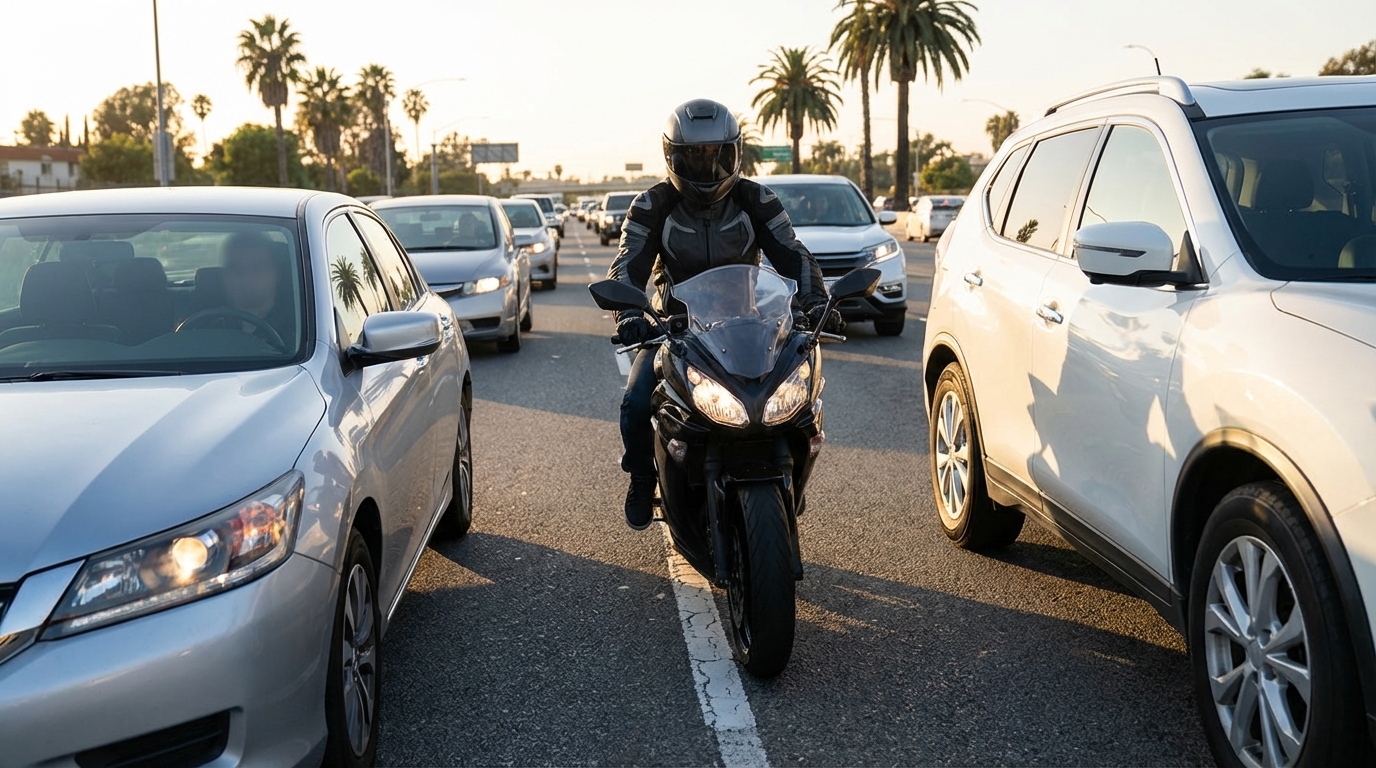
Lane splitting occurs when a motorcyclist rides between two lanes of moving traffic traveling in the same direction. A related practice, often called lane filtering, involves a motorcyclist moving between adjacent lines of stopped or very slow-moving vehicles.
This practice, along with filtering, is often debated for its safety benefits. For instance, research indicates that motorcyclists who split lanes in heavy traffic are significantly less likely to be struck from behind by other motorists or sustain fatal injuries in a crash, according to the SafeTREC 2015 report. Despite these potential safety advantages, the State of Florida explicitly prohibits both practices.
The state's prohibition is explicitly detailed in the law. Florida Statute § 316.209(3) unequivocally prohibits any person from operating a motorcycle between lanes of traffic or between adjacent lines or rows of vehicles. A violation of this statute is classified as a noncriminal traffic infraction and is punishable as a moving violation.
This statutory violation provides the opposing side with powerful evidence to establish the motorcyclist's negligence in any subsequent injury claim, making the fight for compensation much harder.
What is the Difference Between Lane Splitting and Lane Filtering?
Motorcyclists often use the terms lane splitting and lane filtering to describe different levels of risk. Lane splitting typically refers to maneuvering between cars moving at higher speeds. Lane filtering usually describes moving forward in bumper-to-bumper or completely stopped traffic, such as at a stoplight.
It's important to understand that Florida law makes no distinction between these two maneuvers for liability purposes. The law prohibits riding between adjacent rows or lines of vehicles, regardless of the speed of the surrounding traffic. For the purposes of establishing negligence and assessing liability for lane splitting in Florida, both practices are treated as prohibited acts.
Florida's Modified Comparative Negligence Law Explained
Comparative negligence is the fundamental legal doctrine used to allocate responsibility when two or more parties contribute to a collision. This doctrine allows fault to be shared among the parties, meaning that if a victim is partially responsible for their own injuries, the total amount of damages they can recover is reduced proportionally to their assigned percentage of fault.
Understanding the 51% Fault Bar (The Modified Rule)
Florida previously operated under a pure comparative negligence system. That changed substantially when House Bill 837 was signed into law on March 24, 2023. Florida now operates under a modified comparative negligence system, which is commonly referred to as the 51% Fault Bar.
This legislative change has profound consequences for injured parties, including motorcyclists involved in lane-splitting accidents. Under the modified comparative negligence rule, any party found to be greater than 50 percent at fault for their own harm may not recover any damages whatsoever. If the injured motorcyclist is assigned 51 percent or more of the blame, they are completely barred from recovering compensation, even if the other driver was also negligent.
However, if the rider's fault is determined to be 50 percent or less, they can still successfully secure partial fault compensation. For example, if a court determines the motorcyclist is 30% at fault for total damages valued at $100,000, the recovery is reduced by 30%. The motorcyclist would ultimately recover $70,000 from the responsible parties.
How Illegal Lane Splitting Directly Impacts Your Liability
The fact that lane splitting violates Florida Statute § 316.209(3) creates a powerful advantage for the defense. Because the motorcyclist engaged in an illegal act, opposing counsel and insurance carriers will aggressively use it as evidence of negligence against the rider.
An experienced motorcycle accident lawyer will argue that the unlawful behavior was the sole cause of the accident, placing the rider's potential recovery directly at risk under the 51% bar.
The Role of Proximate Cause in Lane-Splitting Accidents
Performing an illegal action doesn't automatically result in 100% liability for the accident. The legal standard requires the concept of proximate cause to be established. Proximate cause means there must be a direct, foreseeable link between the negligent act (the illegal lane splitting) and the resulting collision.
An experienced attorney must still prove that the other driver's negligence was the actual proximate cause of the crash. If the car driver failed to look, was speeding, or made an unsafe lane change without warning, their actions may still be deemed the primary legal cause of the collision, even if the motorcyclist was lane-splitting at the time.
The central legal strategy in these cases is to minimize the rider's percentage of fault. The legal team must prove that the other driver's negligence was the primary cause of the collision. They must also demonstrate that the lane splitting was merely a secondary contributing factor. This strategic approach is essential for keeping the rider's percentage below the 51% threshold.
Common Scenarios Leading to Shared Fault
Most lane-splitting accidents occur when a vehicle attempts to change lanes, merge, or turn into the path of the motorcyclist. Understanding these common scenarios helps illustrate how shared fault is assigned in practice. These situations highlight where the vehicle driver often bears the majority of the responsibility, despite the rider's illegal maneuver.
Research shows that approximately 66% of motorcycle accidents involve the other driver violating the motorcyclist's right of way. This contradicts the frequent claim that reckless motorcyclists are solely responsible for most crashes.
Driver Failure to Check Blind Spots and Signal
A common collision involves a driver changing lanes without checking their blind spot or without signaling their intent. When a vehicle merges into a lane where a motorcyclist is passing illegally, the driver has clearly committed negligence.
Drivers have a legal duty to operate their vehicles safely and verify their surroundings before initiating any movement across lanes. In a situation where a driver abruptly merges into a lane and strikes a lane-splitting motorcyclist, fault will almost certainly be split. The car driver is negligent for executing an unsafe maneuver, and the motorcyclist is negligent for engaging in illegal lane splitting. Both parties contributed to the resulting collision.
To achieve successful recovery when suing after a lane splitting crash, the plaintiff's legal team must demonstrate the car driver's negligence was the greater factor. A judge or jury might assign 60% of the fault to the negligent driver and 40% to the motorcyclist for the motorcyclist's illegal act. Because the rider's percentage is below 51%, they are entitled to compensation.
Distracted or Impaired Driving by the Other Party
When the vehicle driver exhibits extremely dangerous or illegal conduct, their percentage of fault increases dramatically. Evidence of serious negligence, such as driving under the influence (DUI) or excessive speeding, weighs heavily against the defendant.
Distracted driving is six times more likely to cause an accident than drunk driving, and it can increase the risk of an accident by up to 23 times. Establishing egregious actions by the other party can provide significant benefits for the injured motorcyclist.
A driver who was impaired by alcohol or distracted by their cellphone will likely receive a substantial percentage of the blame. This evidence helps ensure the motorcyclist's fault percentage for lane splitting remains low enough to allow for compensation under Florida's 51% bar. The court recognizes that the driver's actions posed a much greater risk than the mere presence of the lane-splitting rider.
Minimizing Your Assigned Fault in a Lane Splitting Claim
Successfully navigating the comparative negligence framework in motorcycle accident cases demands skilled and aggressive legal representation. The insurance companies will focus intently on the illegal nature of lane splitting, attempting to assign the rider the vast majority of the blame.
An experienced motorcycle accident shared fault attorney is essential to counter these tactics and maximize the rider's potential recovery. This strategy involves meticulously proving the other driver's negligence and mitigating the impact of the lane splitting violation.
Countering Insurance Company Tactics
Insurance adjusters often start with the assumption that motorcyclists contributed significantly to the crash due to anti-motorcycle bias. They scrutinize these claims closely, seeking any opportunity to reduce their liability. A frequent tactic is automatically assigning a very high percentage of fault, often 40 to 50 percent, to the motorcyclist.
They use blame-shifting tactics and lowball settlement offers as methods to reduce their required payout. An attorney specializing in these complex claims is prepared to challenge this automatic assignment of blame immediately by focusing on proving the timeline of events. This proactive defense prevents adjusters from successfully shifting the blame entirely onto the motorcyclist.
Necessary Evidence to Establish the Driver's Fault
A robust case hinges on the immediate collection and preservation of crucial evidence. This evidence includes securing the official police report, obtaining statements from all available witnesses, and identifying potential video footage. Footage from traffic cameras, nearby businesses, or vehicle dashcams can often definitively establish which driver initiated the dangerous, crash-causing maneuver.
Expert testimony is often necessary to counter the defense's claims, especially in complex lane-splitting collisions. Accident reconstruction specialists use sophisticated methodologies, including vehicle damage analysis, skid mark interpretation, Event Data Recorder (EDR) information, and computer simulations, to scientifically determine the precise sequence of events. Furthermore, comprehensive medical records are also important, and contemporaneous notes from initial physician visits within 24 to 72 hours are especially important for establishing the causation between the accident and the resulting injuries.
Injured riders should also understand that their immediate actions can significantly affect the success of their claim. It's paramount that they don't admit any form of fault at the scene of the accident. Additionally, before providing extensive or recorded statements to the opposing insurance company, they should contact a qualified lawyer immediately.
Understanding the Statute of Limitations
Beyond the challenge of the 51% fault rule, injured riders in Florida motorcycle claims must be aware of strict legal deadlines. Under the changes brought by House Bill 837, the statute of limitations for negligence actions in Florida was reduced from 4 years to 2 years for causes of action accruing after March 24, 2023.
This shortened timeline means immediate action is necessary to ensure the injured party doesn't lose their right to pursue compensation. Since gathering the evidence needed to challenge fault can take time, contacting an attorney immediately ensures the investigation begins well before the filing deadline.
Speak To A Motorcycle Accident Lawyer About Your Case Today
Florida's adoption of the modified comparative negligence law means compensation may still be available, even if a motorcyclist engaged in illegal lane splitting. However, the final recovery depends entirely on the percentage of fault assigned to the rider. Maintaining the rider's responsibility below the 51% threshold is the key to preserving the right to financial recovery and winning a complex injury case.
We are a top-rated Florida personal injury law firm with offices in Fort Lauderdale, West Palm Beach, and Orlando. We understand the biases insurance companies hold against motorcyclists and fight tirelessly to protect your rights against unjust attempts to assign unfair blame.
If you or a loved one suffered injuries in a lane-splitting accident, don't allow adjusters to exploit your situation. Call Weinstein Legal Team 24/7 at 888.626.1108 to speak with a lawyer about your accident claim, or click here to schedule your free case review today.