


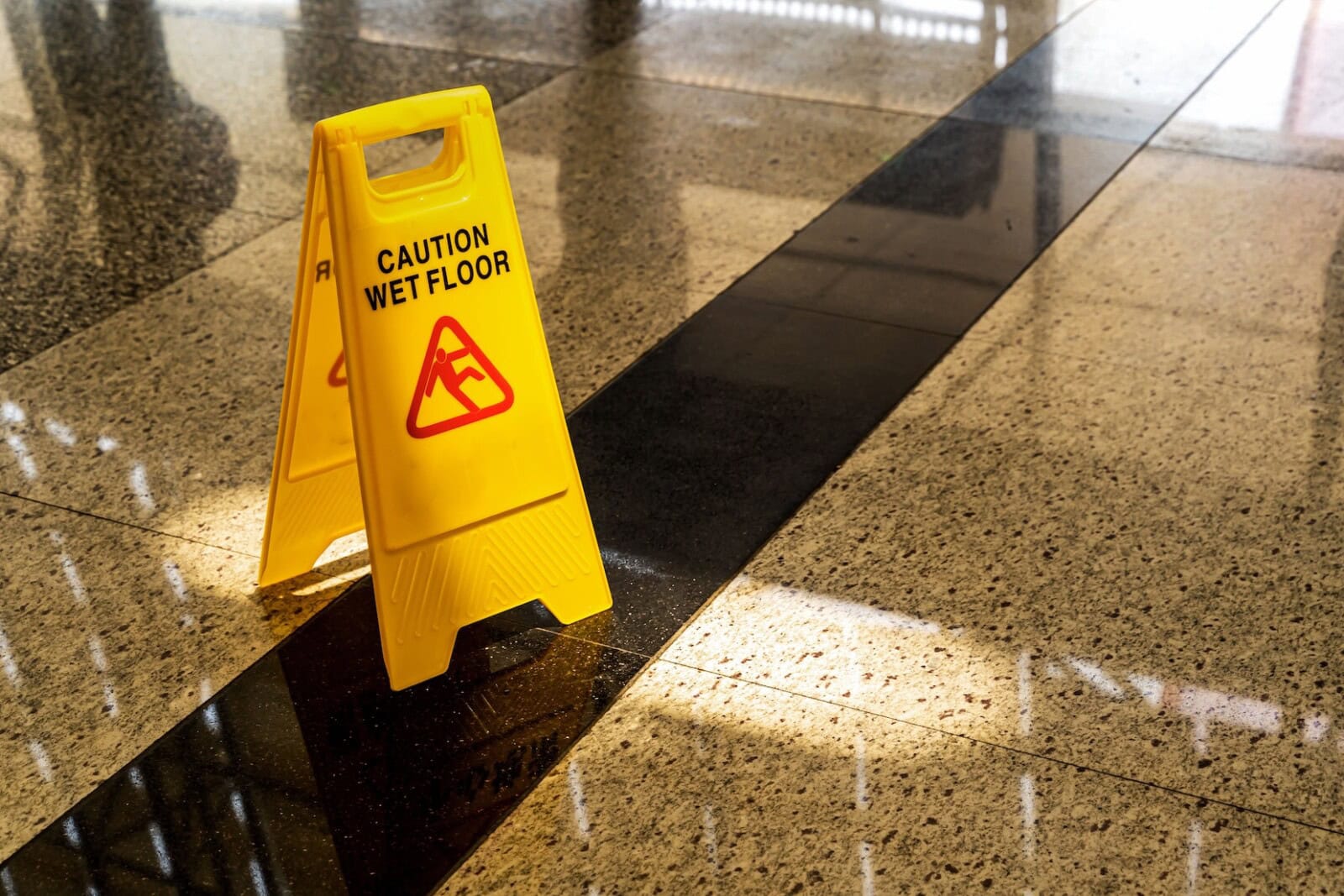
Property owners frequently use yellow caution signs to alert visitors to hazards like wet floors or tripping risks. If you suffer a slip and fall injury despite seeing or passing such a sign, you might wonder whether that warning automatically eliminates your ability to seek damages. In short, the answer is no, the presence of a caution sign does not automatically bar you from compensation in a Florida premises liability claim.
A sign is only one piece of evidence in a premises liability case, and liability ultimately hinges on whether the property owner fulfilled their duty of care. Successfully recovering compensation often involves analyzing two main legal doctrines, the Open and Obvious Defense and Comparative Negligence, to determine who holds the greater responsibility for the accident. Keep reading to learn more about the specific scenarios where a property owner remains liable despite a caution sign.
Understanding the Property Owner’s Duty of Care in Florida
Premises liability law establishes the fundamental requirements that property owners must meet to ensure the safety of their visitors. These obligations require owners and businesses to maintain reasonably safe premises for guests and to take action when they become aware of hidden or dangerous conditions. A property owner's ability to use a caution sign as a defense relies entirely on whether they first met this core legal duty.
The Foundation of Premises Liability Law
Premises liability is the body of law that holds property owners accountable for injuries caused by dangerous conditions on their property. When a slip and fall injury occurs, the injured plaintiff must typically prove that the owner knew, or should have known, of the dangerous condition. They must also show that the owner failed to either remedy the hazard or provide an adequate warning to guests.
This requirement to show knowledge is particularly detailed in Florida Statute §768.0755, which applies specifically to slip-and-fall cases involving a transitory foreign substance in a business establishment. For these cases, the injured person must prove the business had actual or constructive knowledge of the dangerous condition and should have taken action to remedy it. A property owner who posts a sign obviously knows there's a problem, which means their legal duty requires them to fix it, not simply warn about it.
Varying Duties Based on Premises Type
Premises liability law distinguishes between visitors based on their legal status: invitees, licensees, and trespassers. The strict duty of care outlined by law, which requires businesses to remedy hazards, applies mainly to business invitees (customers). Property owners generally owe the highest duty to these individuals.
For licensees, such as social guests, the duty is usually limited to warning them about known or hidden dangers. Trespassers are owed the least protection. This distinction demonstrates the complexity of proving negligence in different settings and underscores why legal interpretation of a caution sign's adequacy is so nuanced.
The Role of an Adequate Warning
The property owner's duty requires them to provide a warning for known hazards that aren't open and obvious. A caution sign is the primary tool owners use to fulfill this duty of warning visitors about a potential danger. If the owner can prove the sign was an adequate warning, it strongly suggests they fulfilled their initial duty of care.
However, a warning sign must meet specific criteria to be deemed adequate under the law. Under Florida law, property owners have a duty to warn invitees of concealed dangers that the owner knows or should know about. These are dangers unknown to the invitee and cannot be discovered by reasonable observation. The sign itself must be clear, visible, and placed directly adjacent to the hazard so that a person has a reasonable chance of noticing it and reacting accordingly.
The Open and Obvious Defense: When a Sign is Not Enough
Property owners frequently rely on the "Open and Obvious" doctrine as a common defense to avoid liability in personal injury cases. This defense operates on the premise that a property owner shouldn't be held responsible for injuries caused by a hazard that a reasonable person should have easily seen and avoided. The presence of a caution sign often triggers this defense, but the mere existence of a sign doesn't make this defense automatically successful because significant exceptions apply.
It's important to recognize the scenarios where the defense is strongest. A property owner is most likely to avoid liability if the hazard was genuinely non-essential, clearly marked with a standard sign, and the injured person had a safe, obvious alternative route nearby. If there were no competing distractions and the danger was static, like a change in elevation, the court would likely find that the property owner met their minimal duty of care.
Defining an Open and Obvious Hazard
An "open and obvious danger" is defined by the courts as a condition that is easily visible or discoverable by casual inspection to someone of typical intelligence. For example, a court might classify a large, clearly marked pothole or a puddle directly next to a visible yellow sign as an open-and-obvious hazard. Courts evaluate these cases based on the reasonable person standard, not based on the specific actions or observational habits of the injured party.
The existence of a clear, alternative path often supports this defense. For instance, in Wolf v. Sam's East, Inc., the court ruled that tree roots in landscaped areas are not inherently dangerous and are obvious enough that no warning or corrective action is required when a nearby alternative walkway is available. If a reasonable person would've seen the hazard and chosen a safe route, the defense may succeed, helping the property owner support this defense.
The Unreasonable Risk Exception
A crucial exception exists where a condition may be open and obvious, yet the property owner is still liable because the danger presents an unreasonable risk of harm. Simply warning a person about a danger is not sufficient if the danger itself is foreseeable and could've been easily remedied by the property owner. The law recognizes that a property owner can't leave a major hazard, such as a giant hole in the middle of a main aisle, with only a small sign to alert guests.
The open-and-obvious nature of a risk may discharge a landowner's duty to warn, but it doesn't necessarily discharge the duty to maintain the property in a reasonably safe condition. Florida courts have consistently held this position. For instance, in Carroll v. Carnival Corp., the U.S. Court of Appeals for the Eleventh Circuit ruled that even if a hazard is open and obvious, that fact doesn't eliminate the defendant's duty to use reasonable care in maintaining a safe walkway.
The Distraction Exception
Another important concept that counters the open-and-obvious defense is the "Distraction Exception." This exception applies when the injured party was reasonably distracted by circumstances created or permitted by the property owner. When a person is distracted, they may not be able to notice either the hazard or the caution sign.
Examples of property-created distractions include bright, attention-grabbing retail displays or areas with poor lighting that naturally obstruct the view of the hazard. If the property owner negligently creates an environment in which a reasonable person would be distracted, the focus of liability shifts back to the owner's failure to maintain a safe environment. This exception recognizes that people don't always walk around staring directly at the floor, especially in commercial settings designed to draw attention elsewhere.
If a distraction causes a person to miss a sign or a visible hazard, an attorney handling the slip-and-fall claim can argue that the owner should've anticipated that harm might occur despite the hazard's visibility. The courts examine the totality of the circumstances to determine if the distraction was reasonably foreseeable and contributed significantly to the accident.
Caution Sign Failures: When a Warning Is Deemed Inadequate
The heart of overcoming the open-and-obvious defense often lies in proving that the warning itself was inadequate under the circumstances. A property owner can fail in their duty even when a caution sign is present if that sign doesn't provide clear and effective notice. The effectiveness of a warning is constantly scrutinized in premises liability cases.
Improper Placement and Obscured Signage
The physical placement of the caution sign is one of the most critical elements in determining if the warning was adequate. A warning sign can only be effective when it puts the visitor on notice of a dangerous condition and must be visible enough to be effective. If the sign is considered unreasonably small, poorly placed, contains unreadable text, or is obscured, it may not be effective.
An owner might place a sign too far from the actual hazard, or in a spot a customer has already passed. A warning is generally considered ineffective if the injured person has no reasonable opportunity to see the warning sign and avoid the danger before encountering the hazard. For instance, a sign placed directly behind a large merchandise display may be considered obscured and therefore inadequate.
Failure to Warn About the True Scope of the Danger
When a hazard, such as a wet floor, covers a very large area, a single caution sign may not constitute an adequate warning. A property owner is expected to exercise reasonable care in addressing the scope of the danger. This may necessitate using multiple signs to delineate the boundaries of a widespread hazard.
In some situations, a reasonable property owner should use additional barriers or cones to cordon off the area entirely, especially if the substance poses a significant slipping hazard. If the single caution sign under-represents the scope of the danger, or if the wet area extends significantly beyond where the sign is placed, the owner can still be held liable. The warning must accurately reflect the potential risk the person faces.
Using the Sign as a Substitute for Timely Cleanup
Property owners have a clear duty to address a hazard promptly once they become aware of it. Placing a caution sign should be an interim step, providing immediate notice while staff work to remedy the situation. The sign is not meant to be a permanent solution.
A property owner can't place a caution sign as a permanent solution and must remedy known hazards promptly. If the hazard persists for an unreasonably long period, particularly for transitory substances such as water, spilled food, or debris, the owner’s negligence shifts. Their liability lies not in failing to warn, but in failing to actually remedy the known danger.
Posting a sign doesn't automatically absolve a property owner of liability. When an owner relies on a sign for hours or even days while failing to address a cleanable hazard, they are likely breaching their duty to maintain a reasonably safe premises. If the property owner's failure to timely fix the hazard constitutes a major breach of duty, that negligence heavily influences the assessment of fault, bringing us to the principle of comparative negligence.
The Comparative Negligence Defense and Your Compensation
Even if a court finds that the hazard was open and obvious, compensation may still be available because Florida operates under the legal principle of comparative negligence, also called comparative fault. This system is critical in premises liability cases where a caution sign was present. The court uses this framework to decide how much each party contributed to the accident.
How Comparative Negligence Works in Florida
Comparative negligence is the system used to assign a percentage of fault to every party involved in an accident. If the injured plaintiff is found to be partially at fault, their total compensation will be reduced proportionally by that percentage. For example, if a court determines that a person was owed $100,000 in damages but found them 20% at fault for failing to see a clearly visible sign, their recovery would be reduced by 20%. The final compensation received would be $80,000.
This system ensures that even if a plaintiff shares some blame for the accident, they are still eligible to recover compensation based on the property owner’s negligence. The presence of a caution sign is typically used by the defense to argue for a higher percentage of fault for the plaintiff. The severity of the property owner's negligence, however, often outweighs the plaintiff's contribution, creating opportunities to counter the plaintiff's comparative negligence claim.
The Critical Impact of Florida's Modified Comparative Negligence Law
Florida's comparative negligence law underwent a significant change in 2023 with the implementation of House Bill 837. Previously, Florida used a pure comparative negligence system, meaning you could recover damages even if you were 99% at fault. This is no longer the case, creating a new challenge for victims.
Florida now uses a modified comparative negligence system, which prevents a plaintiff from recovering any damages if they are found to be more than 50% at fault for their own accident. Because of this legal shift, the property owner’s main goal when using the caution sign defense is often to shift the plaintiff's fault percentage above the 50% threshold. Having an experienced personal injury attorney is crucial to effectively argue the property owner's greater fault and protect your right to recovery.
Speak To A Lawyer About Your Premises Liability Case Today
A caution sign is certainly not a "get out of jail free card" for property owners. Liability hinges on the totality of the circumstances, which includes the adequacy of the warning, the nature of the hazard, and the property owner's underlying duty to remedy known dangers in a reasonable timeframe.
Success in these premises liability injury cases requires a deep understanding of premises liability law, case precedent, and Florida's comparative negligence rules. If you suffered a slip and fall or another premises liability injury in Florida, our experienced attorneys are dedicated to providing aggressive representation and personalized service.
Call Weinstein Legal Team 24/7 at 888.626.1108 for a free case review with a lawyer, or click here to schedule your case review now.