
A dooring crash happens when someone opens a car door into a cyclist's path. In Florida the person who opened the door is usually the one at fault, because Fla. Stat. 316.2005 makes it an infraction to open a vehicle door until it is reasonably safe to do so.
This page covers who is liable, how comparative fault under Fla. Stat. 768.81 can cut what you recover, the two year deadline in Fla. Stat. 95.11(5)(a), and what to do at the scene.
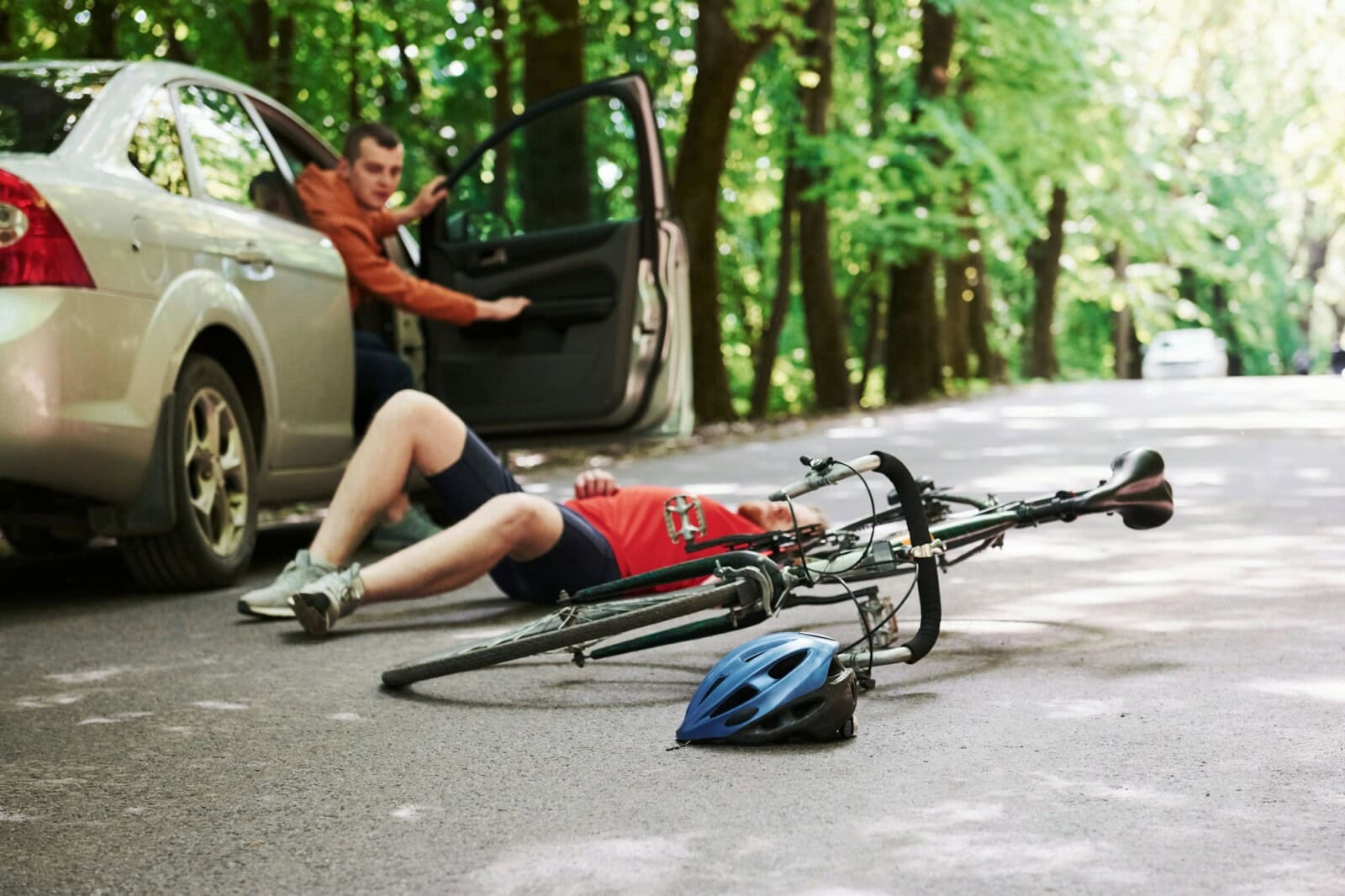
The Dynamics Of Dooring Accidents
Dooring crashes follow a predictable pattern: a parked car, a door opened without a look, and a rider with no time and no room to avoid it.
What Is Dooring?
Dooring occurs when a car door is opened into the path of a cyclist, creating a dangerous situation that can lead to serious injury or even death. This accident occurs suddenly, giving the cyclist little time to react and avoid a collision.
In many cases, dooring isn’t only an unfortunate mishap but also a reflection of the negligence of motorists who fail to look for cyclists.
States have bicycle laws that protect bicyclists and establish the responsibilities of motorists who share the road. Awareness and compliance with these laws by all parties can drastically reduce the number of "dooring" incidents and ensure the safety of cyclists.
Common Injuries
Abrasions and bruises are common when riders come into contact with the opening car door or the sidewalk. More severe impacts can lead to broken bones, particularly in the collarbones or wrists, as cyclists instinctively reach out their arms to cushion a fall.
Head traumas, including concussions, are a significant risk if a helmet isn't worn at the time of impact. Traumatic injuries can lead to even more complex damage, such as internal organ damage or spinal cord injuries that require immediate emergency care.
What Contributes To Dooring Accidents
While often overlooked in discussions about road safety, dooring accidents are a significant hazard, especially in urban areas with a high concentration of cyclists and parked vehicles. Understanding what contributes to these accidents and implementing various prevention strategies can significantly improve the safety of cyclists on our roads.
Lack Of Awareness
Many drivers don't realize the danger that opening a car door presents to passing cyclists. Cyclists often are injured because someone didn’t check their mirror before opening a door.
Raising awareness through campaigns and driver education programs could dramatically reduce the number of dooring accidents, protecting our bicycling community from harm’s way.
Improper Bike Lane Design
Properly designed lanes protect cyclists from swinging doors and help prevent dooring accidents. Designers must give bikes enough space to navigate safely, which means positioning lanes outside the "door zone," where an open car door can reach. This creates a buffer between parked cars and cyclists, significantly reducing the risk of collision.
Additionally, bike lanes should follow smooth paths free from obstructions or sudden changes in direction that could force bikers into harm's way. With thoughtful design, cities can ensure safer travel for everyone on the road, making cycling a more attractive mode of transportation.
Rights And Responsibilities Of Cyclists And Motorists
Understanding the legal framework for dooring accidents is important for cyclists and motorists, as it outlines a web of rights to protect cyclists and duties for motorists. This intersection of law and safety shapes the playing field and ensures that every road user knows what’s expected of them if a door and a cyclist collide.
Traffic Laws
Under Fla. Stat. 316.2065(1), every person propelling a vehicle by human power has all of the rights and all of the duties of the driver of any other vehicle under chapter 316, except where a special bicycle rule applies or where a rule by its nature cannot. You have a right to the lane, and you also have to signal your turns and obey stop signs and traffic lights.
Florida's dooring rule is Fla. Stat. 316.2005, titled Opening and closing vehicle doors. It provides that no person shall open any door on a motor vehicle unless and until it is reasonably safe to do so and it can be done without interfering with the movement of other traffic, and that no one may leave a door open on the traffic side of a vehicle longer than it takes to load or unload passengers.
Two details in that wording matter after a crash. The duty falls on "no person", not only on the driver, so a rear seat passenger who flings a door open into a bike lane is covered by it as well. And the statute does not spell out a mirror check or a shoulder check; it sets a reasonable safety standard, and failing to look is simply how that standard usually gets broken.
A violation of section 316.2005 is a noncriminal traffic infraction, punishable as a nonmoving violation under chapter 318. A citation is not automatic proof of your civil case, but the infraction and the officer's report are useful evidence that the person who opened the door failed to use reasonable care.
Comparative Negligence
Comparative negligence takes the law further by examining how your actions may have contributed to the accident. Even if a car door suddenly opens into your path and causes a dooring accident, you aren't automatically free of fault. Lawyers and courts look closely at every detail, such as whether you were riding too close to parked cars and whether you were following safety rules for cyclists.
Florida uses modified comparative negligence. Under Fla. Stat. 768.81(2) your share of fault reduces your award in proportion, so a cyclist found 20 percent at fault collects 80 percent of the damages. Under Fla. Stat. 768.81(6) a party found greater than 50 percent at fault for their own harm recovers nothing at all. That bar arrived with chapter 2023-15 and applies to negligence actions other than medical negligence under chapter 766.
That 50 percent line is why the insurer will argue you were riding inside the door zone, riding without lights after dark, or riding against traffic. Photographs from the scene, your lights and reflectors, and the names of witnesses are what push that percentage back down.
Steps To Take After A Dooring Accident
In the unfortunate event of a dooring accident, knowing the appropriate steps to take can greatly impact the outcome and protect your rights and well-being. Whether you're a cyclist who's been hit or a motorist involved in the incident, it’s important to respond correctly.
Seek Medical Attention
After a dooring accident, you should seek medical treatment immediately, even if you think you aren’t seriously injured. Some injuries can hide under the adrenaline rush and may not show symptoms until hours or days later.
Having medical professionals examine you will ensure that all your injuries are properly documented, which matters if you later have to prove what the crash cost you.
Make sure to keep a record of any medical treatment you have received about the door collision. This includes visits to the emergency room, appointments with specialists, physiotherapy treatments, and any medication prescribed to treat injuries and pain management related to the accident.
Calling The Police
It's important that the police come to the scene of the accident, even if the injuries appear minor. Officers will make a report, which is an official account of what happened and can prove valuable later. This documentation often contains details that can affect liability and insurance claims.
Ensure you give officers as much information as possible about the incident without admitting fault or speculating about the incident. The facts should speak for themselves, and it's best to avoid making statements that could be used against you in later court proceedings.
Police reports help build a timeline and support your case if you're seeking justice or compensation for damages you suffered in a dooring accident.
Gathering Evidence
Be sure to take photos of the accident, including close-up images of damage to your bike and the vehicle door. Take a wide-angle shot showing the position of both vehicles on the road.
If there are skid marks, record these as well. Don't overlook road signs or traffic signals, because they give the scene context that a close-up photo cannot.
Request contact information from witnesses who saw the incident since their statements can strengthen your claim later. Make notes about the accident while the details are still fresh in your mind, since a contemporaneous note carries far more weight than a recollection given months later in a deposition.
Recourse For Dooring Accident Victims
A cyclist hurt in a dooring crash can pursue a claim against the person who opened the door and against that person's liability insurer. Here is what each route involves.
Insurance Claims
You’ll usually need to file a liability claim citing the motorist's policy to receive compensation from the motorist's insurance company. As a cyclist, you should provide all relevant information about the incident, including medical reports, photographs of injuries, witness statements, and event details.
Insurance companies often try to minimize compensation payments, so it’s usually in your best interest to speak with a bicycle accident attorney about your accident first.
An attorney can negotiate with insurance companies on your behalf and work to ensure that compensation covers the full range of medical costs, rehabilitation costs, loss of earnings due to injury, and other damages associated with the accident.
Personal Injury Lawsuit
A cyclist can sue the person who opened the door and pursue that person's liability insurer. The deadline is two years from the date of the crash under Fla. Stat. 95.11(5)(a) for any cause of action accruing after March 24, 2023. Claims that accrued before that date had four years, so check the date of your crash before assuming either number.
One Florida rule catches cyclists out. Because the person who doored you was the operator or occupant of a motor vehicle carrying the PIP security Florida requires, Fla. Stat. 627.737(2) applies to your claim against them. To recover pain and suffering and other non-economic damages you have to show that the injury consists in whole or in part of a permanent injury within a reasonable degree of medical probability, significant and permanent loss of an important bodily function, significant and permanent scarring or disfigurement, or death. Medical bills and lost wages are not subject to that threshold. Raise it with a lawyer early, because it drives which specialists you need to see and when.
You should also contact a bicycle injury lawyer as soon as possible to ensure your claim is handled properly. Your injury lawyer will handle all of the intricacies of your case, from gathering evidence, filing a claim, negotiating with the insurance company, and even handling the court proceedings if the case goes to trial.
Most claims settle without a trial, and a settlement can and routinely does include non-economic damages such as pain and suffering. Filing suit is what keeps the option open when the insurer's number does not reflect the injury.
Property Damage Claims
Dooring accidents often result in damage to the bicycle itself. In this case, the cyclist has the right to file a claim for damages to recover the cost of repairing or replacing the bicycle. This claim is particularly important as bikes can be expensive, and specialist equipment is often irreparably damaged in a collision.
Keep all receipts and estimates for the repair or replacement of your bike to support your claim. Detailed records and photographic evidence of the damage will strengthen your claim.
A lawyer can help you accurately assess the damage and negotiate with the insurance company to ensure you receive adequate compensation to restore or replace your bike to its condition before the accident.
How To Prevent Dooring Accidents
Preventing dooring accidents requires a joint effort by motorists and cyclists, including awareness, education, and the implementation of safety measures. These strategies can reduce the risk of dooring accidents, creating a safer environment for all road users.
Drivers And Passengers Safety Measures
Drivers and passengers can take several proactive steps to prevent potential dooring accidents. These safety tips include:
- Practice the 'Dutch Reach': In the 'Dutch Reach' method, the hand furthest away from the car door is used to open the door. This simple switch causes the person to turn their body, which naturally causes them to look over their shoulder, making them more likely to notice an approaching cyclist.
- Check Mirrors and Blind Spots: Before getting out of the car, check mirrors and blind spots for cyclists. Drivers should make it a habit to check for cyclists before opening the door, just as they would with any other vehicle.
- Open Doors Slowly: Opening the car door slowly with a pause helps to warn passing cyclists and give them time to react. If you do not open the door too quickly, the driver and the cyclist can avoid a collision.
- Use Appropriate Signaling: Passengers should signal to cyclists and other motorists that they want to open the door by using their turn signals or giving a clear hand signal if this can be done safely.
Safety Precautions For Cyclists
Cyclists share responsibility for their own safety on city streets. Measures worth taking:
- Stay Out of the door zone: Cyclists should ride at a safe distance from parked cars whenever possible and avoid the “door zone," which is usually about 3 to 4 feet from parked cars.
- Ride Defensively: Be aware of your surroundings, assume that drivers may not see you, and be prepared to avoid suddenly opening doors - these are all defensive strategies for cyclists.
- Use Bike Lanes: Use designated bike lanes if available and safe. If there are no bike lanes, cyclists may use the entire roadway to avoid riding too close to parked vehicles.
- Visibility: By making yourself visible with the help of lights, reflective clothing, and hand signals, you can attract the attention of motorists and passengers.
Urban Planning And Policy Measures
The following suggestions are a few ways that cities can do their part to help prevent dooring accidents:
- Improved Infrastructure: Cities can create safer infrastructure for cyclists, such as protected bike lanes that physically separate cyclists from parked cars, significantly reducing the risk of dooring injuries.
- Traffic Engineering: Implement changes such as buffer zones between parking lots and bike lanes, adequate street lighting, and the introduction of technology that alerts motorists when they detect an approaching cyclist.
- Legislation: Introducing and enforcing laws that penalize dooring can serve as a deterrent. Legislators can also enact policies that require driver education programs to include strategies to prevent dooring.
Hire A Personal Injury Lawyer Today
If you’ve been injured in a dooring accident or any other bicycle accident in Florida, you may be entitled to compensation for your injuries. We know the road to recovery can be difficult, so let us handle the legal and medical matters while you focus on your recovery.
Contact the Weinstein Legal Team at 888.626.1108 or click here to start a free case review with a Florida personal injury lawyer today.