


- Under Florida Statute § 768.0755, plaintiffs must prove a business establishment had actual or constructive knowledge of a transitory foreign substance to succeed in a premises liability claim.
- Establishing constructive notice typically requires circumstantial evidence showing the dangerous condition existed for a sufficient length of time or occurred with such regularity that it was foreseeable.
- Key evidence used to prove constructive knowledge in Florida slip and fall cases includes CCTV surveillance footage, store maintenance logs, and physical signs of substance deterioration like tracking or bruising.
- Recent changes to Florida law under HB 837 mean slip and fall victims are barred from recovery if they are found more than 50% at fault under the modified comparative negligence standard.
Proving a business had constructive knowledge of a hazard is often the single most difficult challenge in a Florida premises liability claim. In slip-and-fall cases in a grocery store, the injured party must prove that the property owner was aware of the dangerous condition but failed to take reasonable steps to remedy it.
This awareness is known as "notice," and it can be actual (direct knowledge) or constructive (should-have-known). Because business establishments rarely admit actual knowledge, successfully winning a slip-and-fall claim often hinges on proving constructive notice through circumstantial evidence. Keep reading to learn more about the complex legal requirements for securing compensation after a serious fall in Florida.
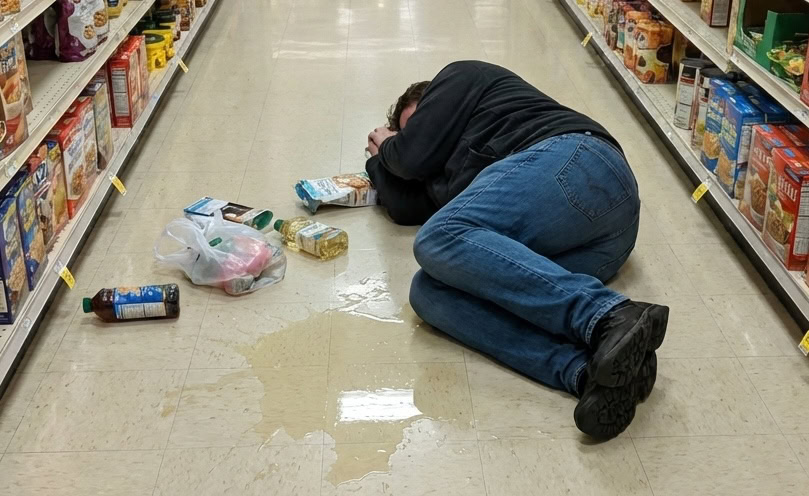
The Legal Foundation: Florida Statute § 768.0755
In Florida, premises liability cases involving hazards created by spills or debris often fall under the specific governance of Florida Statute § 768.0755. This statute addresses injuries caused by a "transitory foreign substance" within a business establishment. It explicitly requires the injured person to prove that the business establishment had either actual or constructive knowledge of the dangerous condition and subsequently failed to address it.
This statute imposes a strict burden of proof on the plaintiff in cases involving substances such as spilled liquids or dropped food. This is distinct from general premises liability claims, which address structural or permanent hazards, such as a broken sidewalk or inadequate lighting. For those structural defects, proving knowledge may rely less on demonstrating a specific time duration and more on showing the owner failed to follow routine maintenance schedules or building codes. However, when dealing with a transitory substance, proving knowledge is paramount.
The statute clarifies that falling on a wet floor alone isn't sufficient to establish a case. The legislature mandated that the plaintiff must provide affirmative proof that the business either knew of the hazard or had ample time to discover it before the accident occurred. This legislative requirement ensures that businesses are held accountable for true negligence, not just for every accident that occurs on their property.
What is a "Transitory Foreign Substance"?
A transitory foreign substance is defined as any liquid or solid material, item, or object that is temporarily present where it doesn't belong. This definition covers a wide range of common hazards that cause slip-and-fall accidents.
Examples include spilled milk, soda, or water, as well as dropped food like a banana peel or a grease spot left by a dropped container. It's important to understand that this specific statutory requirement applies primarily to business establishments, such as grocery stores, retail chains, and restaurants. These locations are expected to exercise ordinary care in continuously inspecting and maintaining their premises to prevent these temporary hazards from injuring customers.
The Two Pillars of Constructive Knowledge Under Florida Law
Because businesses rarely admit to having actual notice of a hazard, injured parties usually rely on proving constructive knowledge. According to Florida Statute § 768.0755, constructive knowledge may be proven by circumstantial evidence that satisfies one of two distinct standards. This means the injured party must present facts that allow a reasonable conclusion that the business should have discovered the danger.
Proof 1: The Hazard Existed for a Sufficient Length of Time
The most common method of establishing constructive notice is demonstrating that the dangerous condition existed for a specific period. The legal standard requires circumstantial evidence showing the condition existed for "such a length of time that, in the exercise of ordinary care, the business establishment should have known of the condition." This standard focuses on how long the hazard was present and whether a reasonably diligent inspection routine would have caught it.
Courts don't adhere to a fixed rule that a substance must be present for an exact time period. Judges and juries must evaluate the facts of each case, taking into account the nature of the business and the location of the spill. For instance, while some courts have suggested that ten minutes or less is generally insufficient to establish constructive knowledge, evidence demonstrating a condition existed for 15 to 20 minutes may be sufficient to charge the owner with constructive knowledge.
A plaintiff must provide evidence beyond the mere presence of the substance itself to establish this sufficient duration. This is often referred to as a "plus" factor, which consists of additional circumstantial evidence that strongly suggests the hazard was present for some time. Evidence of tracking, deterioration, or visible changes to the substance itself can satisfy this requirement.
Proof 2: The Condition Occurred with Regularity and Was Foreseeable
The second method for proving constructive knowledge focuses on a pattern of negligence rather than the duration of the specific spill. This method requires proving that the dangerous condition occurred with such regularity that its existence at the time of the injury was foreseeable. A business can't claim ignorance if it repeatedly fails to address a known, ongoing maintenance issue.
A common example of this occurs in cases involving refrigeration units. If a store knows a freezer or produce mister consistently leaks water onto the floor in the same aisle, the store has constructive knowledge of the hazard, even if that specific puddle formed only minutes before the accident.
The store's failure to fix the leaking unit establishes the pattern of negligence, regardless of the most recent inspection time. This alternative method holds businesses responsible for failing to address systemic problems that predictably create dangerous conditions for customers.
Crucial First Steps: Preserving Evidence for Constructive Notice
The actions taken immediately following an injury on a business property can significantly strengthen the case for constructive notice. Because time is a factor in proving the duration of the hazard, an injured person must act quickly and deliberately. This is especially true now, as Florida slip-and-fall lawsuit requirements are changing due to recent legislative action.
The first step is to report the incident to a manager or supervisor immediately. Ensure that an official incident report is created, even if you don't feel seriously injured at that moment. Ask for a copy of the report, and note the name and contact information of the employee who took the report and any witnesses who saw the incident or the hazard before you fell.
If you are physically able to do so, take photographs of the exact location of the fall and the specific hazard that caused it. Photos should be taken from multiple angles, including close-ups and wider shots that show the surrounding area and the visibility of the hazard. The timestamp and location data attached to these digital photographs provide irrefutable evidence of the physical condition immediately following the fall.
Finally, seek immediate medical attention, even for minor injuries. This establishes a clear link between the fall and the injuries sustained, creating an official medical record. Furthermore, the statute of limitations for most premises liability claims in Florida has been shortened to 2 years from the date of injury, making it crucial to contact a lawyer promptly to begin the investigation and evidence-preservation process.
Navigating Liability After HB 837: The Modified Comparative Negligence Rule
A successful personal injury claim in Florida requires the plaintiff to prove negligence. However, even if negligence is proven, the amount of compensation recoverable now depends on the degree of fault assigned to the injured party. This is due to a substantial change in Florida law.
Florida previously operated under a pure comparative negligence system. That changed substantially with the introduction of House Bill 837, making Florida a modified comparative negligence state. This shift has profound consequences for slip-and-fall victims pursuing compensation.
Under the new standard, if the plaintiff is found to be 51% or more at fault for their own injury, they are completely barred from recovering any damages whatsoever. This means the opposing insurance company will aggressively argue that the victim contributed to the fall by failing to pay attention or by wearing improper shoes. Successfully combating the defense's efforts to shift blame and keeping the plaintiff's fault below 51% are among the most significant hurdles in modern Florida premises liability claims.
Actionable Evidence: Uncovering Constructive Notice Through Discovery
Proving that a business should have known about a transitory foreign substance is highly dependent on the evidence collected during the legal discovery process. The burden rests squarely on the plaintiff to provide evidence, beyond speculation, of the hazard's duration. Diligent investigation is required to piece together the circumstantial facts necessary to establish constructive notice under Florida law.
This is where understanding "what evidence do I need to prove constructive notice" becomes essential to a successful slip-and-fall case. A lawyer must move quickly to secure various forms of evidence before the business can destroy or dismiss them.
Maintenance Records and Store Sweep Logs
Internal business documents, such as maintenance records, inspection checklists, and store sweep logs, are crucial pieces of evidence in premises liability claims. These records document the business's routine effort to maintain a safe environment. However, the quality and honesty of these records are often the key focus of legal inquiry.
An experienced lawyer will thoroughly scrutinize these logs for inconsistencies and suspicious patterns. For example, gaps in logs, where long periods exist between recorded inspections, suggest a lapse in ordinary care. Similarly, if the business claims the log was "lost" or wasn't maintained at all for the relevant timeframe, this can be circumstantial evidence of a general lack of safety awareness.
Lawyers also look for suspicious entries that may indicate fabrication. If all inspection entries are written in the same handwriting or appear to have been signed off minutes after an accident occurred, the authenticity of the records can be successfully challenged. A business attempting to defeat a constructive notice argument by relying on questionable logs often reveals underlying systemic negligence.
Surveillance Footage and CCTV Evidence
Surveillance footage and closed-circuit television, or CCTV, evidence are often considered the best resources for establishing constructive notice. Video footage can definitively show how long a hazard existed before the fall occurred. Even more critically, footage can capture employees walking past a noticeable hazard without taking any action to clean it up or warn customers, thereby providing direct proof of the business's constructive knowledge.
For example, a federal judge in Miami found that a jury could infer constructive knowledge when evidence showed water had been accumulating in a spot for some time. Security footage revealed that multiple store employees walked by the area without inspecting the floor, despite it being a rainy day.
This type of visual proof is powerful circumstantial evidence. An attorney must act immediately to secure this evidence, as most businesses retain surveillance footage for only 30 to 90 days before it's permanently deleted.
Employee Testimony and Admission of Fault
Depositions of current and former business employees are powerful tools for gathering circumstantial evidence on constructive notice. During a deposition, an employee may testify about the store's established inspection routine, or lack thereof. A worker's statement about how long they believed a spill had been present can often contribute to the circumstantial evidence needed to satisfy the statutory requirements.
Furthermore, testimony from former employees can often reveal systemic safety issues within the organization. Workers who are no longer employed by the business may be more willing to discuss pressures to ignore maintenance routines, details about understaffing, or general poor safety practices. This internal insight can establish that the business was aware of ongoing issues that repeatedly created dangerous conditions. This is just one reason why hiring a premises liability lawyer in Florida is vital for a successful claim.
Physical Evidence and Accident Scene Analysis
The nature of the hazard itself often provides physical evidence of its duration. The deteriorated condition of a foreign substance can serve as circumstantial evidence that it had been on the floor for a sufficient period. For example, a dark, bruised banana peel shows it has been on the floor longer than a fresh, bright yellow peel.
Other physical indicators, such as tracking or footprints left in spilled dirt or debris, strongly suggest that time has elapsed since the hazard was created. The more spread out the substance is, the longer it has likely been on the floor while customers walked through it. This type of evidence must be coupled with other "plus" factors to meet the legal standard.
Additionally, the sheer visibility of the hazard can be used as evidence. The more open and obvious the hazard was, the stronger the argument becomes that a reasonable business employee should have observed and remedied the situation. To learn more about how to prove a store was negligent after falling, review our resources.
Navigating Defenses: The Business's Side of the Argument
When an injured party brings a premises liability claim, the business rarely accepts liability immediately. Injury defense lawyers typically introduce common arguments designed to either refute the existence of constructive notice or shift the blame onto the injured person. A successful claim must be prepared to counter these arguments effectively.
The "Open and Obvious" Defense
A frequently used defense in premises liability cases is the "open and obvious" doctrine. The business argues that if the hazard, such as a large puddle or an obvious obstruction, was easily visible, the injured person failed to use reasonable care for their own safety. If the danger was apparent, the injured person arguably should have avoided it.
However, in Florida, the open and obvious nature of a hazard may discharge the landowner's duty to warn customers. Still, it doesn't completely discharge the landowner's separate duty to maintain the property in a reasonably safe condition.
An attorney can counter this defense by arguing that the business should have anticipated that people would be distracted while shopping, or that the danger posed an unreasonable risk, even if it was visible.
The Defense of "Reasonable Inspection"
To defeat an argument of constructive notice, a business will attempt to use its internal inspection logs and maintenance records to prove it exercised reasonable care. The business asserts that it follows a regular, published inspection routine that should have caught the hazard before the injury occurred.
If surveillance footage confirms that an employee inspected the area within a very short, specified timeframe, such as every 15 minutes, the business may successfully defeat the constructive notice argument.
The attorney's role, in this scenario, is to challenge the reasonableness of the routine itself. If the accident occurs in a known high-spill area, such as a self-service beverage station or a deli counter, inspecting the area only once every two hours may not constitute reasonable care. Furthermore, a lawyer will challenge the authenticity of the records, looking for the gaps and suspicious entries discussed earlier, to prove the routine was either insufficient or poorly executed.
Secure Your Rights with an Experienced Florida Premises Liability Lawyer
The standard of proving constructive knowledge, coupled with Florida's restrictive 51% modified comparative negligence rule, means that hiring a premises liability lawyer in Florida can be beneficial to your claim. Successfully navigating the technical requirements of Florida Statute § 768.0755 and countering the common defenses requires aggressive investigation and specialized legal skill. We understand the evidence you need to prove constructive notice and how to leverage it to maximize your recovery.
Don't let a business establishment evade accountability for its negligence because of the complexity of legal standards. Our experienced attorneys specialize in slip-and-fall and catastrophic injury cases in Florida, fighting tirelessly to protect our clients' rights and secure the best possible outcomes.
We are ready to launch an immediate investigation to gather the evidence needed for your claim. Call Weinstein Legal Team 24/7 at 888.626.1108 to speak with a lawyer in Florida about your accident claim, or click here to schedule your free case review today.