


Publix Super Markets, Inc. is one of the Southeast's largest employee-owned grocery chains, operating over 1,300 stores and maintaining a dominant retail presence throughout Florida. Like any large retailer, Publix is frequently the target of personal injury claims related to premises liability and negligent security.
Because the company utilizes sophisticated legal defense teams to aggressively challenge claims, winning a lawsuit against Publix presents unique legal hurdles for injured customers. This analysis provides insight into the specific strategies, successful plaintiff verdicts, and key Florida laws that influence case outcomes against this corporate defendant. Keep reading to learn more about premises liability claims against Publix in Florida.
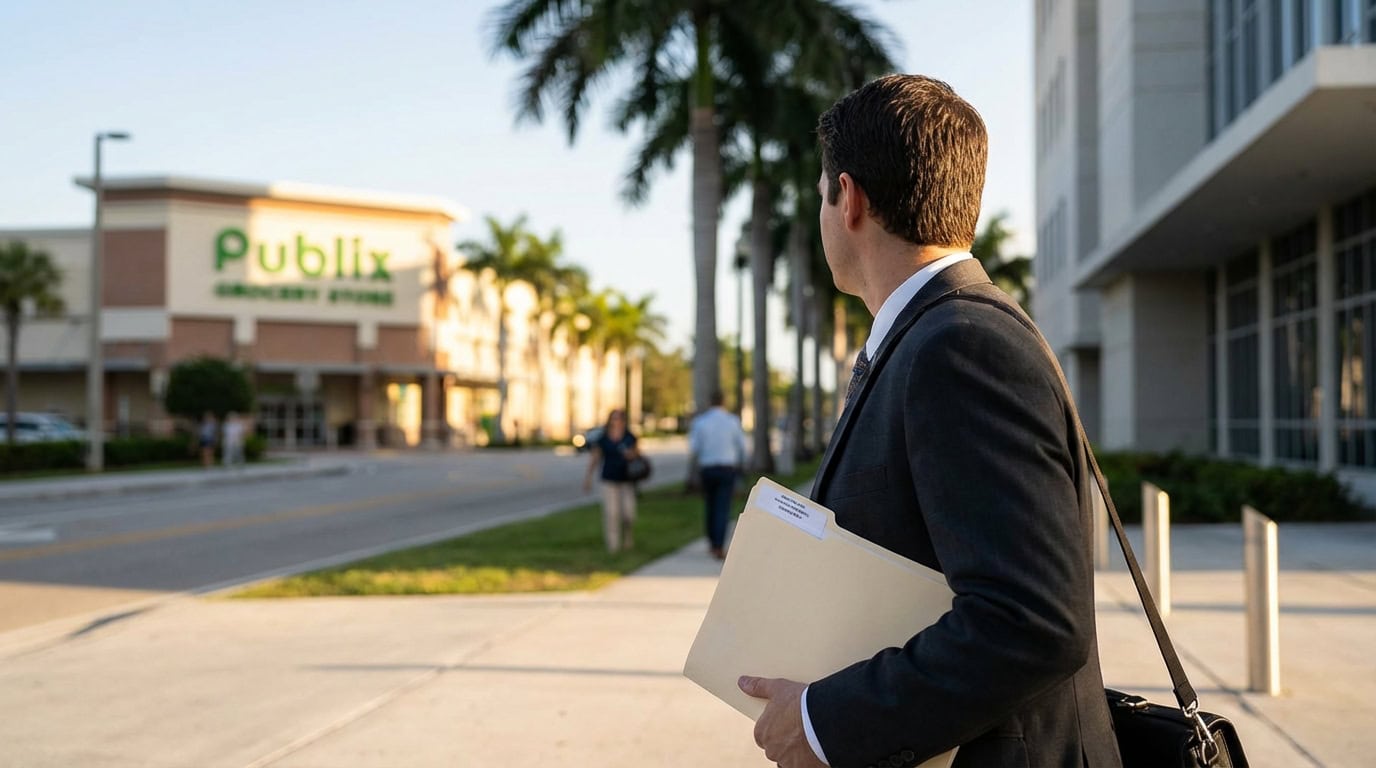
Understanding Florida Premises Liability Law in Publix Cases
As a business that invites customers onto its premises for commercial purposes, Publix owes all patrons a legal duty of care under Florida premises liability law. This fundamental obligation requires property owners to maintain their premises in a reasonably safe condition and protect customers from foreseeable dangers.
Success in any lawsuit against Publix depends on the plaintiff's ability to meet specific statutory burdens of proof codified in Florida law. These statutory requirements balance the interests of injured customers with the business concerns of property owners, creating a challenging legal framework.
The Standard of Proof: Actual vs. Constructive Knowledge (Florida Statute § 768.0755)
Florida Statute § 768.0755 establishes the controlling legal standard for slip-and-fall cases involving transitory foreign substances in business establishments. This statute requires that an injured person prove the business, Publix, had either “actual or constructive knowledge” of the dangerous condition and should have taken action to remedy it. This knowledge requirement presents a substantial evidentiary burden on the plaintiff.
Actual knowledge refers to a situation where a direct employee or agent of Publix was aware of the specific dangerous condition at the relevant time and place. Proof might include direct testimony from a store employee who witnessed the spill or security camera footage showing an employee observing the hazard.
Constructive knowledge, by contrast, relies on circumstantial evidence that allows courts to infer the property owner should've known about the condition despite a lack of direct observation. Constructive knowledge can be established if the dangerous condition existed for such a length of time that the business, exercising ordinary care, should have known of it.
It can also be established when the condition occurred with such regularity that it was foreseeable. The evidence required to prove constructive knowledge includes details about the duration of the hazard, the recurring nature of the problem, or a lack of reasonable inspection procedures. This single point often becomes the primary contested issue in litigation against Publix.
The Role of Comparative Negligence in Florida Claims
The landscape of personal injury litigation in Florida shifted dramatically on March 24, 2023, when the state moved from a pure comparative negligence standard to a modified comparative negligence system. Under the current Florida Statute § 768.81, an injured person's compensation is reduced by their percentage of fault. For example, if a jury finds a plaintiff 30 percent at fault for the accident, their recovered damages are reduced by 30 percent.
The critical change is the introduction of the 51% bar rule. If the plaintiff is found 51 percent or more at fault for their own harm, they may not recover any damages whatsoever, regardless of Publix’s negligence. Publix frequently employs this defense strategy, arguing the injured party was distracted, not paying attention to their surroundings, or otherwise failed to watch where they were walking. By doing so, they attempt to shift blame above that 51 percent threshold.
Immediate Action: What to Do After a Publix Injury in Florida
Successfully pursuing a premises liability claim against a major corporation like Publix requires immediate, decisive action to preserve critical evidence. The steps taken in the moments and hours following an injury can determine the entire course of the lawsuit.
The Importance of Reporting and Evidence Preservation
The most important step following an injury at Publix is to report the incident immediately to a manager or employee and ensure an official incident report is completed. You should document the specific location of the accident, the time of the incident, and the names of any employees present. Although managers may be reluctant to provide a copy, you must request one for litigation purposes.
Immediately following the report, the injured party should take extensive photographs and video of the accident scene. Capture the hazard itself, the surrounding area, the lighting conditions, and any warning signs or the lack thereof. This photographic record creates an objective, contemporaneous record that Publix can’t easily dispute later.
The injured party should also obtain contact information from all witnesses who observed the fall or saw the hazardous condition before the incident. Promptly seeking medical attention, even for seemingly minor injuries, is incredibly important. Immediate medical care ensures your health, establishes contemporaneous medical documentation, and creates a clear connection between the fall and the injury.
You should also preserve physical evidence, such as clothing and, especially, the shoes worn during the slip-and-fall. Publix defense attorneys often request to examine footwear to assess slip resistance or contribution to the accident. Retaining the shoes prevents the hazardous substance from drying or evaporating, allowing experts to analyze them later.
Preparing for the Defense: Pre-Existing Injuries and Fault Allocation
Potential plaintiffs must be prepared for the aggressive defense strategies Publix employs in Florida courts. Publix and its legal counsel often dispute the injury's causation, attempting to attribute the harm to a pre-existing medical condition, such as degenerative disc disease. This strategy aims to shift responsibility away from the fall itself and minimize damages.
The defense also aggressively pursues a comparative negligence defense to shift the blame to the plaintiff. They'll argue the injured party failed to watch where they were walking or ignored an “open and obvious” hazard. Remember, under Florida's modified comparative negligence system, if the defense persuades the jury that the plaintiff bears 51% or more of the fault, the claim is barred entirely.
A strong case requires clear medical evidence that directly links the accident to a new injury or the aggravation of a pre-existing one. Plaintiffs need medical experts who can distinguish between the natural progression of an existing condition and the acute worsening caused by the traumatic fall. This preparation is necessary to overcome the defense's efforts to minimize damages or assign comparative fault.
High-Profile Publix Slip-and-Fall Case Studies
The history of slip-and-fall litigation against Publix reveals how legal principles translate into court outcomes. These case studies demonstrate how the requirement to prove statutory knowledge and the application of comparative negligence determine whether a plaintiff obtains a significant verdict or a complete defense victory.
The Multi-Million Dollar Verdict for Negligence
In July 2024, a Lake County jury awarded Heidi Jordan, a customer who slipped on water in the produce department of a Leesburg Publix Supermarket in August 2020, over $4 million. This verdict ranks among the largest slip-and-fall awards in recent Florida history. Jordan suffered substantial injuries from the fall, including herniated discs in her neck and back, requiring extended physical therapy.
The legal victory was established when Publix admitted to negligence just days before the trial commenced. This admission effectively conceded that the company failed to maintain reasonably safe premises, or knew about the water hazard and failed to address it. By admitting negligence, the dispute shifted entirely to the extent of Jordan’s damages and causation.
The seriousness of Jordan’s injuries was a major factor in the substantial award. After years of conservative treatment, she ultimately required cervical fusion surgery, a major spinal procedure that courts recognize as strong evidence of serious injury. The jury's verdict of over $4.2 million reflects the acceptance of medical evidence demonstrating the permanent impact on her quality of life and the severity of her injuries.
The size of the award demonstrates that juries will hold Publix accountable when evidence clearly establishes negligence and causation. This case demonstrates that obtaining thorough medical documentation, including diagnostic imaging and surgical reports, is crucial for overcoming aggressive corporate defenses.
The Challenge of Constructive Notice and Defense Verdicts
Contrasting sharply with the Jordan victory are numerous Publix cases in which plaintiffs failed to recover because they couldn't satisfy the statutory requirement to prove constructive knowledge. The foundational precedent establishing this difficulty remains Owens v. Publix Supermarkets, Inc. In that case, the trial court ruled in favor of Publix because the plaintiff presented insufficient evidence that the store had constructive knowledge of the banana on the floor.
The plaintiff's burden requires more than merely proving a substance was present and caused a fall. They must present evidence establishing how long the substance had been present, whether employees should've discovered it through reasonable inspection, or whether similar hazards had appeared previously. This difference often comes down to this single point of proof.
Similarly, in Publix Super Markets Inc. v. Sanchez, a judgment for the plaintiff was overturned on appeal because the plaintiff failed to establish the duration the piece of cake had been on the floor. Evidence that successfully overcomes this defense includes surveillance footage showing the exact moment the hazard appeared and how long it remained visible.
Employee maintenance logs demonstrating that routine inspections should've discovered the hazard are also important. If the video evidence or logs are missing, it becomes significantly harder to meet the statutory requirement for constructive notice.
Negligent Security Claims: Publix's Duty to Protect
Premises liability extends beyond typical slip-and-fall accidents to include the duty to protect customers from foreseeable criminal acts committed by third parties. This category of personal injury claim is known as “negligent security.” This duty is especially relevant for businesses like large grocery retailers that maintain extensive parking lots or have a documented history of criminal activity on their premises.
The Foreseeability Standard in Parking Lot Incidents
The cornerstone of any negligent security claim is the legal doctrine of foreseeability. Florida law establishes that a property owner may be liable for criminal acts committed by third parties only when the harm was reasonably foreseeable based on prior, similar incidents or the nature of the location.
Foreseeability turns on whether prior incidents in the area or on the property itself gave notice that criminal activity was likely. Courts examining foreseeability consider factors like the location's crime rates, the prevalence of particular crimes in the area, and prior incidents of assault or theft at the specific property. A store in a high-crime neighborhood faces a much higher duty to implement security measures than one in a low-crime area.
Security failures that often lead to successful claims include inadequate lighting in parking lots, insufficient security personnel, and failure to address a documented history of violence and theft.
The Tragic Case of the Varone Family and Denial of Duty
The element of foreseeability was central to the claims in the Estate of S.V. and Estate of Litha G. Varone v. Publix lawsuit. The family alleged that the tragic wrongful death of a toddler and his grandmother in 2021 was due to Publix failing to provide adequate security. The complaint specifically alleged that the Royal Palm Beach store location had a documented history of 40 or more criminal incidents in the three years preceding the shooting.
Publix denied virtually all allegations in its formal answer to the wrongful death complaint, rejecting the family's claim that Publix had a duty to protect customers from criminal attacks. The company denied the allegation that it had a duty to keep the store safe and further denied knowledge of the 40 prior criminal incidents, claiming insufficient knowledge even though police records documented them. The case remains in litigation, centered on whether the jury accepts the family's argument that the prior crimes established reasonable foreseeability requiring enhanced security.
Litigation Involving Store Personnel and Security
A distinct category of negligent security claims involves situations where Publix employees or associated security personnel injure customers through actions like assault or false imprisonment. The Tawanda Crowell lawsuit illustrates the complexity of these claims. In that 2020 incident, a shopper at a Jacksonville Publix was allegedly approached by an off-duty police officer working loss prevention for the store.
When Crowell refused to show her receipt, the officer, allegedly acting on behalf of the store, threatened to arrest her and ultimately used a taser, causing physical injury. Surveillance footage later confirmed Crowell had paid for the items in question. Her attorneys argued that Publix created a system of loss prevention that resulted in her wrongful detention and assault, suggesting a failure of proper training and supervision.
Publix attempts to deflect liability in such cases by arguing that the individual, such as the off-duty officer, was an independent contractor or acting outside the scope of their employment. However, the plaintiff's lawyers often contend that Publix exercises control over these security personnel through loss prevention training and established protocols. The outcome often depends on whether the court finds that Publix exercised sufficient institutional control to establish vicarious liability.
How Attorneys Build a Case Against Publix in Florida
To overcome the stringent statutory requirements and Publix's aggressive defense, attorneys must deploy a sophisticated litigation strategy that focuses heavily on evidence discovery and expert testimony. This strategy begins long before trial, often immediately after the client retains the attorney.
Evidence Preservation and Formal Discovery
Surveillance footage is often the most valuable piece of evidence in a slip-and-fall case, as it establishes definitively how long a hazard existed. However, most commercial establishments routinely overwrite security footage within days or weeks, making evidence quickly lost. Experienced personal injury attorneys must immediately send a formal preservation letter to Publix, demanding that they secure all surveillance footage, maintenance records, and cleaning logs related to the incident.
Once preservation is secured, obtaining the footage and internal documentation requires the filing of formal discovery requests. Through interrogatories and requests for production, attorneys obtain employee testimony, internal safety manuals, and cleaning schedules. Discrepancies in maintenance logs or cleaning records can establish constructive knowledge, suggesting the store violated its own safety procedures.
The Role of Expert Witness Testimony
Successful litigation against a major retailer like Publix increasingly relies on expert testimony from safety professionals or engineers. These experts testify regarding standard industry practices for grocery store maintenance and reasonable inspection intervals. They can analyze the scene and procedures to opine on whether Publix breached its legal duty of care.
In negligent security claims, security experts can testify about appropriate measures for stores in high-crime areas. They assess whether Publix's actual security measures, or lack thereof, fell below the accepted industry standard in light of the documented history of crime. Expert medical testimony is also used to differentiate between pre-existing conditions and the acute injuries caused by the fall, countering the defense's attempts to minimize damages.
Speak To A Lawyer About Your Publix Premises Liability Claim
Filing a lawsuit against Publix Super Markets presents significant challenges for injured customers because of the stringent evidentiary standards for proving negligence. The company's vast resources allow it to mount aggressive defenses, often relying on comparative negligence and disputes over causation to defeat or minimize claims.
Success requires immediate action to preserve critical evidence, diligent medical documentation, and a sophisticated legal strategy that anticipates the defense’s every move, including the 51% fault bar.
Weinstein Legal Team specializes in handling complex premises liability and negligent security claims against major corporate defendants throughout Florida. Call us 24/7 at 888.626.1108 if you were injured at a Publix in Florida, or click here to schedule your free case review today.