
In a Florida premises liability claim, suffering an injury on commercial property does not automatically guarantee a financial recovery. Under Florida Statute Section 768.0755, the burden rests entirely on the injured party to prove the business had either actual or constructive notice of the hazard before the fall occurred.
Proving the store knew, or should have known, about the danger requires securing direct evidence of employee knowledge or demonstrating the hazard existed long enough that a routine inspection would have uncovered it.
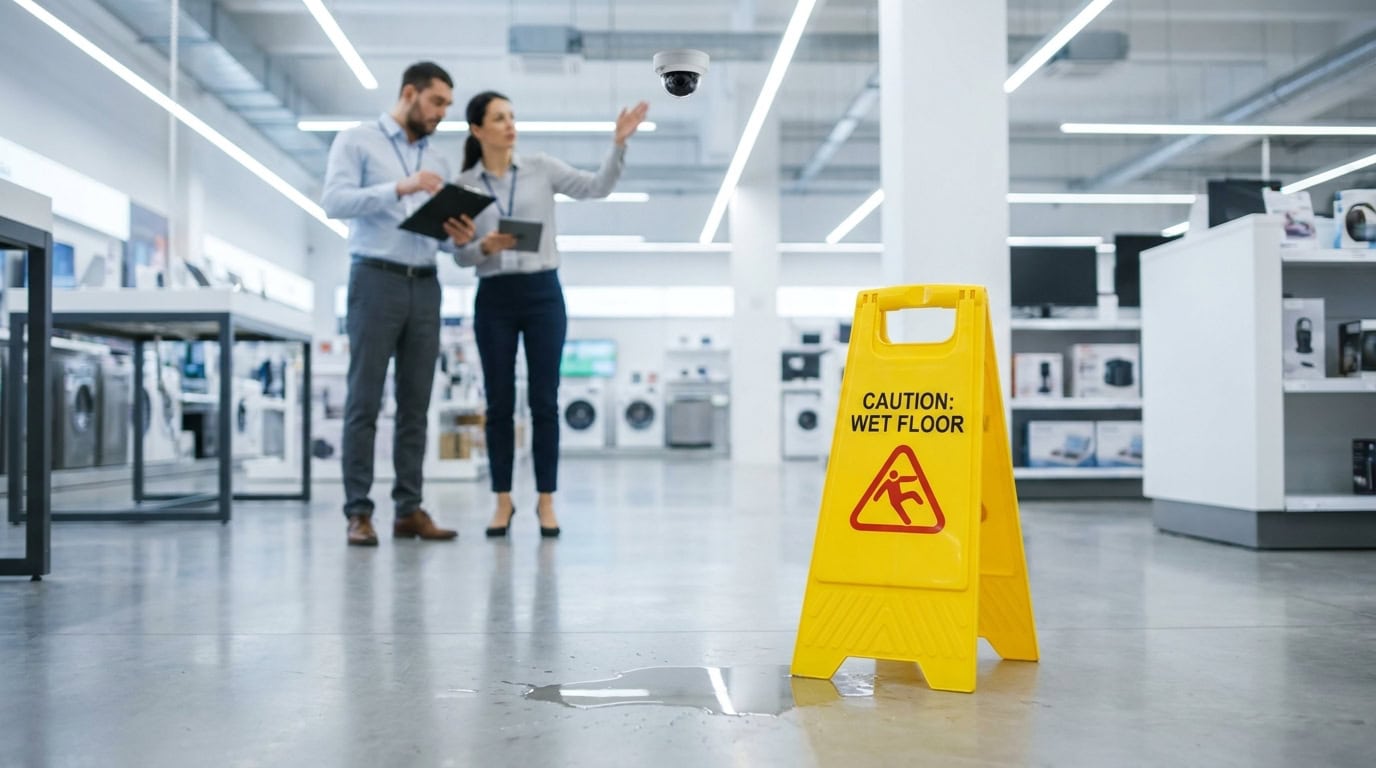
Florida Statute Section 768.0755 and Premises Liability
Under current statutes, simply falling and suffering a severe injury on commercial property doesn't automatically make the business liable for your medical bills. You must actively prove that the business had prior knowledge of the hazardous condition that caused the accident. The strict requirement serves as a legal gatekeeper, making it difficult for plaintiffs to recover damages without evidence of negligence.
What is a Transitory Foreign Substance?
A transitory foreign substance is defined under Florida case law as any liquid or solid item that is located in a place where it doesn't belong. Such hazards include any temporary or unexpected substance on a walking surface that may cause a person to trip or fall unexpectedly. Common retail examples include:
- Spilled juice in a grocery aisle
- A dropped grape in the produce section
- Melted ice near a self-serve soda fountain
- Solid objects, such as clothing not on the rack
- Fruits and vegetables dropped on the floor
The transitory nature of these hazards is precisely why Florida law requires proving notice before a business can be held responsible. Since a business cannot realistically prevent a customer from dropping a bottle in real time, the law focuses on how the store responds once the hazard exists. Liability is triggered only when a store fails to address a mess that it already knew about or should have discovered through reasonable care.
The Legal Definition of a Business Invitee
Retail shoppers are classified under Florida law as business invitees. Because the business benefits from the customer's presence, the property owner owes these visitors the highest duty of care. This ongoing obligation requires store owners to maintain the premises in a reasonably safe condition by regularly inspecting for hazards. If a dangerous condition is found and cannot be resolved immediately, the business must warn customers using clear signage or barriers.
What Is Actual Notice under Florida Law?
Under Florida premises liability law, actual notice represents the most direct and unambiguous form of knowledge a business can have regarding a dangerous condition. It exists when the business establishment or its employees have direct, documented awareness of a hazard before an accident occurs.
Proving actual notice eliminates the need for circumstantial arguments because it establishes that the store was fully aware of the danger and failed to act. This type of notice is often considered the most straightforward method of establishing liability because it removes the need for circumstantial arguments.
Examples of Actual Notice in a Retail Environment
If a retail employee actively creates a hazard, such as spilling cleaning chemicals or leaving an unmarked mop bucket in a high-traffic aisle, the store immediately has actual notice. The employee's direct role in creating the condition establishes clear negligence.
There are also many scenarios where an employee directly witnesses a hazard but fails to act quickly enough to prevent an injury. For example, a cashier might see a customer drop a bottle of olive oil, shattering it on the tile floor. If that employee walks away to grab cleaning supplies without first blocking off the area, the store is on actual notice of the danger. Failure to guard the spill while seeking supplies constitutes a breach of the duty of care.
A third common scenario involves a report from another shopper or a third party who informs the store about a dangerous condition. If a customer tells a manager that there's a puddle of water near the restrooms, the store has received immediate actual notice. If the manager fails to send someone to dry the floor or mark the area, they're knowingly allowing a hazard to exist. This knowing inaction significantly strengthens your legal position during settlement negotiations or trial.
High-Value Evidence for Proving Actual Notice
Weinstein Legal Team's Florida personal injury lawyers seek specific types of direct evidence to establish that a retail store had actual notice of a hazard. Video evidence provides a timestamped, objective record of a hazard. For example, in previous cases against major grocery chains, footage has successfully captured employees looking directly at a spill and walking past it without taking action, or even creating the mess themselves. Presenting this type of indisputable evidence forces the defense to re-evaluate their liability.
When Weinstein Legal Team represents slip and fall victims across Florida, we immediately look for direct evidence that demonstrates store employees had real-time awareness of the hazard. In our practice, this often involves dissecting retail surveillance footage minute by minute. We look for specific behavioral cues, such as an employee glancing at the floor, stepping around a wet spot, or altering their walking path, which directly indicate they recognized the hazard yet chose not to remedy it or warn customers.
Verbal admissions made by store staff immediately after a fall can also serve as powerful evidence in a premises liability claim. If an employee rushes to you and says they told someone to clean that up 10 minutes ago, they've admitted to actual notice. These statements are often recorded in witness statements or noted by the injured person. We use these admissions to establish the store's prior awareness and failure to act.
Internal store records provide another layer of high-value evidence that an attorney will pursue during a case. An incident report filled out by a manager might inadvertently include a detail admitting they were aware of a leak before the accident. Written work orders or maintenance requests submitted hours before the fall can also prove the store knew a specific area was dangerous.
What Is Constructive Notice under Florida Law?
Constructive notice is the legal principle that a business owner should have known about a hazard through the exercise of ordinary, reasonable care. Since retail workers rarely admit they knew about a mess, you will likely have to prove constructive notice. You do not need a smoking gun showing an employee staring at a spill. The law holds the store responsible if a routine floor sweep or inspection would have caught the danger.
The Passage of Time Standard (Florida Statute § 768.0755(1)(a))
Under Florida Statute Section 768.0755(1)(a), you can establish constructive notice by showing that the hazard existed for such a length of time that the business should have discovered it in the exercise of ordinary care. Florida appellate courts strictly enforce this timeline. For instance, in the landmark case of Oliver v. Winn-Dixie Stores, Inc., 291 So. 3d 126 (Fla. 4th DCA 2020), the court affirmed that the burden remains on the plaintiff to produce concrete evidence of how long a substance was on the floor. Without specific facts indicating the passage of time, the court will dismiss the case, reinforcing that the mere presence of a hazard is never enough to prove constructive notice.
Florida courts consider whether the store had a reasonable opportunity to conduct sweeps or floor checks while the substance was present. If a grocery store ignores a high-traffic area for two hours, a 40-minute-old spill falls straight into constructive notice territory. Leaving a hazard unattended for a prolonged period constitutes negligence. Our attorneys routinely subpoena timestamped surveillance video to definitively establish how long a spill sat ignored by staff.
Environmental Clues: Physical Attributes of the Hazard
The physical condition of a transitory foreign substance can provide essential circumstantial evidence of duration, but Florida law requires careful handling of these clues to avoid 'inference stacking.' Under Florida case law, such as McCarthy v. Broward College, 164 So. 3d 78 (Fla. 4th DCA 2015), courts prohibit plaintiffs from piling one assumption upon another. For example, you cannot argue that water was dirty solely because it was on the floor a long time unless you have a 'plus' factor, such as physical track marks, dried edges, or clear footprints running through the spill. As practitioners, we must establish these physical 'plus' factors through high-resolution photography and witness statements to ensure the evidence is legally admissible.
Producing items in a grocery store can also provide physical proof of how long a hazard has existed. A blackened, squashed banana peel or a dried, crusty fruit spill indicates the item was dropped long before you arrived. Because fruit does not rot or dry out instantly, these structural changes establish a timeline that directly refutes the store's assertion of a fresh spill. This objective, physical evidence demonstrates that the hazard was present long enough for a reasonably attentive employee to have discovered and removed it.
The Regular Occurrence Standard (Florida Statute § 768.0755(1)(b))
You can also establish constructive knowledge under Florida Statute Section 768.0755(1)(b) through the regular occurrence standard. This rule applies if a dangerous condition occurs with such regularity that it's entirely foreseeable to the business owner. If a specific hazard is a known and recurring problem, the store is expected to take proactive measures to prevent injuries. This duty exists regardless of whether they knew about the specific spill that caused your fall.
In our practice, we frequently encounter recurring hazards involving faulty commercial refrigeration units. If maintenance logs show a history of work orders for a leaking freezer case, the store has constructive knowledge that water will accumulate. Absent permanent warning signs, absorbent mats, or immediate repairs, the store remains liable for subsequent falls. Other predictable hazards we routinely litigate include overspray from produce misting systems and tracked-in water at store entrances during Florida's heavy afternoon rainstorms.
Proving a regular occurrence requires examining the historical records for the specific store location and its equipment. However, Florida courts interpret this standard strictly. It is not enough to show that a machine leaked once or twice in the past. To establish a regular occurrence under Section 768.0755(1)(b), you must show a consistent, predictable pattern of failure, such as a refrigeration unit that leaks every afternoon due to a known, unaddressed defect. We systematically subpoena past maintenance records, internal repair requests, and prior slip-and-fall incident reports from the exact same location to build a mathematically and legally sound pattern of foreseeability that can withstand aggressive defense challenges.
Notice Requirements for Specific Retail Environments: Grocery Stores vs. Big-Box Retailers
The legal standard for reasonable care in discovering a hazard varies based on the type of retail environment and its foot traffic. We analyze the store's specific risk profile to determine if their inspection frequency met the necessary legal threshold:
- High-volume grocery stores drop and spill product constantly in the produce and cleaning aisles, so courts expect frequent floor sweeps. In a busy supermarket, a hazard left unattended for 10 minutes can be enough to establish constructive notice.
- Big-box retailers and warehouse clubs have wide floor plans and high shelving that make hazards harder to spot, and their heavy machinery adds risks of its own, such as leaked hydraulic fluid or dropped pallet debris.
- Small boutiques with light hourly foot traffic carry a smaller inspection burden than a retail giant, but they still need a safety routine that fits their size.
How the Discovery Phase Uncovers Evidence of Store Knowledge
The slip-and-fall discovery phase of a lawsuit is the stage in which the critical evidence needed to prove notice is formally obtained from the defendant. Retail corporations and big-box stores are often highly protective of their internal data, video footage, and employee records. This makes the formal discovery process, guided by an experienced attorney, essential to uncovering the truth. Hiring a personal injury attorney ensures you have a professional who can navigate these corporate-funded defense teams.
Demanding and Preserving Surveillance Footage
Retail security camera footage is among the most vital evidence in a slip-and-fall case, but it's also the most fragile. Many stores routinely overwrite or delete their surveillance footage within days of an incident as part of their standard data management. If this footage is lost, it becomes much harder to prove how long a spill was on the floor. We act quickly to ensure this evidence is preserved before it disappears forever.
To prevent this loss, a lawyer sends an immediate spoliation letter to the store and its corporate headquarters. This document legally requires the business to retain all video footage from the hours leading up to and following the fall. If a store ignores this letter and deletes the footage anyway, they can face severe legal penalties. This may include a jury instruction allowing the court to assume that the missing video would've been unfavorable to the store.
Subpoenaing Maintenance Logs and Corporate SOPs
Maintenance logs, sweep sheets, and restroom inspection records are frequently used to build the timeline for a slip-and-fall case. Stores use these logs to argue that they conduct regular inspections and that the floor was clean. However, a careful examination of these documents often reveals that employees skipped scheduled sweeps or filled out the logs all at once. Proving a gap in these logs directly supports a claim of constructive notice.
We also analyze Corporate Standard Operating Procedures (SOPs) as a primary tool in litigation. If a store's manual requires a sweep every 15 minutes, but the records show they only sweep every 30, they've breached their own standard of care. This internal failure is a powerful argument for constructive notice. We cross-reference payroll records with these logs to determine if the store was understaffed at the time of your accident.
Depositions: Questioning Store Employees and Managers under Oath
A deposition is an out-of-court oral testimony given under oath that's transcribed for use during a trial. This process allows a personal injury attorney to question cashiers, stockers, and managers about the day of the incident. These sessions are designed to reveal facts that aren't written down in reports. We ask about safety training, staffing levels, and whether they were aware of chronic equipment leaks.
During a deposition, an attorney can often find inconsistencies in the stories told by different staff members. One employee might claim the floors were swept five minutes before the fall, while another might admit they were too busy to check the aisles. These admissions are vital for proving that the store was on notice of the potential for hazards. We use these sworn statements to dismantle the store's "lack of notice" defense.
Overcoming Retail Store Defenses in Florida
Retail corporations employ corporate-funded defense teams specialized in premises liability litigation to escape liability. These attorneys are trained to minimize the store's responsibility by arguing that the hazard was your fault. Understanding these defenses is the first step in building a case that can survive a motion for dismissal. We anticipate these tactics and build your evidence to counter them from day one.
The Open and Obvious Doctrine
The open and obvious defense is a common tactic where the store argues that a hazard was so visible that any reasonable person should have avoided it. If a spill is large or brightly colored, the defense will claim you were negligent for not looking where you were walking.
Defense teams use this doctrine to suggest that the store had no duty to warn you because the danger was already apparent. However, under Florida law, an open and obvious condition may discharge the property owner's duty to warn you, but it does not discharge their duty to maintain the premises in a reasonably safe condition. Even if a spill is highly visible, the landowner can still be held liable for failing to clean it up.
Our team counters this defense by demonstrating that a shopper's attention is naturally drawn away from the floor. Stores spend millions of dollars on eye-level product displays and marketing signs designed to capture a customer's gaze. Because the retail environment is intentionally designed to keep people from looking at their feet, a floor hazard is rarely truly obvious. We argue that the store's own marketing contributed to the distraction that led to the fall.
Modified Comparative Negligence in Florida (The 51% Rule)
Florida follows a modified comparative negligence standard, which means your compensation can be reduced based on your own percentage of fault. House Bill 837, effective March 24, 2023, moved Florida from a pure comparative negligence state to a modified comparative negligence state. The new bar applies to cases filed after that date, including some falls that happened earlier. Under Florida Statute 768.81, if you're found to be more than 50% at fault, you're legally barred from recovering any damages.
This 51% rule makes it a priority for the defense to shift as much blame as possible onto you. They may use your cell phone records or footwear choices to argue that you weren't exercising reasonable care. We protect your claim by presenting evidence that the store's negligence was the primary cause of the accident. Our goal is to keep your fault assignment well below the 50% threshold to ensure you remain eligible for recovery.
Lack of Notice Defense
The lack-of-notice defense is the most frequently invoked argument in Florida slip-and-fall cases. The store will claim that the hazard was created by another customer mere seconds before you fell. By arguing they had no opportunity to remedy the situation, the store tries to bypass the requirements of actual and constructive notice. The strategy aims to convince the jury and insurance adjusters that the store was not negligent because the accident was unavoidable.
We counter this defense by using digital forensics, video timestamp analysis, and the substance's physical characteristics. If the video shows no one in that aisle for fifteen minutes before the fall, the store's claim that the spill was fresh is disproven. By establishing a clear timeline, we trigger the constructive notice standard and hold the business accountable. Section 768.0755 provides the legal framework we use to demonstrate the store's failure to maintain safe premises.
What Damages Can You Recover After Proving Notice?
Once you successfully establish that a property owner had actual or constructive notice of a hazard, you can pursue compensation for the full extent of your losses. Recoverable damages in Florida premises liability claims typically include economic losses, such as emergency room bills, ongoing physical therapy costs, and lost wages from missed work. You may also seek non-economic damages to compensate for the pain, emotional distress, and loss of enjoyment of life caused by your injuries.
Speak To Weinstein Legal Team About Your Injury Claim
Florida's strict notice requirements mean that waiting to act after a slip and fall severely limits your ability to recover damages. There is also a hard filing deadline. Under Section 95.11(5)(a), a negligence claim that accrued on or after March 24, 2023 must be filed within two years of the fall. A claim that accrued before that date still runs on the old four-year period. Essential evidence, like timestamped surveillance footage and internal sweep logs, is routinely purged by corporate retailers within days of an incident. If you were injured on commercial property, securing legal representation immediately allows us to send the necessary preservation letters and lock down the records required to meet the legal burden of proof.
Weinstein Legal Team advocates for injury victims across Florida. We push back against the aggressive tactics that big-box stores and insurance companies use to avoid paying fair claims. Our team works tirelessly to uncover the truth through the discovery process, ensuring that every piece of evidence supports your case. Contact us today for a free case review and let us build the evidence-based strategy you need to secure the compensation you deserve across the State of Florida.