
- NHTSA recognizes only three standardized field sobriety exercises: Horizontal Gaze Nystagmus, Walk-and-Turn and One-Leg Stand. All three are graded on the officer's visual judgment, and research shows up to 46 percent of sober people can show clues of impairment on them.
- Multiple Sclerosis and Parkinson's Disease cause muscle weakness, tremors and impaired coordination that an officer records as swaying, stumbling or a stiff gait, none of which the driver can control at the roadside.
- Inner ear conditions such as vertigo, Meniere's Disease and labyrinthitis disrupt the vestibular system, and an attack can make it impossible for a sober driver to hold balance during the One-Leg Stand or to keep the eyes tracking during the eye test.
- Diabetic hypoglycemia produces confusion, dizziness and loss of balance, and ketoacidosis produces a fruity breath odor an officer can mistake for alcohol. Continuous glucose monitor data can show a driver's blood sugar minute by minute during the stop.
- Field sobriety exercises sit outside Florida's implied consent law, so a driver may decline them with no license suspension and no criminal charge. The breath or urine test after a DUI arrest is different: a first refusal suspends the license for one year and, under Florida Statute 316.1939 as amended by chapter 2025-121, is also a second-degree misdemeanor punishable by up to 60 days in jail and a $500 fine.
Law enforcement officers in Florida often rely on Standardized Field Sobriety Tests (SFSTs) to build DUI cases. These roadside exercises require significant physical coordination and mental focus that many people lack even when sober.
Research shows that many factors can influence these results. Understanding the mechanics of these tests is the first step toward building a physical disability DUI defense against unfair accusations.
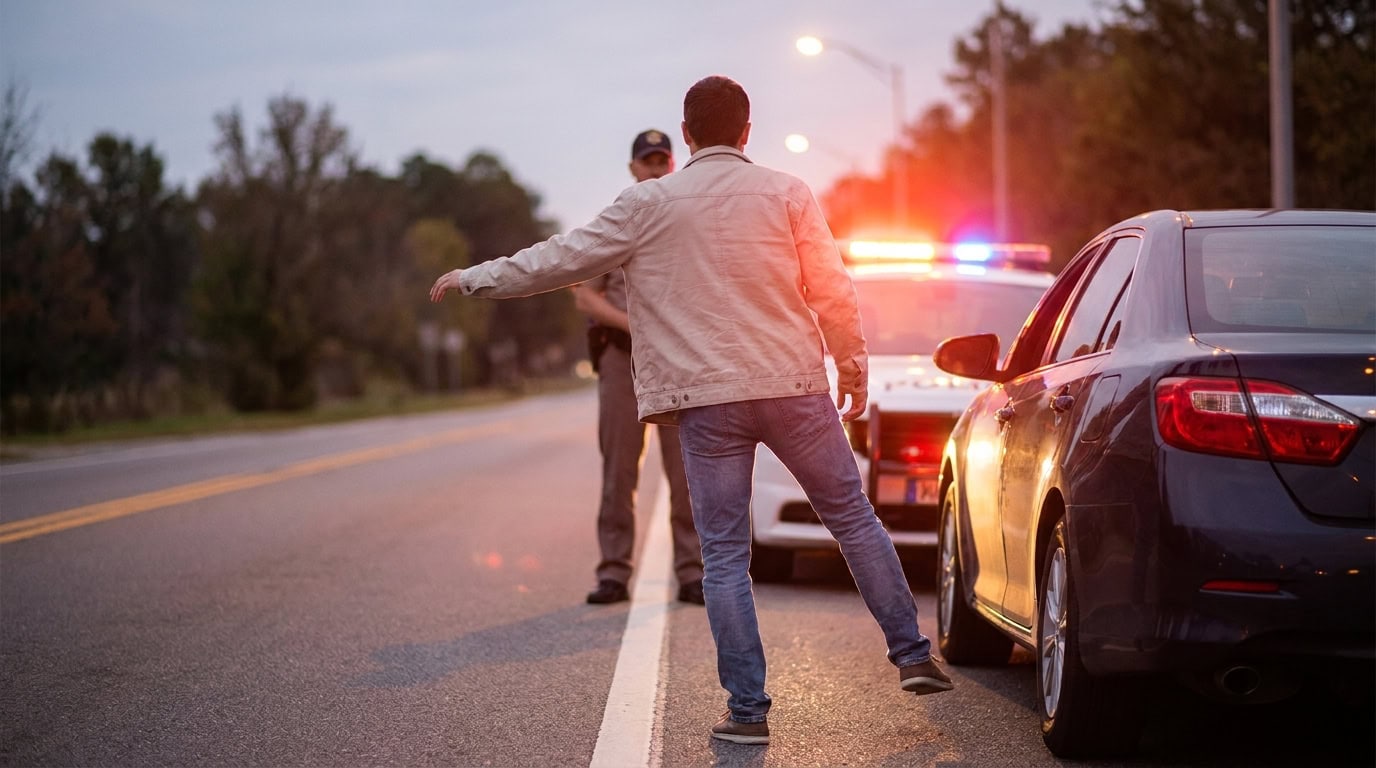
The Difference Between Standardized and Non-standardized Field Sobriety Tests
Most drivers assume that any exercise a police officer requests is a valid scientific assessment. In reality, the National Highway Traffic Safety Administration (NHTSA) only recognizes three specific exercises as standardized. These are the Horizontal Gaze Nystagmus, the Walk-and-Turn, and the One-Leg Stand tests.
Officers frequently use non-standardized field sobriety tests to gather more evidence for an arrest. These can include touching your finger to your nose, reciting the alphabet backward, or counting fingers. These exercises have no scientific validation and are not supported by NHTSA research. They rely entirely on the officer's personal opinion of what constitutes "normal" behavior.
Using non-standardized field sobriety tests often leads to highly inaccurate results. Since there's no set grading criteria, an officer might count any slight hesitation as a sign of drug or alcohol use. The absence of a standardized grading system makes it nearly impossible for a driver to "pass" in the eyes of a suspicious officer. Defense attorneys often challenge these results because they don't meet the legal requirements for established scientific evidence.
Understanding the Subjective Nature of Standardized Field Sobriety Tests (SFSTs)
Standardized tests are designed to help officers identify drivers who may be over the legal limit. In Florida, police use a battery of three specific exercises to establish probable cause for a DUI arrest. Even though these tests have specific instructions, the final grade is based on the officer's visual judgment.
Challenging field sobriety tests is a common strategy in criminal defense because the tests are difficult for the general public. The tests are hard for many sober people, and nerves, footwear, weight, age, and injury all change the result. That is why a failed exercise is not proof of impairment.
Officers are trained to look for minute "clues" that they believe indicate a high blood alcohol concentration. However, these clues are often caused by nerves, poor lighting, or high-stress environments. When an officer doesn't account for these factors, they may incorrectly assume that a lack of balance is proof of a crime. Relying on an officer's personal judgment can lead to a permanent criminal record for an innocent person.
The Walk-and-Turn Test (WAT)
The Walk-and-Turn test is a divided-attention exercise that requires a driver to take nine heel-to-toe steps along a straight line. The individual must keep their arms at their sides and count each step aloud throughout the exercise. After the ninth step, they must turn in a specific manner and return in the same way. The Walk-and-Turn exercise forces the brain to handle physical movement and mental counting simultaneously.
Officers look for eight specific clues to determine if a driver is impaired. These include losing balance during instructions, starting too soon, or missing heel-to-toe contact. Other indicators are stepping off the line, using arms for balance, or taking an incorrect number of steps. If an officer observes just two of these clues, they will likely proceed with an arrest.
Success in this test requires a degree of motor coordination that exceeds the requirements for standard vehicle operation. Many drivers struggle with these movements because the roadside environment is rarely ideal for balancing. Uneven pavement and passing traffic can make the heel-to-toe movement difficult for anyone. When these external factors combine with common physical ailments, the chance of a false positive increases.
The One-Leg Stand Test (OLS)
The One-Leg Stand test measures balance and divided attention under high-stress conditions. In this test, the individual is told to stand on one leg with the other foot held six inches off the ground. They must keep their eyes on the elevated foot and count aloud until the officer tells them to stop. The balancing phase of the One-Leg Stand usually lasts for thirty seconds, which is a long time for someone with physical limitations.
There are four primary criteria for failure that officers monitor during this exercise. They watch to see if the driver sways while balancing or uses their arms to maintain equilibrium. Hopping to stay upright or putting the foot down before the thirty seconds are up are also counted as clues. For many people, standing still on one leg is difficult, even in a controlled environment.
The One-Leg Stand is particularly grueling for anyone with lower-body issues or chronic pain. The NHTSA acknowledges that certain biological factors can lead to poor performance regardless of sobriety. For instance, individuals who are significantly overweight may have natural difficulty with balance. These demographic factors are frequently ignored by officers who are focused on identifying clues of intoxication.
Horizontal Gaze Nystagmus (HGN) Test
The Horizontal Gaze Nystagmus test is often referred to as the "eye test" by law enforcement. During this procedure, an officer holds a stimulus, such as a pen or flashlight, about 12 inches from the driver's face. The officer moves the stimulus slowly from side to side while watching the eyes for signs of nystagmus. Nystagmus is an involuntary jerking or twitching of the eyeball that can be enhanced by alcohol.
As the officer conducts the test, they look for three specific clues in each eye. They check whether the eye can follow the stimulus smoothly or jerk as it moves. They also look for distinct nystagmus when the eye is held at maximum deviation and whether the jerking starts before the eye reaches a 45-degree angle. If the officer sees four or more clues, they will use them as evidence of impairment.
While the HGN test is considered scientific, it's highly susceptible to false triggers from medical conditions. The eyes are sensitive to many factors unrelated to intoxication. Neurological issues, inner ear problems, and even common medications can cause the eyes to jerk involuntarily. These non-alcohol-related factors make the HGN test a potentially unreliable indicator of a driver's actual sobriety.
Neurological Conditions and Their Impact on Coordination
The human brain and nervous system control every movement required to complete field sobriety tests. When a person is asked to walk a straight line, their brain must send clear signals to their muscles. Any disruption in these pathways can manifest as physical symptoms that an officer will mistake for impairment. This often leads to an arrest where a physical disability DUI defense is necessary to explain why the driver appeared impaired.
Multiple Sclerosis and Parkinson's Disease
Degenerative neurological diseases like Multiple Sclerosis (MS) and Parkinson's Disease severely impact motor skills. Multiple sclerosis causes muscle weakness and impaired coordination. A driver with MS might struggle to maintain balance during the Walk-and-Turn test because their nerves aren't transmitting signals properly. Their stumbling or swaying is a result of their condition, not the consumption of alcohol.
Parkinson's Disease presents similar challenges because it often causes tremors and muscle rigidity. A person with Parkinson's may have a stiff gait that an officer interprets as a sign of being drunk. They might also have difficulty following instructions if the disease has affected their cognitive processing speeds. These symptoms are involuntary and cannot be corrected by the individual during a roadside stop.
In both of these conditions, the physical clues an officer looks for are manifestations of a serious medical issue. An officer might report that a driver was fumbling, unaware that the driver has Parkinson's. These involuntary movements often result in a sober person being penalized for a disease they cannot control. A strong defense strategy focuses on these medical realities to challenge the prosecution's narrative.
Peripheral Neuropathy and Sensory Impairment
Peripheral neuropathy affects the nerves outside the brain and spinal cord, often resulting from diabetes. It frequently causes numbness or a pins-and-needles sensation in the hands and feet. For a driver, this lack of sensation makes it extremely difficult to feel the ground while walking. Losing sensation in the extremities is a critical problem for the Walk-and-Turn test, which requires precise heel-to-toe contact.
When a person can't feel their feet properly, they lose the sensory feedback needed for balance. They might stumble or step off the line because their brain isn't receiving correct information about foot placement. An officer watching from a distance may only see the stumbling and assume it's due to alcohol. They don't see the underlying nerve damage that's actually causing the lack of coordination.
This sensory impairment also affects the One-Leg Stand test, as balance relies on feeling the pressure of the foot. If a driver has peripheral neuropathy, they may sway or put their foot down frequently to avoid falling. These are standard clues for intoxication in a police report, but they're actually symptoms of a chronic condition. Without the proper medical context, these symptoms lead to wrongful arrests and unfair legal battles.
Post-Concussion Syndrome and Traumatic Brain Injury (TBI)
Traumatic Brain Injuries (TBI) and post-concussion syndrome can leave lasting effects on balance and eye movements. A TBI can cause permanent nystagmus, which is the exact involuntary jerking that officers look for during the HGN test. If a person has a history of head injuries, they might fail the eye test every time. A history of head trauma creates a false positive that is difficult to overcome without medical documentation.
Even if a person feels fine in their daily life, the intense focus required during a roadside test can trigger latent neurological deficits. The stress of being pulled over, combined with the demand for divided attention, can cause a TBI survivor to struggle. They might show signs of confusion or have difficulty following complex instructions. These are common symptoms of a past brain injury that mimic the cognitive effects of alcohol.
Defense attorneys often look into a client's medical history to see if a past accident caused a failed test. A neurologist can provide testimony that explains how a specific brain injury affects a person's ability to perform. Neurological testimony is how the defense shows that the officer's observations were not proof of impairment. It helps the court understand that the clues were symptoms of a pre-existing neurological condition.
Inner Ear Disorders and Balance Issues
The vestibular system in the inner ear serves as the body's primary center for maintaining balance. When this system is compromised by illness, a person's ability to stand on one leg is severely diminished. These inner ear balance issues can make a sober person look incredibly impaired to an untrained officer. The results of balance tests become meaningless when the driver's internal gyroscope isn't functioning correctly.
Vertigo and Meniere's Disease
Vertigo and Meniere's Disease cause significant disruptions to a person's sense of balance. Vertigo is characterized by a sensation that the world is spinning or tilting, even when the person is standing still. Meniere's Disease is a chronic condition that involves episodes of vertigo, ringing in the ears, and hearing loss. Both conditions can strike suddenly, making it impossible to maintain equilibrium during a roadside stop.
A sudden attack of vertigo can make a person appear highly intoxicated during the One-Leg Stand test. They might sway violently or even fall over because their brain is receiving false signals about their position. These symptoms are internal and completely invisible to the observing officer. To the police, the driver looks like they're struggling due to alcohol, when they're actually suffering from a medical episode.
Even chronic, mild vertigo can interfere with the precision required for standardized field sobriety tests. A driver might not feel as if the room is spinning, but they may still experience a slight lack of stability. Since these conditions are not always documented with obvious external signs, they're frequently overlooked during a DUI investigation. Because symptoms are not externally apparent, it is easy for an officer to jump to the wrong conclusion.
Labyrinthitis and Vestibular Neuritis
Labyrinthitis and vestibular neuritis involve inflammation of the inner ear or the nerves connecting it to the brain. These conditions often follow a cold or flu and can cause sudden, severe balance issues. Labyrinthitis can trigger involuntary eye jerking, which may be observed during a roadside investigation. These symptoms can last for several weeks, making it difficult for the person to pass a physical coordination test.
During an HGN test, an officer might notice that the driver's eyes are jerking or unable to follow the stimulus. This is a common symptom of inner ear inflammation, but the officer will likely record it as a sign of alcohol. The driver may also stumble during the Walk-and-Turn because their vestibular system is sending erratic signals. Their physical movements look drunk to an untrained observer, but they're actually the result of an infection.
A driver suffering from a temporary ear condition faces significant legal risk when symptoms are misinterpreted as criminal impairment. They might try to explain their symptoms, but their words are often dismissed as excuses for poor performance. Without the help of a legal team that understands these nuances, a medical emergency could turn into a permanent criminal record. Challenging the results based on these conditions is a key part of a strong defense.
Orthopedic Injuries and Physical Limitations
Many people live with chronic pain or structural damage to their limbs that directly interferes with physical agility. Roadside tests require a level of athleticism and flexibility that a large portion of the population doesn't possess. An old sports injury or a degenerative joint condition can make it impossible for a driver to meet strict requirements. When an officer ignores these physical limitations, the resulting failure is a reflection of health rather than sobriety.
Chronic Knee, Hip, and Back Injuries
Chronic orthopedic issues, such as ACL tears or hip dysplasia, significantly affect a person's performance on the Walk-and-Turn test. This exercise requires a specific heel-to-toe movement that puts immense strain on the knees and hips. If a driver has a limited range of motion, they may be unable to touch their heel to their toe. An officer will count each of these misses as a clue of impairment, even if the person is physically unable to do it.
Chronic back pain is another major factor that can cause a person to sway or use their arms for balance. Herniated discs impair physical balance by disrupting spinal stability. When the back is compromised, the body naturally tries to compensate by shifting weight or using arms for balance. These are both considered signs of intoxication in an officer's report, even though they're actually survival mechanisms for someone in pain.
These orthopedic conditions often involve flares where the pain and stiffness are worse than usual. If a driver is stopped during a flare, their performance on the One-Leg Stand will be compromised. They might have to put their foot down frequently to relieve the pressure on their back or hips. To the officer, this looks like a lack of balance caused by alcohol, but it's a necessary response to physical agony.
Defense attorneys can use medical records to show that these clues resulted from a documented condition. If a driver is under the care of a spine specialist, that evidence carries real weight in court. It provides a logical, medical explanation for why the person couldn't perform the requested tasks. This helps to neutralize the officer's testimony and shows that the arrest was based on a misunderstanding.
The Impact of Recent Surgeries on Mobility
Individuals who are recovering from surgery are often not physically capable of performing a stress test. Even if a person has been cleared to drive, they may still have lingering weakness or a limited range of motion. The SFSTs require a level of balance and strength that far exceeds what's needed to operate a vehicle safely. A person who can drive a car without issue might still fail a roadside test due to a recent operation.
Surgical hardware like pins, plates, or joint replacements can also alter a person's natural gait and limit flexibility. A driver with a replaced hip may never be able to perform the Walk-and-Turn test perfectly. Their body doesn't move as the test requires, leading to clues such as an improper turn. These physical restrictions are permanent and should be taken into account by any officer conducting an investigation.
When an officer fails to ask about recent surgeries, they're missing a critical piece of information. A driver might be wearing a brace or have visible scarring, yet the officer might still insist they perform the tests. Ignoring a driver's recent surgical history can be a powerful point of contention in a DUI case. It shows that the officer was more interested in finding signs of impairment than in conducting a fair assessment.
Demographic Factors and Biological Limitations
A person's physical build and age affect how well they can perform balance-based exercises. The NHTSA guidelines state that individuals who are 50 pounds or more overweight may have difficulty. Excess weight shifts a person's center of gravity and increases stress on the joints during balance tasks. A shifted center of gravity often leads to swaying or to using the arms for balance, both of which are considered signs of intoxication.
Age-related physical decline is also a well-documented factor that influences the results of field sobriety tests. As people age, their natural balance and coordination often diminish, even if they're in relatively good health. The NHTSA suggests that officers should be cautious when testing individuals over the age of 65. However, many officers continue to apply the same strict standards to a senior as they would to a young athlete.
Officers should consider demographic factors such as age and weight before deciding to make an arrest. If an officer ignores these factors, they're likely to get a failed result that doesn't reflect actual sobriety. A defense attorney can highlight these guidelines to show that the test results were biased against the driver. It's a way to demonstrate that the failure was due to biology rather than alcohol consumption.
Eye Conditions and HGN Test False Positives
The HGN test is often the most difficult part of a DUI case to challenge because it appears objective. Officers often present the eye test as definitive proof that a driver is under the influence. However, the human eye is extremely sensitive to a wide range of external and internal factors. There are many eye conditions and environmental influences that can cause nystagmus without the presence of alcohol.
A small percentage of the population has natural nystagmus, which occurs without any chemical or medical influence. These individuals have eyes that naturally jerk, meaning they'll fail the HGN test every time they're stopped. If an officer isn't aware of this, they'll mistakenly record these movements as proof of intoxication. The prevalence of natural eye twitching is why a defense team needs to investigate a client's prior eye health records.
HGN test false positives can also be caused by specific medications like Lithium or certain anti-seizure drugs. These prescriptions can cause the eyes to jerk even if the driver hasn't consumed any alcohol. Fatigue and eye strain from long-distance driving can also interfere with the results. A driver who has been on the road for ten hours might fail the eye test simply because their eyes are exhausted.
Vision issues such as strabismus, commonly known as a lazy eye, can severely skew the results. If one eye doesn't track at the same speed as the other, the officer will see the lack of coordination as a sign of drug use. Significant differences in vision between the two eyes can also cause the brain to struggle with following a stimulus. These conditions are structural and have nothing to do with the driver's current state of sobriety.
Metabolic and Systemic Conditions
Some medical emergencies look exactly like alcohol intoxication to an untrained eye, which leads to dangerous misunderstandings. When a person is experiencing a metabolic crisis, they may be confused, dizzy, and physically uncoordinated. These systemic issues affect both the physical balance tests and the driver's mental state. An officer who isn't trained to recognize medical emergencies may see a driver in distress and assume they're just too drunk.
Diabetes, Hypoglycemia, and Hyperglycemia
The relationship between diabetes and DUI investigations is complex and often leads to wrongful arrests. Low blood sugar, known as hypoglycemia, can cause symptoms that are nearly identical to alcohol impairment. A person experiencing a sugar crash may be dizzy, confused, and unable to maintain their balance. They might have trouble understanding instructions or appear lethargic, all of which are documented as signs of intoxication.
High blood sugar can lead to a condition called ketoacidosis, which happens when the body starts burning fat for fuel. One of the primary symptoms of ketoacidosis is breath that smells fruity or similar to the scent of alcohol. An officer who smells this on a driver's breath will almost certainly assume the person has been drinking. Ketoacidosis also causes physical symptoms that can lead to failure on every physical test at the roadside.
A person's diabetic history is one of the most important factors in a DUI defense if they were experiencing blood sugar issues. Defense attorneys can use data from a Continuous Glucose Monitor (CGM) to prove the driver was in a metabolic state. CGM data can show a minute-by-minute timeline of a diabetic driver's blood sugar levels during a police interaction. It helps the court understand that the clues were signs of a life-threatening medical condition.
Gastroesophageal Reflux Disease (GERD) and Breathalyzers
Gastroesophageal Reflux Disease (GERD) or acid reflux can influence a DUI investigation in surprising ways. While SFSTs are the primary focus, GERD can contaminate subsequent breathalyzer tests. Stomach acid and undigested alcohol gases can rise into the esophagus, which may cause a breathalyzer to register a much higher reading. This is known as mouth alcohol and can lead to a false reading above the legal limit.
Beyond the breath test, the physical discomfort of acid reflux can be a major distraction during field sobriety tests. A driver experiencing chest pain may not be able to fully focus on the officer's instructions. They might be fidgety or have trouble standing still for the One-Leg Stand because they're in physical distress. An officer can misinterpret this lack of focus as a sign of being under the influence.
Florida Environmental Factors and the Right to Refuse
The environment on a Florida roadside can create significant obstacles for any driver. Intense heat and high humidity can cause physical exhaustion and dizziness during a traffic stop. Sudden afternoon rainstorms often leave pavement slick and uneven, making balance tests nearly impossible to perform. An officer might ignore these conditions, but they directly affect whether a driver can stay steady.
Many drivers don't realize that they can decline field sobriety exercises in Florida. The roadside exercises sit outside Florida's implied consent law, so declining them brings no license suspension and no charge for the refusal itself, though the officer can still arrest on other evidence and, under State v. Taylor, 648 So. 2d 701 (Fla. 1995), a prosecutor can tell the jury you refused. The breath or urine test after a DUI arrest is a different matter. Refusing that one suspends your license for a year on a first refusal, and under Florida Statute 316.1939, as amended by chapter 2025-121, a first refusal is also a second-degree misdemeanor punishable by up to 60 days in jail and a fine of up to $500. You can politely decline to perform the exercises if you have a medical condition or physical injury. Declining the tests prevents the officer from gathering subjective "clues" that they will use against you in court.
Declining these tests is often a smart move if you know your physical health will prevent you from performing at your best. The state uses the results of these tests to justify a DUI charge and eventual prosecution. By exercising your right to refuse, you limit the amount of observational evidence the state can use. A defense attorney can then focus on the lack of probable cause for the initial arrest.
The Americans with Disabilities Act and Roadside Investigations
The Americans with Disabilities Act (ADA) provides protections for individuals with physical and mental impairments in all areas of public life. This includes interactions with law enforcement and the conduct of criminal investigations. Florida law enforcement has a duty to ensure that individuals with disabilities are not discriminated against during a traffic stop. If a driver informs an officer of a disability, the officer should consider whether standard tests are appropriate.
In many cases, an officer's failure to provide accommodations can be a violation of the driver's civil rights. For example, forcing a person with a prosthetic limb to perform a balance test might be considered discriminatory. A lawyer can argue that the officer should have used alternative methods to evaluate sobriety that didn't rely on the person's physical disability. This adds a significant layer of defense that focuses on the officer's failure to follow legal protocols.
Anyone with a chronic illness or a physical limitation should understand these rights. The ADA requires that government agencies make reasonable modifications to their practices to avoid discrimination. If an officer ignores a documented disability and proceeds with physical tests, the resulting evidence may be suppressed in court. Invoking the ADA ensures that a person's medical history isn't used as a weapon to secure an unfair conviction.
Challenging Police Observations and Protocol Violations
A defense lawyer will carefully cross-examine the arresting officer to determine if they followed proper procedures. Most police training manuals require officers to screen for medical issues before starting the tests. If the officer failed to ask about or ignored the driver's mention of a bad knee, that would weaken the state's case. Officers must ensure that the test results are valid by accounting for the driver's physical reality.
The attorney will also assess whether the officer's observations align with the physical reality of the driver's condition. For example, if the officer reported bloodshot eyes but the driver has severe allergies, that's a point of contention. By highlighting these inconsistencies, the lawyer can show that the officer was biased and looking for signs of guilt. Highlighting these inconsistencies calls into question the reliability of every observation the officer made during the stop.
Challenging the Results of Field Sobriety Tests in Court
A failed field sobriety test is not a conviction. These tests are merely tools that officers use to justify an arrest, and their results can be challenged. An experienced criminal defense attorney can use medical evidence to dismantle the prosecution's case. They can show that the failure was due to biology and pre-existing conditions rather than alcohol.
Gathering a comprehensive medical history is one of the first steps in building a strong defense against a DUI charge. A defense team can use past diagnoses, MRIs, and doctors' notes to prove a defendant had a pre-existing condition. This evidence can be used to file a motion to suppress because the officer lacked probable cause. If the judge agrees that the arrest was based on a misunderstanding, the entire case might be dismissed.
Medical experts and sobriety test experts are frequently used to challenge the state's narrative in court. A neurologist or an orthopedic surgeon can testify about how a specific condition would lead to the failures in the police report. This expert testimony carries significant weight with a jury and provides a professional perspective on the driver's physical state. It helps to demystify the science behind the tests and shows how easily they can be manipulated.
Experts can also educate the jury on the general limitations and flaws of standardized field sobriety tests. They can point out that these tests were developed under controlled conditions and aren't always reliable on a roadside. An expert might explain how factors like uneven pavement or passing traffic can influence the results for anyone. This provides a counter-narrative that is grounded in science and medicine rather than subjective opinion.
Protect Your Future with an Experienced Florida DUI Defense Attorney
Standardized field sobriety tests are often biased against individuals with medical conditions or physical limitations. These exercises are subjective and often fail to account for each driver's unique health history. If a medical condition led to your DUI arrest, our legal team is ready to review your medical records and build a defense strategy tailored to your specific history. We understand that "failing" a roadside test is often just a reflection of physical health rather than criminal behavior.
The experienced Florida DUI defense lawyers at Weinstein Legal Team provide a dedicated approach to every criminal defense case we handle. Our attorneys will look at every detail, from your past medical records to the specific training of the arresting officer. We fight to secure the best possible outcomes for our clients by exposing the flaws in the state's evidence.
Call us 24/7 at 888.626.1108 to speak with a lawyer about your case right away, or click here to schedule your free case review online.