
- Objective errors in a crash report, such as a wrong vehicle identification number, a misspelled name or the wrong location, are usually corrected once you show the agency a registration card or license. A fault determination is the officer's judgment call and is much harder to change.
- Florida Statute 768.81(6) bars a party found greater than 50 percent at fault for his or her own harm from recovering any damages. The bar applies to actions filed after March 24, 2023, and it does not reach medical negligence claims under chapter 766.
- For a negligence cause of action accruing on or after March 24, 2023, Florida Statute 95.11(5)(a) gives you two years to file suit. A claim that accrued before that date keeps the old four years.
- If an officer will not revise the report, you can have a supplemental statement attached to the file or file FLHSMV Form 90011S, the Driver Report of a Traffic Crash, so your account sits in the state record alongside the officer's.
- An independent investigation using an event data recorder download, cell phone records and an accident reconstruction expert is often what it takes to challenge an officer's fault determination.
If the crash report is wrong you can get the record corrected, and a wrong report does not end your claim. Contact the agency that wrote it, give the officer documentary proof of the error, and where the officer will not change a judgment call, file your own written statement so the file carries both accounts. Errors are common for an ordinary reason: the officer arrives after the crash and is working a scene he needs to clear.
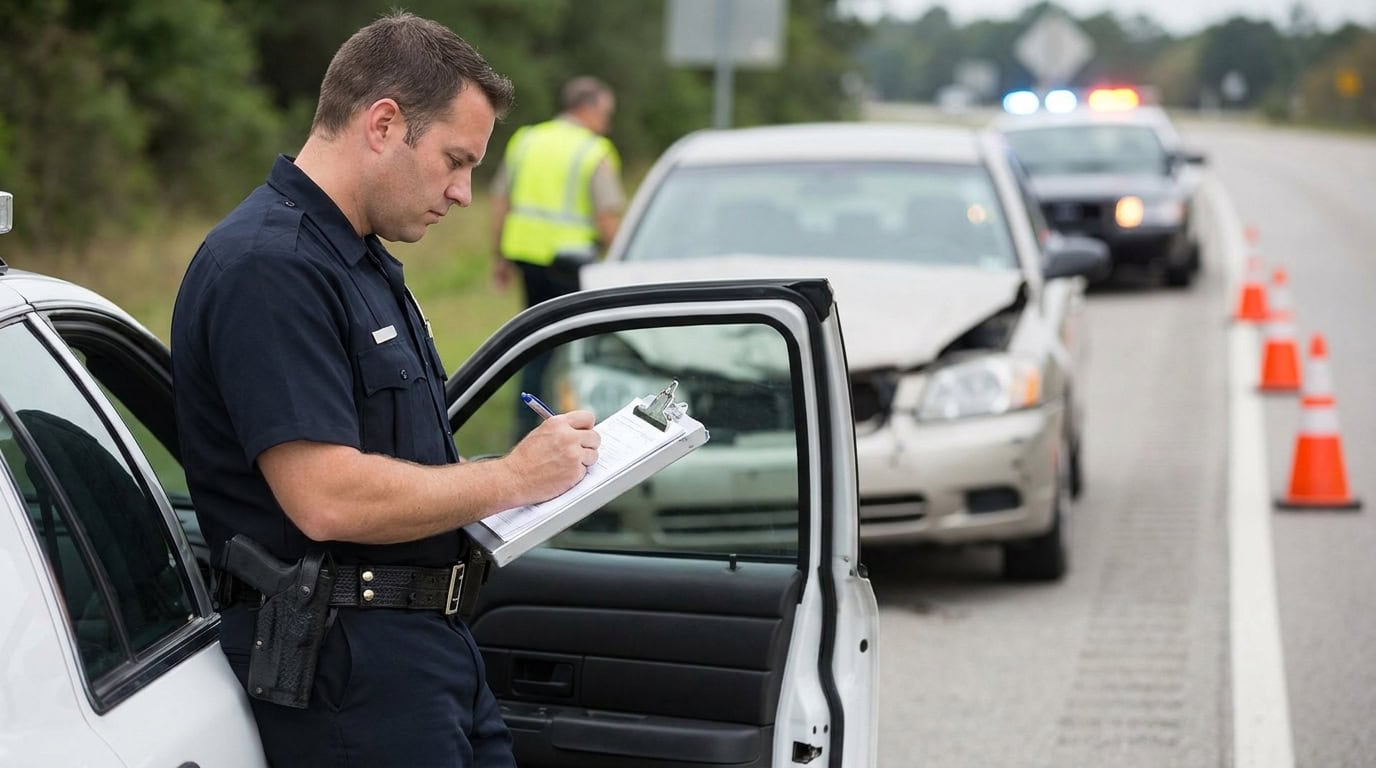
Law enforcement officers often juggle multiple responsibilities at a chaotic crash site and may overlook specific details. Officers might misinterpret how the vehicles collided or fail to record statements from critical witnesses who quickly left the area. Challenging these inaccuracies is the first step toward securing the compensation you deserve for your injuries.
Distinguishing Between Objective and Subjective Errors
It's necessary to distinguish between objective factual errors and subjective interpretive errors when you review your crash documentation. Identifying factual errors in accident report documents is the first step toward ensuring that the insurance adjuster receives an accurate depiction of the parties involved. The approach to correcting these mistakes varies significantly depending on the nature of the disputed information.
Common Factual and Administrative Mistakes
Factual mistakes in a police report can often be corrected with documented proof. These errors typically involve objective data that can be easily verified through official state records. Common issues include incorrect vehicle identification numbers, misspelled names, or the wrong insurance policy details. You might also find that the officer recorded the wrong location or the wrong date and time of the occurrence.
These mistakes often occur because the officer is rushing to clear the scene and restore traffic flow. Because these errors are objective, they're typically the easiest problems to fix within the document. You can usually resolve these issues by providing a registration card or a driver's license that shows the correct information.
Most law enforcement agencies are willing to update the record when you present clear documentation that proves a typo occurred. This process ensures that the basic facts of the incident are correctly recorded for your insurance company to review. It's helpful to provide copies of your vehicle registration or insurance card when making these requests.
Subjective Interpretive Errors and Opinions
Subjective errors involve judgment calls made by the officer regarding how the accident happened or who was at fault. An officer might claim a driver was speeding or failed to yield based on their own assessment of the skid marks or vehicle damage. These conclusions are often reached without the benefit of detailed measurements or electronic data from the vehicles involved.
Officers are human and may misinterpret the mechanics of a collision, especially if they arrive long after the impact occurred. They might rely too heavily on one driver's statement while the other party is being treated by emergency medical personnel. This reliance on a single perspective can lead to a narrative that is inconsistent with the physical or forensic evidence from the scene.
When challenging officer determination, the focus must shift from personal narrative to physical evidence that contradicts the initial assessment. Correcting opinion-based findings is much harder because it requires the officer to admit their professional judgment was wrong. Insurance adjusters use these opinions as the primary tool for initial liability apportionment.
Why Inaccurate Reports Jeopardize Your Recovery
Insurance adjusters rely heavily on police reports when determining liability and settlement value. They view the report as a neutral account of the events, even though the officer didn't actually witness the crash. If the report contains errors that suggest you were at fault, the insurance company will use this as leverage during negotiations.
The Foundation for Liability Apportionment
This reliance on a police report often leads to settlement posturing, in which the insurer offers a significantly lower payout than you actually deserve. They may argue that because the police report blames you, a jury would never rule in your favor if the case went to trial. This perception of fault can create a ripple effect throughout the entire claims process and lead to a lengthy dispute over responsibility for damages.
The 2023 tort reform raised the stakes on report accuracy. Florida Statute § 768.81(6) bars any party found greater than 50 percent at fault for his or her own harm from recovering any damages, in cases filed after March 24, 2023. No officer assigns that percentage and no report decides fault. What a report does is set the story an adjuster reads first, and an adjuster who opens the file near that line will spend the rest of the claim defending the number.
While Florida is a no-fault state, the police report still impacts your ability to recover funds beyond personal injury protection benefits. Your PIP claim provides medical care coverage regardless of fault, but the report dictates the direction of any liability claim against the other driver. Address these inaccuracies early, before the insurance company closes its initial investigation.
Florida's 2023 Tort Reform and Modified Comparative Negligence
House Bill 837 was signed on March 24, 2023 and moved Florida from pure comparative negligence to modified comparative negligence. Under the old rule a plaintiff who was 99 percent at fault still collected 1 percent of the damages. Under the new one a plaintiff past the halfway mark collects nothing, which is why a report that misstates who did what is now worth fighting over.
The 51% Bar Rule
Section 768.81(6) bars recovery by any party found to be greater than 50 percent at fault for his or her own harm, and it does not reach medical negligence claims under chapter 766. An officer never makes that finding. A jury does, or an adjuster does informally when valuing the claim. What a wrong report does is hand the other side the version of events that gets told first.
If a jury finds you were exactly 50% at fault, you can still recover 50% of your total damages. This makes every percentage point of fault a critical factor in your financial recovery. Insurance companies often systematically deny claims based on the 51% bar rule when a police report is in their favor.
Your attorney must use forensic evidence to keep your share of the fault at 50 percent or less. We work to shift the focus back to the other driver's negligence to protect your right to compensation. Without an accurate report, you face an uphill battle against insurance adjusters who are looking for any reason to deny your claim.
Reduced Statute of Limitations
The 2023 tort reform also reduced the statute of limitations for most negligence cases in Florida. Previously, victims had four years to file a lawsuit following a car accident. Under the new law, this timeframe has been cut in half to only two years.
This tighter timeframe creates a significant sense of urgency for victims to resolve disputes regarding their accident reports. You no longer have the luxury of time to wait and see if the insurance company will change its mind. If a report is wrong, you must act immediately to correct the record and build a strong legal case.
Missing this two-year deadline will result in a total loss of your right to sue the negligent driver. The shorter window makes the initial investigation and the accuracy of the crash report more important than ever. You should speak with a personal injury lawyer as soon as possible to ensure all deadlines are met.
Florida Traffic Crash Report Forms: Long Form vs. Short Form
Florida law requires officers to use specific forms depending on the severity of the accident. Understanding which form was filed in your case is important because each form contains different levels of detail. The information included in these forms will directly influence how an insurance adjuster views your claim.
The Long Form Crash Report
Florida Statute § 316.066(1)(a) lists four triggers for the Florida Traffic Crash Report, Long Form: a crash that resulted in death, personal injury, or any indication of a complaint of pain or discomfort by anyone involved; a crash involving a violation of § 316.061(1) or § 316.193; a crash that left a vehicle inoperable to a degree requiring a wrecker; or a crash involving a commercial motor vehicle. Property damage on its own is not on that list. The officer has 10 days after finishing the investigation to submit it, and the form carries a narrative and usually a diagram.
The Long Form also contains specific sections on weather conditions, lighting, and road-surface factors. It lists the officer's initial determination of fault and any citations that were issued at the scene. Because of its depth, this form is the most common target for subjective interpretive errors.
Insurance companies view the Long Form as the most authoritative record of the accident. If there's a mistake in the narrative or the diagram, it can be extremely damaging to your case. We review these forms line by line to identify any inconsistencies with the physical evidence.
The Short Form and Driver Reports
Where a long form is not required, § 316.066(1)(c) tells the officer to complete a short-form crash report or hand out a driver exchange-of-information form. The short form still names the parties and the basic facts of the collision. You also have a reporting duty of your own: Florida Statute § 316.065(1) requires the driver of a vehicle involved in a crash causing injury, death, or apparent property damage of at least $2,000 (raised from $500 effective October 1, 2026) to give notice immediately, by the quickest means of communication, to the local police, the sheriff or the Florida Highway Patrol. If no official report gets filed, you may need to file a Driver Report of Traffic Crash yourself.
FLHSMV Form 90011S, the Driver Report of a Traffic Crash, lets a driver self-report. Use it when an officer refuses to amend the record, or when no officer came out at all. Filing it puts your version into the state's records instead of leaving the other driver's account standing as the only one.
While a self-reported form doesn't carry the same weight as an officer's report, it serves as a formal rebuttal. It creates a paper trail that demonstrates you disputed the facts from the very beginning. This can be used as evidence during settlement negotiations or at trial.
Police Procedures: FHP vs. Local Agencies
The procedure for disputing a report can vary depending on which agency responded to your call. The Florida Highway Patrol (FHP) handles accidents on state highways and interstates like I-95. Local municipal police departments or county sheriff's offices handle crashes on city streets and residential roads.
Florida Highway Patrol Protocols
FHP has a centralized system for managing crash reports across the state. If you find an error in an FHP report, you must typically contact the specific station where the officer is based. They have a formal process for submitting evidence to request an amendment or a supplemental report.
FHP troopers are often highly trained in accident reconstruction, which can make them more resistant to changing their opinions. However, they are also bound by strict administrative rules. Providing clear, objective proof of a factual error usually results in a quick correction of the record.
In Broward and Palm Beach County, FHP units are often stretched thin and may spend limited time at a scene. This can lead to missed witnesses or incomplete diagrams in the Long Form. We know the specific protocols for these agencies and how to navigate their chain of command.
Local Municipal Police Departments
City police departments in places like Fort Lauderdale or West Palm Beach have their own internal records divisions. Each department may have a slightly different process for handling disputes over accident reports. Some may allow for a phone call with the officer, while others require a formal written request.
Local officers may be more familiar with the specific intersections and traffic patterns where the crash occurred. An officer's local knowledge can be a double-edged sword if the officer has a bias about a particular road design. We work with local supervisors to ensure that every report is a fair and accurate reflection of the facts.
Regardless of the agency, you should always treat the responding officer with respect. A polite and professional approach is more likely to result in a successful amendment. If the officer is uncooperative, we can escalate the matter to their supervisor or the department's records division.
Immediate Steps for Amending a Police Report
You must act quickly once you discover that a crash report contains inaccurate information. Evidence at the scene can disappear and memories can fade, so delay works against you. Taking action immediately demonstrates that you take the record seriously and helps prevent the insurance company from relying on false data.
Contacting the Responding Officer Directly
The first step in amending a police report is to contact the officer who authored it. You can typically find the officer's contact information and badge number listed on the first page of the report. It's helpful to remain professional and calm when you explain the nature of the error.
You should provide clear and documented proof of the mistake, such as photos of the vehicle damage. While many officers are willing to fix factual typos, they may be resistant to changing their formal opinion. Having your own documentation of injuries and scene details can help support your request for a correction.
At the very minimum, submitting your own written statement to the police as quickly as possible may dramatically change the outcome of your case. It forces the adjuster to acknowledge a dispute over the facts. Filing a statement creates a more balanced record for future legal proceedings or settlement discussions.
Requesting a Supplemental Statement
If the officer refuses to revise their original assessment, you can request that a supplemental statement be attached to the file. Requesting a supplement allows you to submit your own written account of the events or additional evidence as a permanent addition. While it doesn't delete the original notes, it ensures that your version of events is preserved.
This supplemental documentation can include statements from witnesses who were not interviewed at the scene. Having this information officially recorded in the police file makes it much harder for the insurance company to claim your version is new. It serves as a formal rebuttal to any remaining inaccuracies in the primary report.
You can also include photos that the officer didn't see or didn't take at the crash site. These visual records are often more persuasive than the officer's written narrative. A supplemental report ensures that the insurance carrier considers all available evidence.
What to Do If the Other Driver Lied on a Police Report
It's a common and frustrating occurrence for a negligent driver to lie to an officer to avoid a citation. They may claim the light was green when it was red or that you were speeding. These lies can become the basis for the officer's final determination of fault in the report.
Identifying Contradictory Evidence
When the other driver provides false information, you must counter it with objective proof. This often involves looking for data that the driver cannot control or manipulate. Forensic investigators retrieve event data recorder information to establish vehicle speed and braking points.
Witness statements also expose a driver's lies at the scene. A neutral third party who saw the light change or saw the driver on their phone is highly credible. We cross-reference these statements with the driver's narrative to highlight the inconsistencies.
Video footage is perhaps the most powerful tool for proving that another driver lied. Dashcams and surveillance cameras provide an unblinking account of the collision. If a driver lied about their actions, the video will expose the truth and destroy their credibility with the insurance company.
A Checklist for Disputing a Car Accident Report in Florida
Disputing a report requires a systematic approach to ensure you have all the necessary information. Following a checklist can help you stay organized during a stressful time. Here are the steps you should take immediately after finding an error in your report.
- Obtain the officer's name, badge number, and the responding precinct or station.
- Draft a formal letter of dispute that clearly outlines each error and provides the correct information.
- Gather at least three pieces of corroborating evidence, such as photos, witness contacts, or medical records.
- Request a meeting with the officer's supervisor if the initial amendment request is denied.
When drafting your letter of dispute, be specific and objective in your language. Avoid emotional arguments and focus on the facts that can be proven with evidence. Include copies of your supporting documents rather than the original versions.
Maintaining a record of all your communications with the police department is also important. Keep copies of your letters and make notes of the dates and times of your phone calls. This paper trail will be useful if your attorney needs to take further legal action to correct the record.
The Impact of an Independent Accident Investigation
A private and independent accident investigation is often necessary when the official report is fundamentally flawed. Law firms have resources and time that the police departments may not have utilized during their brief time at the scene. A private investigator can thoroughly review the facts to uncover evidence that the responding officer missed or ignored.
Gathering Fresh Witness Statements
Officers often miss witnesses who were at the scene but left before the police arrived. An independent investigator can track down these individuals by visiting nearby businesses or canvassing the neighborhood. Obtaining formal and sworn statements from these neutral parties can provide the evidence needed to contradict an inaccurate report.
Witnesses who were not involved in the crash and have no personal connection to the drivers are viewed as highly credible. Their observations can clarify lane positions, traffic signal colors, or vehicle speeds before the impact. These statements provide a more complete picture of the accident that the insurance company cannot ignore.
If the report says nobody saw it, one neutral observer can change the whole file. That person may have seen the other driver on a phone or drifting across the line. This is a civil claim rather than a criminal case, so nobody is proving innocence. What you are showing is that the other driver's share of the fault is the larger one.
Utilizing Digital Forensic Evidence
Modern technology provides a wealth of data that can serve as a silent witness to a traffic accident. Forensic investigators retrieve event data recorder information to establish vehicle speed and steering patterns. The EDR data provides an objective record of the crash that can prove an officer's interpretation was incorrect.
Personal injury attorneys subpoena cell phone records to prove distracted driving was a factor. This information is rarely included in a standard police report unless a fatality occurred. Accessing these records allows us to determine whether the other driver was texting or using an app at the time of impact.
We also look for surveillance footage from doorbell cameras and commercial security systems. Many businesses retain their security video footage for only a few days, so swift action is required to secure this evidence. Once obtained, this video can show exactly how the accident unfolded and who was truly at fault.
Working with Accident Reconstruction Experts
An accident reconstructionist uses physics and advanced computer modeling to recreate the crash in a digital environment. They can determine vehicle speeds, braking points, and impact angles with a high degree of precision. Their work provides a scientific basis for challenging a report that was based on a quick visual assessment.
These experts examine data from a vehicle's event data recorder, which functions like a black box. This device records information such as throttle position and seatbelt usage in the seconds leading up to a crash. An expert can translate this raw data into a clear explanation of the events.
The testimony of an accident reconstruction expert often carries more weight than an officer's initial hunch. While the officer has general training, the expert has specialized knowledge in the physics of collisions. This technical depth is often what is required to overturn a fault determination that was wrongly assigned.
Understanding Florida's Accident Report Privilege
Florida law provides specific protections regarding how crash reports are handled in legal cases. Under Florida Statute section 316.066, there is a concept known as the accident report privilege. This generally prevents the statements made to an officer for the report from being used as evidence in a civil trial.
Florida Statute 316.066 and Hearsay Rules
Two separate rules keep a crash report away from a jury, and it helps to know which is which. Florida Statute § 316.066(4) makes each crash report, and each statement a person involved gives an officer for the purpose of that report, privileged: the statute says such a report or statement may not be used as evidence in any trial, civil or criminal. Hearsay is the separate rule, and it is what keeps the officer's own written conclusions out. The practical result is the same either way. A report that wrongly blames you may never be seen by a jury, and it will still steer the entire insurance claim long before anyone gets near a courtroom.
Insurance companies treat the report as a factual document when they are setting their reserves. As a result, even if a jury never sees the report, its contents still have a massive impact on your ability to get paid. You must still fight to correct the report to ensure a fair settlement offer.
The accident report privilege is designed to encourage drivers to be honest with officers, without fear that their statements will be used against them later. It applies to any statement made to complete a required crash report. Knowing these legal nuances helps us build a strategy that works around a flawed initial report.
The privilege has limits worth knowing. Under § 316.066(4) a law enforcement officer at a criminal trial may still testify about a statement you made to him, subject to the rules of evidence, so long as it does not violate your privilege against self-incrimination. Results of breath, urine and blood tests administered under § 316.1932 or § 316.1933 are not confidential at all and are admissible under § 316.1934(2). What the privilege protects is what you said in order to complete the report, not everything that happened at the scene.
How Legal Representation Overcomes Erroneous Reports
Because the laws are complex and reports are generally inadmissible in court, professional legal strategy is the only way to effectively bridge the gap between a bad report and a successful claim. Trying to fix a complex police report error alone is a difficult task for most people who are dealing with injuries. A lawyer acts as a shield and an advocate against insurance companies that are eager to use a bad report to their advantage.
Challenging the Officer's Determination in Negotiations
An experienced attorney uses the results of an independent investigation to negotiate more effectively. When we present superior evidence such as expert reports, adjusters may be forced to disregard the police report's conclusions. Presenting superior evidence creates the leverage needed to secure a settlement that reflects the facts.
Adjusters are more likely to listen to a legal professional who has a track record of taking cases to trial. They know that if the evidence we've gathered is strong enough, the police report will not save them in a courtroom. This pressure often leads to a more favorable outcome during the pre-litigation phase.
By focusing on the physical evidence, we can move the conversation away from the officer's mistakes. We highlight the gaps in the original investigation and fill them with verified facts. This approach ensures that the insurance company sees the full picture rather than a flawed narrative.
Preparing for Litigation and Discovery
If the insurance company refuses to budge, we prepare to take the case to court. A lawsuit allows formal discovery, including the ability to take depositions of the responding officer. We can ask the officer specific questions about their investigation and highlight any inconsistencies.
During litigation, we can present our own accident reconstruction experts and witnesses to a jury. Since the police report is generally inadmissible, the jury will decide the case based on the facts presented at trial. This provides a fresh opportunity to prove what really happened.
The litigation process also allows us to subpoena records that were not available during the initial insurance claim. This might include cell phone records showing the other driver was distracted at the time of impact. We use every available tool to ensure the truth is told and you are not unfairly penalized.
Frequently Asked Questions Regarding Disputed Reports
Many victims have questions about their rights when facing a biased or incorrect crash report. Understanding the basics can help you make informed decisions about your legal options. Here are some of the most common questions we receive regarding disputed reports.
Can I still win my case if the police report blames me?
Yes, you can still win because the report is not the final word on liability. We use independent evidence and expert testimony to prove what actually happened and refute the officer's errors.
Is there a deadline to request an amendment to a police report?
There is no formal state deadline, but timing is critical for your insurance claim. You should act as soon as you find the error to prevent the insurance company from hardening its stance based on false data.
What if the officer refuses to change their opinion?
If an officer won't change their narrative, we can file a supplemental statement or a Driver Report of Traffic Crash. This ensures your version of the events is included in the official record for the insurance company to review.
Does a traffic ticket in the report mean I am at fault?
No. A citation is an accusation, not a finding of fault, though adjusters treat it as far more than that. Florida Statute § 318.14(4)(b) is worth knowing here: a person who pays the civil penalty for a noncriminal traffic infraction is deemed to have admitted the infraction and waived a hearing, but that admission may not be used as evidence in any other proceedings. We answer a citation with physical evidence and witness statements rather than with the ticket itself.
Speak To A Florida Personal Injury Attorney Now
While an inaccurate police report is a significant hurdle in a personal injury claim, it is not an insurmountable one with the right legal strategy. Errors in these documents can range from simple typos in your vehicle information to complex, disputed fault determinations. Both types of inaccuracies require immediate attention to prevent insurance companies from using them to deny your rightful compensation.
Weinstein Legal Team understands how stressful it is to see a biased or incorrect account of your accident. We have the experience and resources to conduct litigation-focused investigations and challenge law enforcement findings when they are wrong. We are committed to ensuring that the truth is told so that you can secure the compensation you deserve for your injuries.
If you are struggling with a police report that doesn't reflect the truth, we're here to help you navigate the legal system. Call us now at 888.626.1108 to speak with a lawyer 24/7, or click here to start your free case review online.