
- Florida Statute 810.06 makes it a third-degree felony to possess a tool, machine or implement with intent to use it to commit a burglary or trespass. It carries up to five years in prison, up to five years of probation and a fine of up to $5,000, and is ranked Level 4 on the offense severity chart in Section 921.0022.
- The State has to prove three elements beyond a reasonable doubt: that the defendant possessed a tool, that he intended to use it to commit a burglary or trespass, and that he took an overt act toward the crime going beyond mere preparation.
- The statute reaches burglary tools, not theft tools. The tool has to be intended for the unlawful entry into a dwelling, structure or conveyance, so an item meant for a theft after entry was already accomplished does not qualify, the distinction drawn in Calliar v. State and Fortson v. State.
- No list of forbidden tools appears anywhere in the statute. Flashlights, screwdrivers, pliers and crowbars can support a charge where the circumstances show intended unlawful use, but under Brooks v. State the mere possession of a flashlight and a crowbar is not enough to convict.
- Defenses aim at the weakest parts of a circumstantial case: a legitimate work or professional purpose for the tools, an unlawful stop or search that makes them suppressible under the Fourth Amendment, and proof that the defendant never moved past the preparation stage.
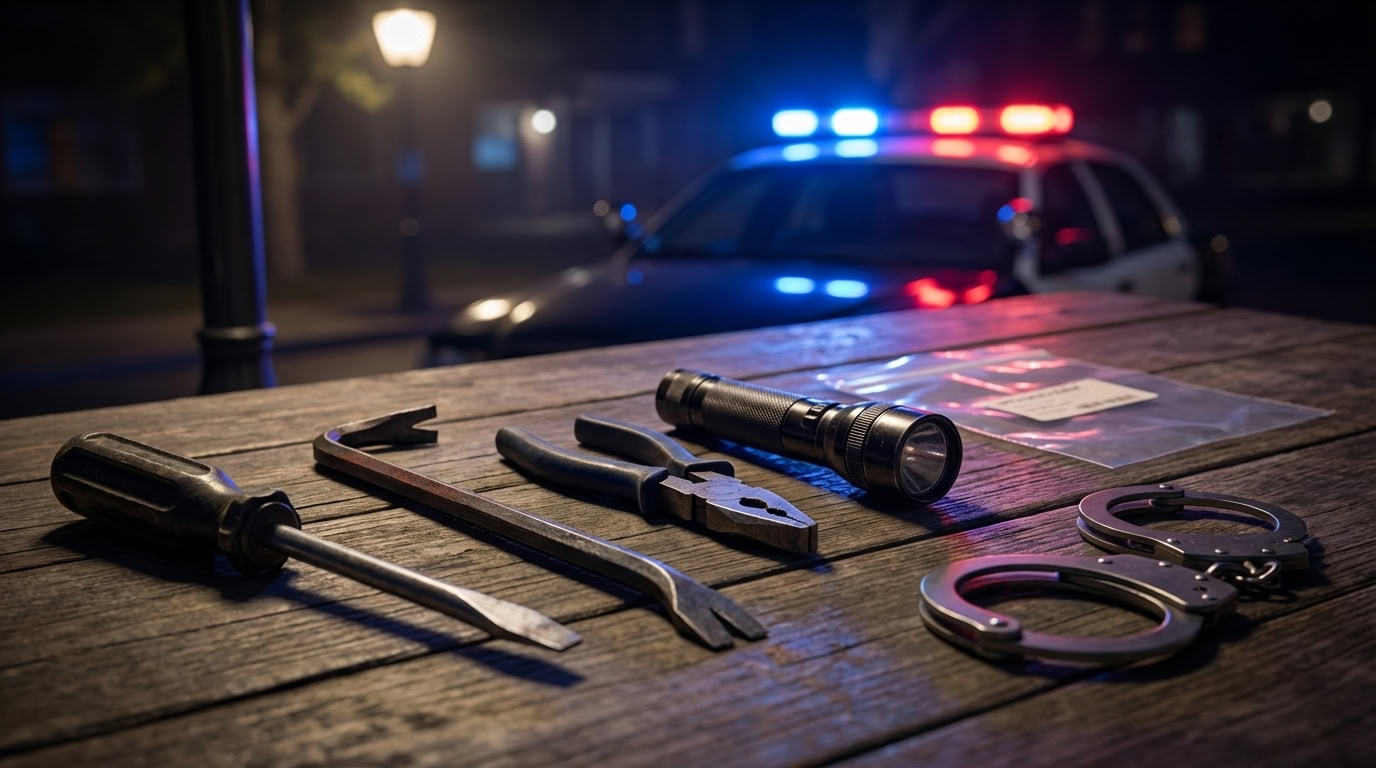
It may seem surprising, but carrying common, everyday tools like a screwdriver, a flashlight, or a pair of pliers can lead to a serious felony conviction in Florida. The charge of possession of burglary tools is unusual because it criminalizes the intent behind possession rather than the tools themselves.
The State has to prove what you meant to do with the screwdriver, not just that you had it, and that is where these cases are won and lost. Three elements have to be established beyond a reasonable doubt, and the middle one is hard to prove without a confession or an unlucky set of circumstances.
Understanding Florida Statute § 810.06: The Law of Possession of Burglary Tools
The law governing this offense is Florida Statute § 810.06, which criminalizes preparatory actions that facilitate the commission of burglary or trespass. The statute reaches anyone who has in his or her possession any tool, machine, or implement with intent to use the same, or allow the same to be used, to commit any burglary or trespass. Possession on its own is not the crime, and no list of forbidden tools exists anywhere in the statute. Intent to use the item for a burglary or a trespass is the thing the State has to prove.
Florida classifies the offense as a third-degree felony, ranked at Level 4 on the offense severity ranking chart in section 921.0022. A felony record carries immediate and long-term consequences for your personal and professional life, so the goal is to avoid the conviction.
The Core Elements the Prosecution Must Prove
Possession of burglary tools isn't an easy charge for the State of Florida to prove, as it hinges almost entirely on circumstantial evidence of intent. To secure a conviction, the prosecution must prove three distinct elements beyond a reasonable doubt. These elements are: the defendant possessed a tool, the defendant intended to use that tool to commit a burglary or trespass, and the defendant took an overt act toward the commission of the crime.
Possession of a Tool, Machine, or Implement
The first element is simply the possession of a tool, machine, or implement. Legally, possession can be actual, meaning the defendant had the tool on their person, or constructive, meaning the tool was in a place the defendant controlled, such as their vehicle. The tool does not have to be something built for crime, such as a lock pick.
The breadth of this element means that items normally carried by tradespeople, or even items in a standard emergency kit, can form the basis of a felony charge. Since the law doesn't define what constitutes a "burglary tool," the classification depends on the context of possession and the user's alleged purpose.
Distinguishing Between Actual and Constructive Possession
In Florida burglary tool cases, the prosecution can argue possession in two ways. Actual possession means the item was in your hand or pocket at the time of the arrest. Constructive possession is more complex, requiring the State to prove that you knew the tool was present and that you could control it, such as an item found in a shared glove compartment. Defense attorneys often challenge constructive possession by showing that multiple people had access to the area where the tools were discovered.
The Intent to Commit a Burglary or Trespass
The element of intent is the most difficult element for the State to prove and is the linchpin of the entire case. Since the tool itself isn't illegal, the prosecution must prove that the defendant's specific purpose was to use it to commit burglary or trespass. The court requires proof that the defendant intended to break into a dwelling, structure, or conveyance, not just that they had a tool that could potentially be used for that purpose.
In some contexts, possession of tools might constitute "prima facie evidence," suggesting intent when other circumstances are suspicious. For example, possession of tools outside a closed business late at night may suggest intent. However, a suspicious context alone isn't always sufficient evidence. The State still has to show the defendant intended to commit the burglary, not merely that the tools could have been used for one.
An Overt Act Toward the Commission of the Crime
The final element requires the State to prove an "overt act," meaning the defendant must have taken a measurable step toward committing the crime that goes beyond mere preparation. Mere preparation involves devising or arranging the means or measures necessary to commit a crime, such as driving to a neighborhood to scout a location. The overt act must follow this planning stage.
An overt act is any movement toward committing the crime, even if it isn't the final act required to complete the burglary. Examples of overt acts include approaching the target location or placing tools on the ground near the structure to be entered. The distinction between preparation and an overt act is often fine and frequently becomes a question of fact that a jury must decide.
Key Legal Distinction: Burglary Tools vs. Theft Tools
The point most often missed in these cases is what the tool has to be for. The Florida Supreme Court has held that the statute prohibits the possession of burglary tools, not theft tools. This means the tool must be intended for the unlawful entry into a dwelling, structure, or conveyance to qualify as a burglary tool.
Recognizing the difference between entry and theft is key to a strong defense. According to the principles established in Calliar v. State and Fortson v. State, tools intended for a crime after the initial entry has been accomplished don't qualify as burglary tools. For instance, a pair of wire cutters intended to cut a bike chain inside a fenced yard may not qualify because the item didn't facilitate the actual breaking and entering.
Applying this strict interpretation provides a powerful defense argument by showing the tool was not intended to gain illegal entry. Law enforcement agencies and prosecuting offices often misunderstand or overlook this distinction. Frequent misinterpretation of the statute often leads to the overcharging of individuals whose alleged intent was theft or property destruction rather than gaining entry.
Common Tools That Can Become Criminal Instruments
Because the definition of a burglary tool is broad, prosecutors often apply the statute to a wide range of everyday scenarios. The absence of a strict legal definition for a "burglary tool" means that police and prosecutors often have wide discretion to levy charges based on circumstantial evidence alone. When the circumstances of the possession are suspicious, a charge of possession of burglary tools becomes very likely.
Everyday Items vs. Inherently Criminal Tools
Many items commonly found in a vehicle or a toolkit are frequently charged under this statute. These items include flashlights, crowbars, screwdrivers, pliers, and bolt cutters. Courts have consistently held that even possession of otherwise innocent items can constitute unlawful possession under Florida law if there's proof of intended unlawful use, as established in cases such as Preston v. State.
However, the State cannot simply rely on the presence of these objects. For example, the court explained in Brooks v. State that mere possession of a flashlight and a crowbar isn't enough to convict for possession of burglary tools. The State must prove the defendant intended to use these specific items to commit the burglary, not merely that they could be used for that purpose.
Other tools are considered inherently suspicious because their primary or sole purpose is to facilitate entry into a locked area. These generally include items like lock picks, tension wrenches, and slim jims. Conversely, the courts have generally held that items such as gloves aren't considered burglary tools under the statute's plain meaning, as established in T.R.C. v. State.
Felony Penalties and The Long-Term Consequences of a Conviction
As a third-degree felony, a conviction for possession of burglary tools carries harsh and immediate consequences. The statutory maximum penalties include a state prison sentence of up to five years, in addition to up to five years of supervised probation. The court may also impose a substantial fine of up to $5,000.
Beyond the immediate penalties, a permanent felony record creates significant collateral consequences that impact virtually every aspect of a person's life. A felony conviction impacts one's civil rights, including the loss of the right to own or possess firearms, ammunition, or electric weapons, per Florida Statute 790.23. The same record blocks professional licensing and makes steady employment much harder to find.
A felony record also creates significant challenges for those applying for rental housing. Fortunately, sealing or expunging an eligible record can sometimes mitigate this housing barrier by making the record generally invisible to private landlords and most background screening companies.
Strategic Defense: Challenging the Prosecution's Evidentiary Burden
Successfully defending against a possession-of-burglary-tools charge requires dismantling the State's case, element by element. Since the charge relies so heavily on circumstantial evidence regarding intent, a strong defense must focus on exposing the gaps in the prosecution's narrative and highlighting the legitimacy of the defendant's actions.
Immediate Steps: Protecting Your Rights Post-Arrest
If you're arrested for possession of burglary tools, remember that your actions immediately following the arrest are critical. You must immediately invoke your Fifth Amendment right to remain silent and refuse to answer any questions about the tools or your intentions without an attorney present. Any statement you give can be used to satisfy the prosecution's burden of proving intent.
Your attorney can review the circumstances of your arrest, particularly concerning the bond hearing. Because this is a serious Level 4 felony charge, securing a favorable bond requires an attorney to present evidence of your ties to the local community and lack of flight risk.
Challenging the Element of Criminal Intent
The primary defense strategy involves proving a lawful purpose for possessing the tools. For many defendants, the tools found are legitimate items used in their profession. Defense attorneys can argue that the defendant is a construction worker, general contractor, or auto mechanic, and the tools were simply part of their standard work kit.
An attorney can use documentation, such as legitimate employment records, recent work orders, receipts for the tools, or testimony from employers, to demonstrate a non-criminal intent. If the defendant was found with tools near a job site, that context supports the argument that the tools were intended for their legitimate use, not for an unlawful entry into a separate structure. Presenting this evidence helps shift the focus away from suspicion toward legitimate conduct.
Challenging the Legality of the Stop and Search
Another constitutional defense strategy focuses on the Fourth Amendment, which protects against unreasonable searches and seizures. If law enforcement officers stopped the defendant or searched their vehicle without reasonable suspicion or probable cause, the seizure of the tools may have been illegal. Learn more about Florida's search and seizure laws here.
In such a case, a defense attorney can file a motion to suppress the evidence, including the tools themselves. If the court suppresses the tools, the prosecution can no longer meet its burden of proving that the defendant possessed the necessary tools for the charge to stand. Without the tools, the entire case against the defendant falls apart.
Arguing Lack of an Overt Act
Even if the State can prove intent, it must still prove that the defendant committed an overt act. An effective defense involves arguing that the defendant was merely engaged in preparation, which isn't enough to secure a conviction. Simply possessing the tools, or even driving to a neighborhood where a crime might be committed, is not legally sufficient to constitute an overt act.
The defense must show that the defendant hadn't yet taken a step beyond the planning stage. If the movement toward the crime is too ambiguous, such as lingering near a property without making a clear move toward the structure, the prosecution fails to meet its burden of proof. Defense teams often focus on this distinction to argue that the defendant's actions remained in the preparation phase.
Protecting Your Future with Expert Criminal Defense
The charge of possession of burglary tools is deceptively complex and incredibly serious because it elevates the possession of otherwise innocent items to a third-degree felony based solely on the ambiguous element of intent. Successfully fighting this charge requires an attorney who understands the critical legal distinctions within Florida Statute § 810.06, particularly the difference between intent to enter versus intent to steal.
Because this legal nuance is often the difference between a felony conviction and a dismissal, get immediate and aggressive legal representation. If you or a loved one is facing felony charges for possession of burglary tools in Florida, don't wait to secure your defense.
Weinstein Legal Team's criminal defense lawyers have the experience and knowledge necessary to challenge the prosecution's circumstantial evidence and protect your rights. We'll meticulously review your case to expose weaknesses in the State's narrative and fight for the best possible outcome. Contact us today to start your free case review.