
- Florida applies the ordinary reasonable care standard to commercial truck drivers, but a driver holding a CDL, operating an 80,000 pound vehicle and bound by FMCSA regulations has to do far more to meet it, including clearing the No-Zone blind spots before every maneuver.
- Under Florida Statute 768.81(6), an injured person found more than 50 percent at fault recovers nothing at all, which is exactly the result the blind spot defense is aimed at producing.
- Event data recorder and electronic logging device records are the strongest evidence against a blind spot claim, and a preservation letter sent early is what keeps them from being overwritten.
- Accident reconstruction and trucking safety experts can show how long the passenger vehicle sat in the driver's field of view and whether the carrier followed its own training and maintenance rules.
- Under Florida Statute 95.11(5)(a), a negligence claim that accrued on or after March 24, 2023 must be filed within two years of the date it accrued.
Commercial truck crashes frequently cause catastrophic injuries or death, because a loaded tractor-trailer can weigh twenty times what a passenger car weighs. The Insurance Institute for Highway Safety counted 5,478 deaths in large truck crashes in 2023. That was down about 8 percent from 2022, but still roughly 40 percent above the 2014 figure of 3,908.
Afterward, trucking companies and their insurers lean on a familiar argument: the "blind spot" or "No-Zone" defense. It shifts the blame onto the injured driver by claiming the car was sitting where the trucker could not possibly see it. The answer to it is specific rather than rhetorical. You show what a trained commercial driver was supposed to do before that maneuver, then use the truck's own electronic records to show what the driver actually did.
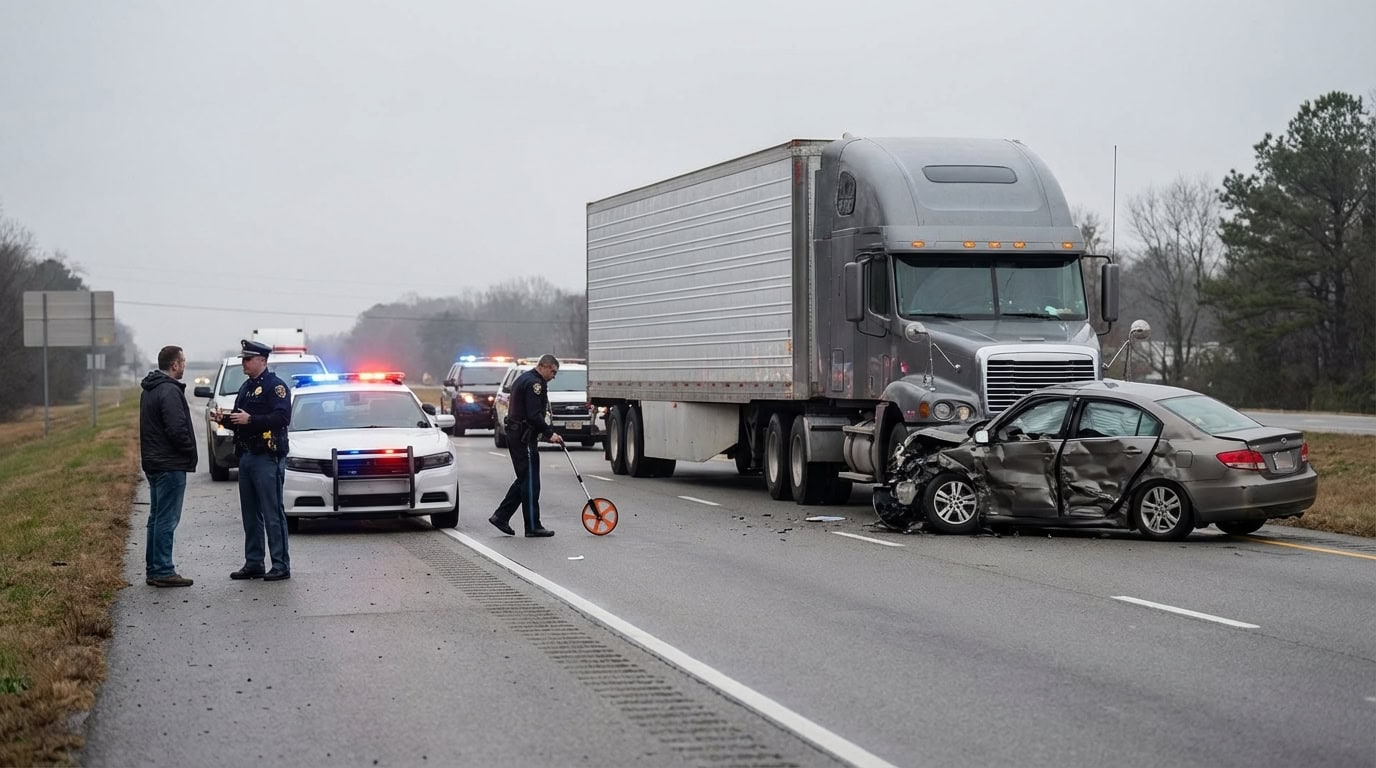
What Florida Requires of a Commercial Truck Driver
A fundamental difference exists between the responsibilities of a standard motorist and a commercial truck driver. Operating an 80,000-pound vehicle requires specialized training and a far greater level of caution and professionalism.
Florida does not apply a separate, higher negligence standard to truck drivers. The standard is the same one that applies to everyone: reasonable care under the circumstances. What changes is the circumstances. A driver operating an 80,000 pound vehicle, holding a commercial license, trained on blind spot management, and bound by federal safety regulations has to do considerably more than a car driver in order to meet that same standard. Spelling out what reasonable care required of this driver, on this road, in this truck, is the first step in proving negligence and in answering the claim that the crash was unavoidable.
Defining "No-Zones" and the Commercial Standard
The term "No-Zone" refers to the four blind spots around a commercial truck where a smaller vehicle can completely disappear from the driver's view. These zones include the area directly in front of the truck, the area immediately behind it, a small strip on the driver's side, and the largest blind spot extending several lanes back along the right passenger side.
Professional drivers know where these zones are and are trained to monitor and clear them. That training is the point. Because the No-Zones are known, fixed, and predictable, a careful commercial driver is expected to take active steps before every maneuver: a full sweep of the convex and West Coast mirrors, a head check, a signal held long enough to be seen, and a reduction in speed where the view is limited.
An accident occurring in a known No-Zone often demonstrates a failure to exercise the expected level of professional care, proving the event was preventable. Failing to monitor these zones forms the basis of proving liability in a truck collision claim.
Proving a Violation of Federal and State Regulations
Commercial trucking companies and their drivers are strictly governed by regulations set forth by the Federal Motor Carrier Safety Administration (FMCSA). These regulations establish a baseline for safe operation and provide concrete evidence of negligence when they're violated.
A documented rule violation undercuts the plain "I could not see them" defense, because it shows the driver fell below a written standard rather than simply having bad luck. Commercial driving instruction also teaches drivers to scan their mirrors every few seconds so they always know what is beside and behind them. That is training practice rather than a federal regulation, but a defense witness who trains drivers will be asked about it, and a lane change collision suggests the scan was not happening.
The rules that matter most in a blind spot case are the ones on driver qualification, hours of service, vehicle inspection, and the carrier's duty to supervise. If the driver failed to signal, failed to check the lane before merging, or was still on the road past the hours he was allowed to drive, that conduct is negligent whatever position the smaller vehicle was in.
The Blind Spot Defense and Florida's Modified Comparative Negligence Law
Trucking companies employ the blind-spot defense not because they believe the accident was unavoidable, but because they seek to reduce their financial liability by shifting blame. The blame-shifting strategy is highly effective in states like Florida, where negligence laws directly tie the victim's percentage of fault to their ability to recover compensation.
The Trucking Company's Strategy to Shift Blame Under Florida Comparative Negligence Law
The heart of the blind-spot defense is the doctrine of comparative negligence, which assigns a percentage of fault to each party involved in the crash. The defense team will aggressively argue that the passenger-vehicle driver caused the accident through unsafe conduct. They may accuse the victim of "lingering" too long beside the truck or passing improperly.
Defense attorneys often attempt to paint the victim as reckless by pointing to alleged improper maneuvers, such as speeding, tailgating the trailer, or making an aggressive pass. If the trucking company can convince a jury that the victim should've known better than to be in that specific area, the resulting percentage of fault assigned to the victim can significantly reduce or even eliminate the damages the trucking company must pay.
Immediate Steps to Preserve Evidence After a Florida Truck Crash
Because the carrier's central strategy is to shift blame, what you do in the first days after the crash decides what evidence still exists later. Engine control module data can be overwritten by continued driving, dash cam footage is often kept on a short rolling loop, and a carrier that has not been told to preserve records may destroy them on its ordinary retention schedule.
First, seek medical treatment immediately. Second, if you're able, take photographs of the scene, including the positions of both vehicles and any physical damage. Most importantly, contact a personal injury lawyer right away to secure the electronic evidence before it's lost.
Your attorney's first move is usually a preservation letter, sometimes called a spoliation letter, sent to the carrier and its insurer. The letter does not by itself compel anything, but it puts the carrier on notice that litigation is coming, which triggers a duty to preserve the electronic records, driver logs, and maintenance files it identifies. If the carrier destroys that material afterward, a court can sanction it, and in some cases the jury can be told to assume the missing evidence would have hurt the carrier.
Florida's 50 Percent Bar on Recovery
Florida operates under a modified comparative negligence law, which became effective on March 24, 2023. The 2023 legislation makes the defense strategy of shifting blame extremely high-stakes for accident victims.
The restriction is written into Florida Statute 768.81(6). If the injured person is found to bear more than 50 percent of the fault for their own harm, they recover nothing at all from the other party. The bar does not apply to medical negligence claims brought under chapter 766, but it applies squarely to a truck crash.
This is why the blind spot defense is worth so much to a carrier. Pushing a plaintiff from 45 percent fault to 55 percent does not shave the award, it deletes it. Answering the accusation of shared fault therefore does two jobs at once: it raises what the claim is worth at 50 percent or less, and it keeps the claim alive at all. Ignoring the allegation is how people walk into the comparative negligence trap.
Leveraging Electronic Evidence to Expose Negligence
In the modern age of trucking, commercial vehicles are essentially moving computers that record vast amounts of objective, non-biased data. This electronic evidence provides the single most powerful tool for countering a driver's testimonial claim that they didn't see the smaller vehicle.
Objective electronic records often prove that the driver was inattentive or operating unsafely at the moment of the crash. Since trucking companies are incentivized to erase or 'lose' incriminating data, securing this evidence early through a formal legal process is non-negotiable.
The Black Box: Event Data Recorder (EDR) and ECM Data
Most modern commercial trucks carry an Event Data Recorder, often called a "black box," alongside the Engine Control Module, or ECM. Between them these devices record the truck's operational data in the seconds leading up to, during, and after a collision. What gets recorded, and for how long it survives, varies by engine manufacturer and model year, which is one more reason to get the truck inspected early.
Data from the EDR and ECM is the least arguable evidence in the case, because the truck recorded it rather than a witness remembering it. The recorder captures speed, steering input, throttle position, braking status and impact force, and on many units GPS location. If the driver testifies that he checked his mirrors and eased over, a sudden steering input with no brake application and no signal tells a different story.
The resulting objective timeline proves that negligence occurred despite the alleged "blind spot" or the driver's subsequent testimony. An attorney must move quickly to ensure this complex data is extracted and preserved.
Electronic Logging Devices (ELDs) and HOS Violations
Federal regulations require most commercial truck drivers to use Electronic Logging Devices (ELDs) to monitor compliance with hours-of-service, or HOS, regulations. The primary function of the ELD is to prevent driver fatigue by automatically recording driving time.
ELD data can expose a driver who broke the hours of service rules or was running right up against the limit when the crash happened. Fatigue degrades reaction time and attention in ways a driver often does not notice, and a log showing eleven straight hours behind the wheel is a far better explanation for a missed lane check than a blind spot is.
ELD data helps prove that inattentiveness, not an unavoidable blind spot, was the true cause of the accident.
Dash Cam Footage and Driver Behavior
Many commercial fleets now utilize dual-facing dash cams that record both the road ahead and the driver's actions inside the cab. This video evidence can directly refute a blind-spot defense by showing the driver was distracted by a mobile device or failed to check their mirrors at the time of the merge. If a carrier fails to produce this footage after a crash, it may lead to a legal presumption that the evidence would have been unfavorable to their case.
Safety Technology and Corporate Negligence
Many modern truck fleets utilize advanced safety technology, such as collision mitigation systems, forward-looking radar, and lane departure warning systems. When functioning properly, these systems are designed to detect risks a human driver might miss.
Turning that technology off, letting it fall out of calibration, or declining to fit it at all is itself evidence about the carrier. Research by the Insurance Institute for Highway Safety on passenger vehicles found that lane departure warning cut the rate of injury crashes of the relevant types by 21 percent. If a truck had the system and an alert was ignored, or the carrier chose not to equip its fleet, that is evidence a jury can weigh against the company.
The Power of Accident Reconstruction and Expert Testimony
While electronic data provides the necessary facts, it takes specialized expertise to translate complex technical readings into a narrative that a jury can understand. Proving a truck accident injury claim relies on technical experts who can explain precisely how the crash occurred and why the truck driver should have prevented it.
Attorneys often utilize a trusted network of specialists to build this objective framework.
Accident Reconstruction Specialists
Accident reconstruction specialists are technical experts who analyze all physical and electronic evidence related to the crash scene. They meticulously examine skid marks, vehicle damage patterns, debris fields, and combine this with the speed and braking data from the EDR.
A full reconstruction lets the expert work out the speed, trajectory, and impact forces involved. From there the expert can build a model of the crash, often animated, showing where each vehicle was second by second. Where the physical evidence supports it, that model can show how long the passenger vehicle sat in the driver's field of view before impact.
That analysis gives the jury something to test the driver's account against. If a careful driver doing the mirror checks he was trained to do would have seen the car, the blind spot explanation stops being an answer.
Trucking Safety and Industry Experts
A trucking safety expert provides specialized testimony on the operational standards and requirements within the commercial transportation industry. These experts are uniquely qualified to discuss industry best practices that often go beyond the minimum federal regulations.
Their testimony can focus on whether the driver followed proper defensive driving techniques. These industry experts can testify about required mirror adjustment techniques, proper lane-change procedures, and the company's internal training manuals.
They can reveal that the trucking company failed to adhere to its own established safety protocols or federal training standards. Testimony from industry specialists shifts the focus from a simple "blind spot issue" to systemic institutional negligence.
Exposing Corporate and Institutional Negligence
Liability in a major commercial truck crash often extends far beyond the actions of the individual truck driver. Trucking companies must prioritize safety, and when they cut corners to increase profits, they open themselves to claims of corporate negligence.
By establishing this institutional failure, attorneys can pursue significantly higher compensation for the victim.
Negligent Hiring, Training, and Maintenance
There are multiple avenues for proving that the trucking company was negligent in its operations, not just its driving. The company has a legal obligation to ensure its drivers are qualified and adequately trained, and failure to exercise reasonable care in hiring can result in legal responsibility.
For instance, a claim of negligent hiring can arise if the company failed to conduct a proper background check and hired a driver with a history of safety violations or poor driving records. If the driver wasn't properly trained to clear blind spots or operate advanced safety equipment, that constitutes negligent training.
Negligent maintenance claims arise when the company fails to keep equipment in safe working order, such as failing to repair or replace faulty side mirrors. These issues are discovered through scrutinizing company documents, maintenance logs, and training manuals, all of which demonstrate institutional failure.
The Florida Issue of 'Chameleon Carriers'
Florida truck accident litigation often involves the added complexity of "chameleon carriers," trucking companies that seek to evade financial liability. These companies typically dissolve, often after accumulating numerous safety violations or following a major crash, and then quickly reappear under a new name and a new Department of Transportation number.
They do this specifically to evade regulatory oversight and escape massive financial liabilities. A thorough investigation conducted by a local Florida firm is often necessary to connect the new, seemingly independent company back to the original negligent entity.
Identifying the true owner and operational structure ensures that the victim can pursue damages from the responsible, well-insured company rather than a shell corporation designed solely to avoid accountability. This careful investigation protects the victim's right to full and fair recovery.
Secure Immediate Legal Action for Your Claim
The blind spot defense is a common, though often beatable, tactic used by large trucking carriers to avoid paying fair compensation to accident victims. The No-Zone defense can be systematically defeated by demonstrating the commercial driver's heightened duty of care and meticulously collecting objective electronic evidence from the truck itself.
There are two clocks running. The first is evidentiary: EDR and ELD data can be overwritten or lost within weeks. The second is legal. Under Florida Statute 95.11(5)(a), a negligence claim that accrued on or after March 24, 2023 has to be filed within two years of the date it accrued, and Florida Statute 768.81(6) bars recovery entirely if you are found more than 50 percent at fault.
If you or a loved one has been seriously injured in a commercial truck crash in Florida, do not deal with the carrier's investigators on your own. We can open our own investigation, send the preservation letter, and work to get the truck and its data inspected before anything is lost. No lawyer can promise a particular result, but the fault allegation is the part of the case worth fighting hardest, because of what Florida Statute 768.81(6) does to a claim that crosses 50 percent.
We are a Florida personal injury law firm that handles commercial vehicle crash claims. Call us to schedule a free case review with Weinstein Legal Team, or schedule a free case review online today.