
- Under Florida Statute 768.81(6) a slip and fall plaintiff found more than 50 percent at fault for their own injury recovers nothing; below that line, phone distraction reduces the award by the assigned percentage instead of ending the claim.
- To prove premises liability under Florida Statute 768.0755, the injured person must show the business had actual or constructive knowledge of the transitory foreign substance and should have removed it or warned about it.
- Insurers build the distraction defense out of social media timestamps, store surveillance, witness interviews and offhand remarks recorded in medical files, which is why recorded statements should go through an attorney.
- An insurance company cannot take your phone or your passcode; during a lawsuit it must get a subpoena from a judge to your wireless carrier, and Florida judges limit those subpoenas to records around the time of the fall and to logs rather than message content.
- Florida Statute 95.11(5)(a) allows two years from the date of the fall to file, for claims that accrued on or after March 24, 2023, while a fall before that date still runs on the old four-year deadline.
Can you recover damages if you were distracted by your phone during a fall in Florida? Yes, but your compensation may be significantly reduced or barred entirely depending on your percentage of fault. Under Florida's comparative negligence laws, you can recover damages as long as you're not more than 50% responsible for the incident. If a court finds your phone use accounted for more than 50% of the negligence, you receive nothing.
Insurers routinely use your mobile device usage to discredit you and shift the blame. To recover damages in a phone-distraction slip-and-fall claim, you must definitively prove that the property owner's hazard was the dominant factor in the accident.
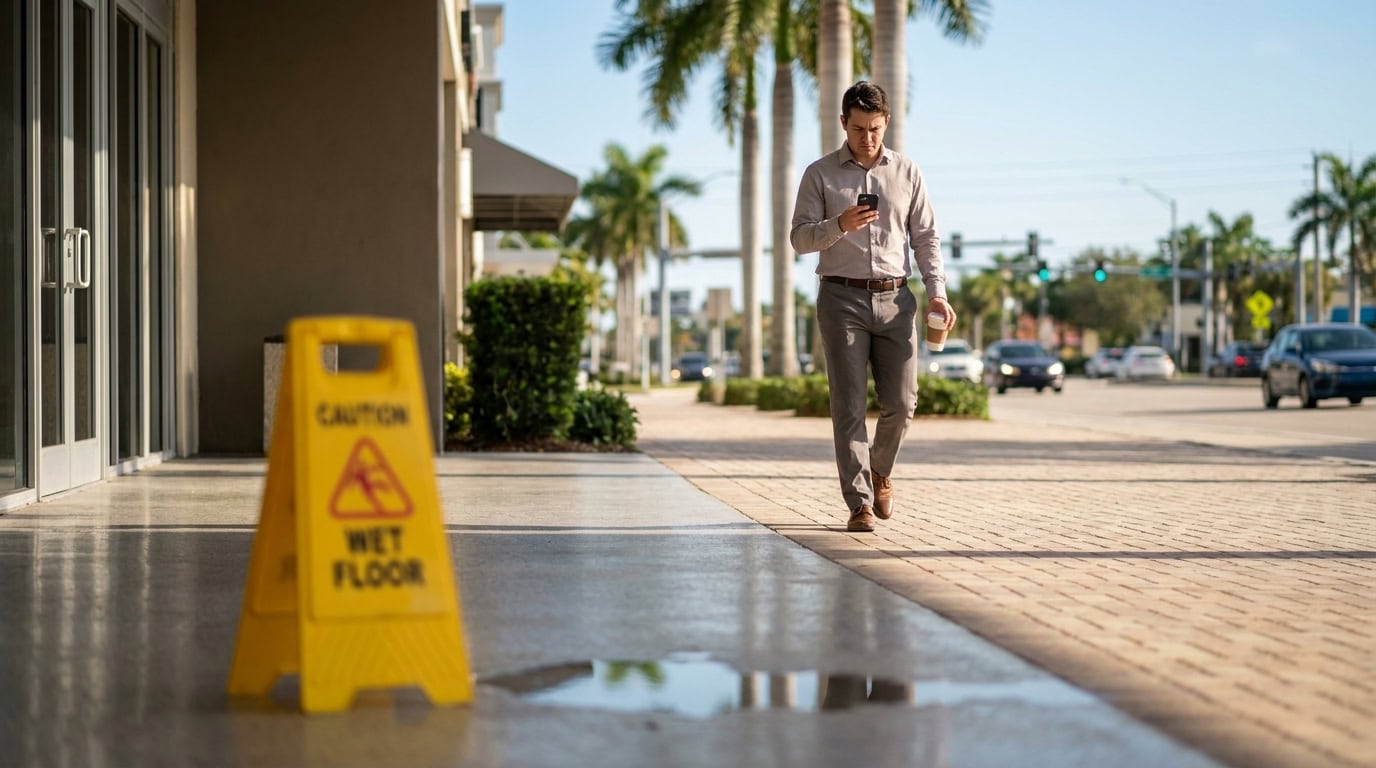
Understanding Distracted Walking and Florida Slip-and-Fall Claims
Distracted walking has become a widespread concern in Florida's retail and public spaces. Property owners carry a legal duty to maintain safe premises for all visitors and patrons. Despite this responsibility, many owners try to shift the blame onto the injured person to protect their profits. Identifying how statutory duties and legal definitions shape these claims remains a critical task for your legal team.
The Legal Concept of Distracted Walking in Premises Liability
In premises liability claims, defense attorneys aggressively frame distracted walking, such as texting or checking emails, as a breach of your legal duty to exercise reasonable care. They rely on this argument to shift blame, even when a clear and dangerous property hazard existed at the time of the fall.
To support this defense, insurers often cite biomechanical studies showing that typing or reading a text significantly alters a pedestrian's gait, shortens stride length, and decreases reaction time. Juries must then weigh these physical changes and any perception bias against the severity of the property owner's hazard to determine fault.
Proving Property Owner Liability Under Florida Statute 768.0755
Florida Statute Section 768.0755 governs incidents involving transitory foreign substances on business property. The statute puts two things on the injured person to prove:
- The business establishment had actual or constructive knowledge of the dangerous condition.
- It should have taken action to remedy that condition, whether by clearing it or by warning customers about it.
The burden of proof rests on the injured party when proving fault in a fall. You must demonstrate that a spill or object remained on the floor long enough for the staff to notice it. Failure to clean up a leak or to place a warning sign constitutes primary negligence by the owner. Proving fault in a fall often involves showing that the liquid had been present for a significant duration.
Establishing constructive knowledge often involves showing that the hazard occurred with regular frequency. If a leak is persistent, the owner is expected to know about the danger and fix it permanently. We investigate whether the store had an ongoing problem with a specific refrigerator or roof leak. For example, our team successfully represented a client when maintenance logs revealed that a dairy cooler had leaked three times in the week before the fall, undermining the defense's argument that our client's glance at a text message was the primary cause.
Florida's 51% Modified Comparative Negligence Rule
Recent changes to Florida's tort laws have significantly increased the stakes for accident victims. Understanding the updated negligence standard is critical for anyone pursuing a personal injury claim where phone distraction is an issue. These rules can eliminate a victim's ability to recover financial damages. Florida Statute Section 768.81 establishes a modified comparative negligence system that changed how fault is assigned.
The Shift from Pure to Modified Comparative Negligence (HB 837)
House Bill 837 took effect on March 24, 2023, replacing Florida's pure comparative negligence system with a modified comparative negligence standard. The new fault bar applies to cases filed after that date, even where the fall itself happened earlier.
| Negligence Standard | Maximum Plaintiff Fault Allowed | Impact on Compensation |
| Pure Comparative Negligence (Pre-March 2023) | Up to 99% | Your exact percentage of fault reduces damages. |
| Modified Comparative Negligence (Current Law) | 50% | If you are more than 50% at fault, recovery is completely barred. |
Defense strategies now aggressively target smartphone usage to push you past that 50% mark, aiming to prove that your distraction caused the accident, so they pay nothing.
The transition to this system has made insurance companies much less likely to settle. They know that if they can convince a jury you were mostly at fault, they pay nothing. The legal update creates a cliff effect where a single percentage point determines whether you get a settlement. Our job is to ensure your share of the blame stays well below that 50% threshold.
Florida Statute Section 768.81 dictates that your exact percentage of fault reduces your compensation. If you are 30% responsible, you receive 70% of your total damages. However, once that percentage goes above 50%, your right to recovery vanishes. Because adjusters are fully aware of this legal threshold, they will aggressively search for evidence of distraction to push your fault percentage over that line.
Adjusters may use your own statements about your phone to tip the scales against you. They focus on the moment of the fall to maximize your perceived negligence. Adjusters use such aggressive approaches to save the insurance company money at your expense. They don't want to hear about the leaking roof; they only want to talk about your text messages.
A lawyer works to keep your percentage of fault as low as possible through evidence and expert testimony. Without professional help, you risk losing everything based on a minor error in judgment. We focus on the property owner's systemic failures to keep the spotlight on their negligence. Keeping your comparative negligence cell phone usage from becoming the main story is our primary goal.
Every detail of your behavior before the fall is scrutinized for signs of inattention by the defense. They will look for any reason to argue you were more than half responsible. We counter this by showing that the hazard was difficult to see even for an attentive person. Protecting your claim requires a strategic approach to the 51% rule from day one.
Real-World Scenarios: How Fault is Apportioned in Distracted Walking Falls
For example, if a texting shopper slips on a puddle from a leaking refrigerator, a jury might assign the store 70% of the fault for the leak and the shopper 30% for the distraction. The shopper's final settlement would be reduced by 30% to reflect their shared responsibility.
In a different scenario, the shopper might ignore a highly visible yellow warning sign while looking at their phone. An adjuster could argue the shopper is 55% at fault for ignoring a clear warning. In this case, the shopper would recover nothing because they exceeded the 50% threshold. A texting-while-walking accident becomes legally complex when a jury must weigh personal distraction against a visible hazard.
Florida courts have repeatedly weighed visible warnings against personal distraction. For example, in premises liability precedents involving retail environments, courts have found plaintiffs primarily responsible when they slip in areas clearly marked with "Caution: Wet Floor" signs while distracted by their devices. See Brookie v. Winn-Dixie Stores, Inc., 213 So. 3d 1129 (Fla. 1st DCA 2017), where the court affirmed that a business has no duty to warn of an open and obvious condition that is not inherently dangerous. The courts generally hold that a plaintiff may be excused from noticing an obvious hazard only when the distraction is directly caused by the defendant (such as a store display designed to draw the eye), rather than a self-imposed distraction like checking a text message.
A large, hidden puddle represents a severe breach of a property owner's duty. However, the presence of adequate warning signs significantly shifts the balance of comparative negligence, making it critical to prove that the hazard was either unmarked or the warning was obscured.
How Insurance Companies Use Phone Distraction as a Shield
Insurance companies operate as businesses that prioritize minimizing their financial payouts. They routinely use allegations of smartphone distraction as a powerful shield against liability. Understanding their tactics is the best way to protect your legal rights after a fall. Comparative negligence cell phone arguments are now standard practice for defense adjusters in every slip and fall case.
The Goal of the Insurance Adjuster: Shifting the Blame Past 50%
Following a slip-and-fall report, an adjuster will aggressively leverage Florida's modified comparative negligence law against you. Their objective is to push your share of the fault above 50% during their investigation by combing through your digital and physical footprint for evidence of distraction.
Adjusters will take seemingly harmless statements and use them to build a defense against your claim. They may downplay the property's dangerous condition while emphasizing your phone use. Every detail of your behavior before the fall is scrutinized for signs of inattention. A phone-distraction slip-and-fall accusation is a standard tool they use to deny valid claims.
They hyper-focus on whether you were actively holding or looking at your screen when you fell. Even if the property was clearly dangerous, they will argue that your distraction made the fall inevitable. Blaming the victim's device is a standard part of modern insurance defense in Florida. They want to make the case about your phone rather than their failure to maintain the floor.
By focusing on the phone, they attempt to divert attention from their own client's negligence. They want the narrative to focus on your behavior rather than on their failure to maintain the premises. Such tactics successfully reduce or eliminate valid claims for injured people. We work to refocus on the dangerous conditions that existed on the property.
Common Tactics Used to Paint You as a Distracted Pedestrian
Insurance adjusters use several investigative methods to gather evidence of your phone use and build a comparative negligence defense. To protect your claim, never give a recorded statement without your attorney present, and be aware of these common surveillance tactics:
- Social Media Monitoring: Adjusters look for posts timestamped near the time of your fall to prove you were actively using your device.
- Surveillance Footage Review: They scan store video for visual cues, such as a lowered head or a texting posture, to argue that you were not watching your path.
- Witness Interviews: Investigators seek out bystanders to testify that they saw you looking at a screen before the incident.
- Medical Record Scrutiny: Any offhand comment made to emergency responders about calling or texting someone when you fell will be extracted and used against you.
- Leading Questions: During early phone calls, adjusters deliberately frame questions to extract damaging admissions about your screen time.
Can the Insurance Company Force You to Turn Over Your Cell Phone?
A common conflict in these cases involves the insurance company's search for evidence versus your right to privacy. Insurers may act as if they have an absolute right to access your personal digital data. However, Florida law provides strong protections against unwarranted intrusion into your private life. You don't have to hand over your device just because they ask for it.
Your Constitutional Right to Privacy in Florida
Florida law recognizes a constitutional right to privacy that protects your digital devices from unwarranted fishing expeditions. An insurance company cannot simply demand your physical phone, nor do you have to provide your passcode to an adjuster.
Defense attorneys must follow strict legal procedures to request any data, and courts actively protect victims from overbroad requests. Unless a judge specifically orders the release of targeted data (such as call logs restricted to the exact time of the accident), your private photos, emails, and messages are shielded from the defense team's investigation.
The Subpoena Process for Cell Phone Records in a Personal Injury Lawsuit
An insurance defense team must use a formal legal process to obtain records during a lawsuit. A judge issues a cell phone records subpoena directly to your wireless service provider. This order compels the production of specific logs related to calls, texts, or data usage. A phone records personal injury claim requires a balancing test performed by a Florida judge.
The judge decides whether to grant or limit the subpoena based on the facts of the case. They weigh your privacy against the defendant's right to gather evidence for their defense. The defense must show a reasonable, factual basis to believe the phone was in use during the fall. They cannot simply guess that you were distracted to get your records.
If a subpoena is issued, your attorney can file an objection to limit its scope. They ensure that only the relevant timestamps are provided to the defense team. This keeps the focus on the moment of the accident rather than your entire history. Managing a personal injury claim that involves phone records means protecting your data from overreach.
Wireless carriers usually provide logs of when messages were sent, not the content of the texts. These logs show the exact second a data packet leaves your device and enters the network. We cross-reference these times with the exact time of your fall to prove you were focused. A judge will only allow access to information that directly relates to the accident's timing.
What Types of Phone Data Can Be Used Against You?
If a judge permits a formal subpoena of your cell phone records, adjusters will look for specific digital footprints to prove distraction. We work with digital forensic experts to contextualize this data, as background app activity is frequently misinterpreted as active screen time.
| Data Type | What It Shows | How Adjusters Use It |
| Call Logs | Active voice calls and exact duration. | To argue that you were actively speaking and distracted during the exact moment of the trip. |
| SMS/Text Metadata | Timestamps for sent and received messages (not content). | To prove a message was being composed or read at the exact second the fall occurred. |
| Cellular Data & GPS | App usage timestamps and location timeline within a store. | To build a movement timeline and argue that you were actively browsing or using apps while walking. |
The Role of Cell Phone Forensic Experts
Insurance companies often retain digital forensic experts to extract and analyze metadata from your devices. These specialists use extraction software to uncover hidden timestamps, background app activity, and deleted messages that standard carrier logs might miss. Having your own legal team and forensic analysts to challenge their findings ensures they do not misrepresent routine background data as active phone usage at the exact moment you fell.
Defeating the "Phone Distraction" Defense
An allegation of phone distraction is not a death sentence for your personal injury claim. A skilled attorney has several powerful legal strategies to effectively combat these allegations. They focus on proving that the property owner's negligence remains the primary cause of the accident. We use forensic timeline reconstruction and spoliation letters to protect your right to compensation.
Proving the Property Owner's Knowledge and Primary Liability
Establishing the property owner's liability under Florida Statute Section 768.0755 is the core of your case. You must demonstrate that the business had actual or constructive knowledge of the hazard. This might involve proving a spill had been on the floor for a long time. Property owners owe visitors a duty of care that they cannot simply ignore.
A systemic failure to maintain a safe environment is a much more severe breach of duty. If a roof has been leaking for weeks, the owner's negligence is the dominant factor. Neglecting basic maintenance outweighs a pedestrian's glance at a phone to check a message. The store's failure to fix a known problem is more dangerous than a glance at a screen.
Attorneys use maintenance logs and employee testimony to prove these systemic failures. If the staff failed to follow their own cleaning schedules, the owner is liable. Such physical evidence shifts the focus back to the property's dangerous condition. We look for patterns of neglect that show the accident was inevitable for anyone.
By emphasizing the owner's duty, you can minimize the impact of your own behavior. The law requires businesses to be proactive in protecting their customers from known dangers. Their failure to do so is the primary reason the injury occurred. We make sure the jury understands that the floor was the real problem.
Overcoming the "Open and Obvious" Hazard Defense
Property owners often use the open and obvious hazard doctrine to avoid paying claims. They argue they had no duty to warn of a hazard because any reasonable person would see it. They claim that your phone use prevented you from noticing a clear danger. However, Florida's modified comparative negligence framework means this doesn't automatically end your case.
Visibility of the hazard is treated as one factor in determining shared fault. A landowner still has a duty to maintain safe premises even if a hazard is visible. We prove that a hazard was actually hidden or unexpected due to poor lighting or floor color. In these cases, even a fully attentive pedestrian would have fallen on the slick surface.
Proving that the hazard was not truly obvious is a key part of the legal strategy. If the danger was difficult to see, your phone use becomes less relevant to the case. An attorney may hire lighting engineers to test the visibility levels at the scene. We show that the store failed to provide a safe environment regardless of your focus.
We also look at the placement of products and displays designed to distract shoppers. Stores spend millions to make you look at their shelves rather than the floor. This environment makes it unreasonable to expect you to see every minor spill. We argue that the store created the distraction that led to the accident.
Establishing the Exact Timeline: Matching Phone Activity with the Time of the Fall
Forensic timeline reconstruction is a powerful tool used by personal injury lawyers. Your attorney can obtain security camera footage and register receipts to find the exact time of the fall. They may also use emergency dispatch logs to confirm the sequence of events. Matching the logs to the fall is the best way to disprove distraction.
Your attorney then cross-references the established timeline with your cellular carrier's usage logs. If the logs show no activity at the time of the fall, the distraction defense fails. Cellular data can prove you were not texting or calling when the accident happened. We use hard data to silence insurance adjusters' speculation.
Establishing this precise timeline prevents the insurance company from using general assumptions. They cannot claim you were distracted if the data shows your phone was in your pocket. Objective electronic evidence is often the most convincing part of a slip-and-fall case. We leave no room for the defense to guess about your behavior.
Matching the digital records with the physical evidence provides a clear picture of the incident. It removes the guesswork that adjusters use to shift blame and reduce payouts. A clear timeline is the best defense against allegations of distracted walking. We rely on facts rather than the narrative the insurance company wants to tell.
Demanding Surveillance Footage and Preserving Critical Evidence
Commercial establishments routinely overwrite their security camera footage within a few days. To prevent this, your attorney must immediately send a formal spoliation-of-evidence notice. This letter legally demands that the property owner preserve all video and incident reports. If they destroy it after receiving this notice, they face severe legal sanctions.
The letter covers everything from sweep logs to internal employee communications from the day of the accident. A court may even allow a jury to presume that the video would have proven the owner's liability if it had been destroyed. This proactive step ensures that the truth of the incident is preserved for the legal process. We move quickly to ensure the store doesn't hide the evidence.
The footage is worth securing because it shows the hazard and your behavior at the same time. It can show that the spill had been there for a long time before you arrived. It also provides visual evidence of whether you were actually looking at a phone. The camera doesn't lie, and we make sure it tells your side of the story.
Without a spoliation letter, critical evidence vanishes into the store's data overwrite systems. Securing this footage forms the foundation of a strong premises liability claim.
Steps to Protect Your Florida Premises Liability Claim After a Fall
The actions you take immediately following a fall in Florida will heavily impact your success. Following a structured set of steps is the best way to preserve evidence for the future. These actions help you counter any allegations of phone distraction that may arise later. You must treat the minutes after a fall as the start of your legal case.
Step 1: Seek Immediate Medical Treatment
Get professional medical care immediately after a fall. Adrenaline often masks the pain of serious injuries, making you feel fine initially. Adjusters will use a delay in treatment to claim your injuries are unrelated to the fall. You need a medical record that documents the damage the fall caused.
When speaking with doctors, be honest about your symptoms but stay focused on your physical condition. You do not need to speculate about your phone use or other distractions during your visit. Your medical record should serve as a clear account of the physical damage caused by the accident. Let your attorney handle the legal questions while you focus on recovery.
Follow all of your doctor's instructions and attend every follow-up appointment without fail. Missing appointments gives the insurance company a reason to claim you aren't really hurt. We use your medical history to prove the severity of the impact on your life. Your health is the priority, but your records are the evidence.
If you were using your phone to call for help, make sure the doctor knows the timeline of your pain. We will use the call log to show you that you only used the phone after the injury occurred. This prevents the defense from claiming the phone use preceded the accident. Clear medical documentation is the first pillar of your claim.
Step 2: Document the Scene and Note the Time
Immediate documentation at the scene provides objective evidence that protects against claims of distraction. Take the following steps before leaving the premises:
- Photograph the hazard and surroundings: Take close-up shots of the spill or uneven surface, plus wider shots showing the area's layout and lighting. The digital metadata in these photos establishes a precise timeline of your presence.
- Identify and collect contact information for witnesses: Objective bystanders can testify that you were paying attention to your path rather than your screen.
- Preserve your footwear and clothing: Keep the exact shoes you were wearing in a safe place, as insurers frequently blame improper footwear. Your attorney may need an engineer to test the slip resistance.
Step 3: Avoid Giving Recorded Statements to Insurance Adjusters
Speaking directly with the property owner's insurance company without a lawyer is dangerous. Adjusters are trained to ask misleading or open-ended questions designed to trick you. They want you to admit you were not looking where you were going or were on your phone. Even a small slip of the tongue can destroy your chance at a recovery.
Politely decline to provide any recorded statements if an adjuster calls you. Refer all communications regarding the accident directly to your personal injury attorney. This ensures that you do not accidentally say something that jeopardizes your ability to recover compensation. We manage the flow of information to protect your interests.
The insurance adjuster is not your friend, regardless of how polite they may seem on the phone. Their goal is to close the file for the lowest possible amount. They will use your words against you to push your fault percentage over the 50% line. Let our team handle the talking while you focus on getting better.
If they ask about your phone, tell them that your attorney will provide any relevant records during the discovery process. You have no obligation to discuss your digital habits with an insurance company. We will protect your privacy and ensure they only get what they are legally entitled to. Silence is often your best defense during the early stages of a claim.
Step 4: Contact an Experienced Florida slip-and-fall lawyer
Hiring a Florida slip and fall lawyer immediately is the most important step you can take after a fall. A lawyer will handle all communications with the insurance company and conduct an independent investigation. They have the resources to secure electronic evidence and analyze carrier logs professionally. We know how to investigate the facts and challenge the insurance adjusters.
Your attorney's job is to build a powerful case that keeps your fault determination low. By keeping your comparative fault at 50% or less, they ensure you remain eligible for recovery. Professional legal help is the best way to hold negligent property owners accountable. We fight to maximize your settlement while the defense tries to minimize it.
We work with experts who understand the physics of walking and the mechanics of friction. These professionals can explain to a jury why even a focused person would have fallen. This technical support is how we answer the "obvious hazard" arguments made by the defense. We handle complex premises liability cases in Florida courts.
Our team also understands the local courts and how they handle phone distraction cases. We use this knowledge to craft a strategy that resonates with Florida judges and juries. You don't have to face the legal system alone against a giant corporation. We provide the aggressive representation necessary to secure your future.
Understanding the Florida Statute of Limitations for Fall Claims
Florida also cut the filing deadline for negligence claims. Under Section 95.11(5)(a) you generally have two years from the date of the accident to file. That two-year period applies to claims that accrued on or after March 24, 2023. A fall before that date still runs on the old four-year deadline. Miss whichever deadline applies to you and you are permanently barred from seeking compensation.
Failing to file within two years means the property owner is no longer legally responsible for your injuries. The statute of limitations applies regardless of how severe your medical bills or long-term damages may be. We recommend starting the process as soon as possible to ensure all evidence is preserved. Waiting too long can result in the loss of critical surveillance footage and witness memories.
A wrongful death claim arising from a fall also carries a two-year deadline, and that one was already two years before the 2023 change. While there are very rare exceptions, you should never rely on them to save your case. Our team will manage all filing deadlines to ensure your rights stay protected. We move quickly to gather evidence before the clock runs out on your claim.
Frequently Asked Questions About Phone Distraction and Slip-and-Fall Claims
Slip-and-fall cases involving smartphone use are legally complex and often cause concern for victims. The following questions address the most common issues regarding phone records, liability, and insurance company tactics. These answers provide a starting point for understanding your rights under Florida law. We help you navigate the confusion of modern personal injury litigation.
Can a grocery store subpoena my phone records if I slip on a wet floor?
A grocery store or its insurance carrier cannot automatically access your phone records just because you filed an injury claim. If a formal lawsuit is filed, they can request a subpoena from a judge to see your activity logs. However, they must prove to the court that there is a reasonable basis to suspect the phone was in use during the fall. Managing a personal injury claim requires an attorney to fight for your privacy.
Judges typically limit these subpoenas to a narrow window of time surrounding the accident. They will not allow the defense to see your entire history of calls or the content of your messages. We will file objections to any request that is overbroad or invasive. Your digital privacy remains protected unless the records are directly relevant to proving fault in the accident.
What if I were looking at my phone, but the wet floor sign was hidden?
If a property owner fails to display a warning sign or hides it from view, they are still primarily negligent. While your phone use may constitute a small percentage of comparative fault, the owner's failure to warn is the primary cause. You can still recover substantial damages that are proportionally reduced by your share of the blame. We will prove that the store's failure to warn was the dominant factor.
The law requires businesses to provide adequate warning of any known hazards on the property. For customer safety, a hidden sign is as useless as no sign at all. We will use surveillance footage to show that the sign was not visible to shoppers. Your distraction becomes less significant when the store fails its basic duty to protect the public.
Will my slip-and-fall case go to court if the insurance company claims I was distracted?
Most slip-and-fall claims are settled through negotiation without the need for a full trial in court. However, if an insurer aggressively uses the phone distraction defense to deny your claim, a lawsuit may be necessary. Having an attorney prepared to present your case to a jury is often the only way to force a fair settlement. We prepare every case as if it is going to trial to maximize your leverage.
Juries are often more understanding of modern phone habits than insurance adjusters are. They understand that people use phones for grocery lists, maps, and urgent family communication. We will tell your story in a way that emphasizes the property owner's negligence. Whether the case resolves in settlement or goes to a verdict, the same evidence has to carry it.
How long does it take for an insurance company to subpoena cell phone records?
An insurance company cannot issue subpoenas during the initial phase of an insurance claim; they must wait until a lawsuit is filed. Once the discovery phase begins, drafting and serving a subpoena typically take several weeks. The timeline depends on the cellular carrier's responsiveness and any legal objections we raise. We will manage this process to ensure your data is handled in accordance with the law.
Carriers often take 30 to 60 days to respond to a legal request for digital records. During this time, we will review additional evidence, such as store maintenance logs and security video footage. A phone records personal injury claim is just one piece of the larger discovery process. We ensure that all pieces fit together to build the strongest possible case for your recovery.
Speak with Weinstein Legal Team Today About Your Slip and Fall Case
Weinstein Legal Team is a personal injury law firm serving clients throughout the State of Florida. We know how to investigate the facts, challenge the insurance adjusters, and build a case for the full value of your claim. If you have been injured in a fall and are facing allegations of phone distraction, do not wait to seek legal help. Contact us today to schedule a free, confidential case evaluation with an experienced personal injury lawyer.