
- Florida Statute 83.51(2)(a)3. requires the landlord of a multi-family dwelling to make reasonable provisions for the clean and safe condition of common areas at all times.
- To establish landlord liability for a slip and fall, the injured tenant or guest must prove the landlord had actual or constructive notice of the dangerous condition and failed to repair it or warn about it.
- Environmental and maintenance hazards behind these claims include algae growth on shaded stairs and breezeways, water from leaking air conditioning condensation lines, and slip-resistant floor coatings that were never reapplied as they wore down.
- Falls on concrete stairs and tile pool decks commonly cause traumatic brain injuries, spinal disc herniations and hip fractures, and the resulting medical bills and lost earning capacity are recoverable as economic damages.
- Florida Statute 768.81(6) bars recovery altogether if the injured tenant is found more than 50 percent at fault, so the evidence has to place the majority of the negligence on the landlord.
- Under Florida Statute 95.11(5)(a), a negligence claim that accrued on or after March 24, 2023 must be filed within two years of the fall; a claim that accrued before that date keeps the old four-year period.
Establishing landlord liability for a slip-and-fall in a Florida apartment complex requires proving the property owner had actual or constructive notice of the hazard. Under Florida Statute 83.51, property managers owe a specific duty to maintain safe common areas. Yet, corporate landlords frequently dispute these claims by alleging that the tenant was at fault or by denying that the hazard existed.
Whether that claim goes anywhere depends on what you can prove about the hazard and what the complex knew about it. Weinstein Legal Team actively litigates these premises liability cases across Florida, forcing management companies to preserve key evidence and holding them accountable for negligent property maintenance.
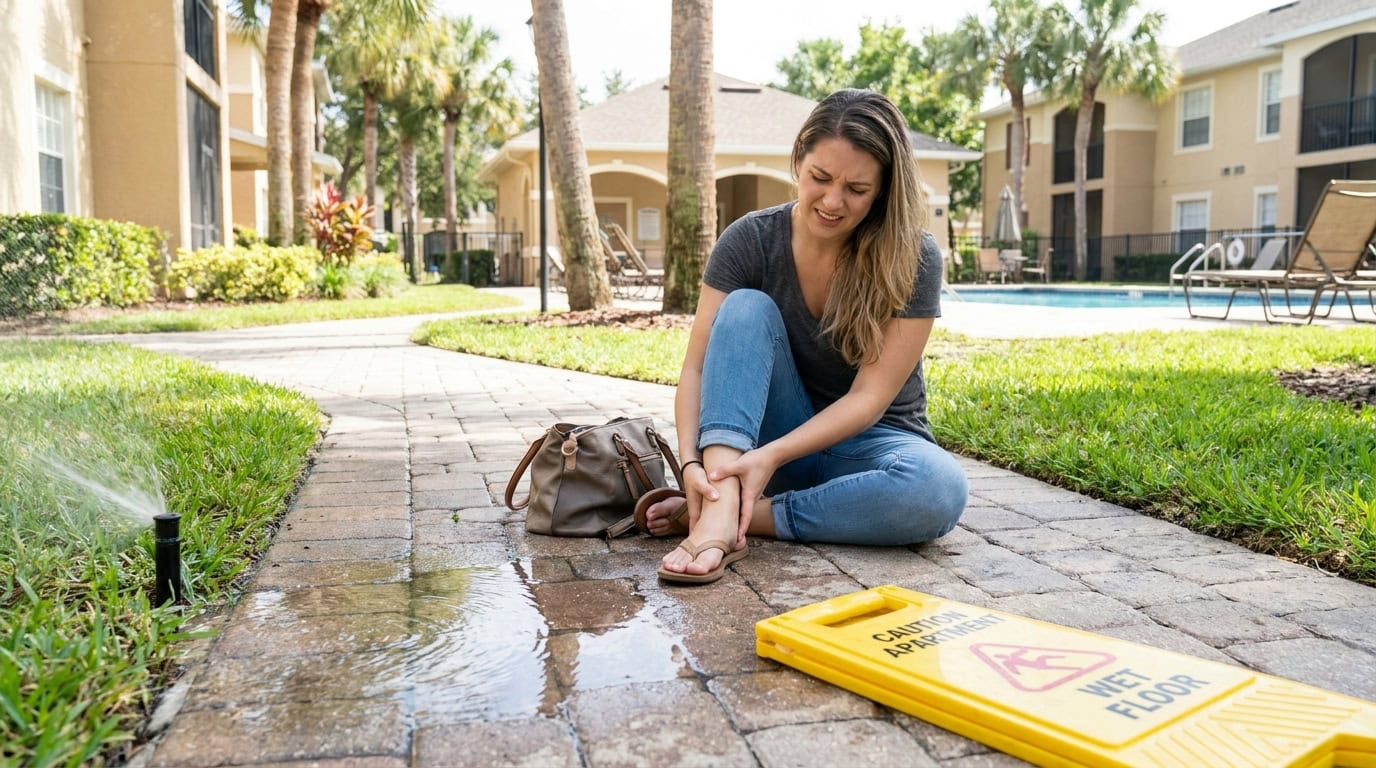
Understanding Landlord Liability in Florida Apartment Complexes
Premises liability in the Sunshine State is built upon the principle that property owners must maintain a safe environment for those they invite onto their land. Landlords aren't automatically responsible for every fall that occurs on their property, but they're legally obligated to prevent foreseeable harm. Consequently, owners must keep shared spaces safe and address hazards that could reasonably cause an injury to a resident or visitor.
Definition of Landlord Liability for Slip and Fall Accidents
Landlord liability in Florida makes a property owner financially responsible for injuries to tenants or guests caused by dangerous conditions in common areas. To establish a successful claim, a victim must prove:
- The landlord owed a legal duty of care to maintain the common area.
- The landlord breached that duty by ignoring a hazard they knew or should have known about.
- The hazardous condition directly caused the slip-and-fall accident.
- The victim suffered measurable physical and financial damages as a result.
Victims must prove that the hazardous condition directly caused their physical damages and financial losses. Establishing this link requires evidence that management failed to take reasonable measures to fix the danger or warn residents about it.
What Is Premises Liability Under Florida Law?
Under Florida law, rent-paying tenants and their guests are classified as invitees. In Fieldhouse v. Tam Investment Co., 959 So. 2d 1214 (Fla. 4th DCA 2007), the Fourth District Court of Appeal held that landowners owe invitees a duty to use reasonable care in maintaining the premises. This legal standard means landlords must routinely inspect the property, promptly repair known hazards, and warn visitors of non-obvious dangers.
What Are a Landlord's Maintenance Duties Under Florida Statute 83.51?
Florida Statute Section 83.51 provides a specific legal framework for landlord responsibilities regarding property maintenance. This law mandates that landlords of multi-family dwellings must comply with all applicable building, housing, and health codes. The statute requires that structural components like floors, steps, porches, and exterior walls remain in good repair.
Section 83.51(2)(a)3. is particularly important for cases involving shared spaces. It states that landlords must make reasonable provisions for the clean and safe condition of common areas at all times. Under these statutory rules, the landlord is responsible for ensuring that hallways, walkways, and other shared areas don't become hazardous to residents.
When a landlord violates these statutory requirements, that violation is strong evidence of negligence. Depending on which code provision was broken, it can also support a negligence per se argument, which treats the violation itself as the breach of duty. Either way you still have to prove that the violation is what caused your fall and your injuries.
Landlords are expected to conduct regular checks of the property at reasonable intervals. The law doesn't allow them to remain willfully ignorant of dangerous conditions that exist in the common areas. If a structural component, such as a stairwell floor, isn't in good repair, the landlord has breached their legal obligation to the tenant.
Common Areas vs. Individual Units: Where Does Landlord Responsibility Apply?
There's a clear geographical distinction between a tenant's private rental unit and the shared spaces of an apartment complex. While a tenant is generally responsible for hazards they create inside their own locked apartment, the landlord retains control over the shared zones. Because the landlord retains exclusive access to and control over shared zones, they bear the legal responsibility for keeping those pathways safe for everyone.
Breezeways, Courtyards, and Walking Paths
Open-air breezeways, courtyards, and walking paths are frequently the sites of slip-and-fall incidents in apartment common areas. Florida's subtropical climate produces frequent heavy rainfall and high humidity, which can create slick walking surfaces in these exposed areas. Landlords must design these walkways with proper drainage systems to prevent water from pooling during a storm.
Maintenance neglect in these areas often involves failing to clear debris, mud, or organic buildup that reduces traction. Property managers have a legal obligation to conduct regular inspections and maintenance of these facilities to identify slick spots. When they ignore these duties, they create an environment in which residents are at high risk of falls.
Poor lighting in these outdoor areas can also hide existing hazards. Landlords should ensure that every walking path is adequately illuminated to reveal slippery patches or uneven pavement. If a resident falls because they couldn't see a puddle in a dark breezeway, the landlord may be held liable for the oversight.
Stairwells, Outdoor Staircases, and Handrails
Slippery or poorly maintained apartment staircases are among the most dangerous hazards in a residential complex. While a slip on a flat surface can cause injury, a fall on a concrete or metal staircase is frequently catastrophic. Landlords must ensure that all staircases have adequate non-slip tread and are illuminated by functioning light fixtures.
Florida building codes require owners to equip all staircases with secure, compliant handrails to prevent catastrophic falls. Poorly designed or defective handrails can make a staircase much more dangerous than it should be. Landlords must also monitor for water runoff from rain or from leaking roofs, which frequently make outdoor stairs slick.
Regular checks ensure that risers are of the correct height and that lighting conditions don't obscure hazards. If a landlord fails to address these structural or environmental issues, they may be held liable for the resulting damages.
Laundry Rooms and Shared Amenities
Indoor shared common areas, such as laundry rooms and fitness centers, are prone to specific moisture hazards. Leaking washing machines or dripping plumbing fixtures can create immediate slip hazards on hard flooring. Additionally, overflowing condensation lines from air conditioning units often discharge water onto the floor in these high-traffic rooms.
Landlords should implement a routine monitoring schedule for these areas to identify moisture accumulation. Routine monitoring requires actively checking for leaks and ensuring that appliance drainage systems are functioning properly. If a leak is detected, the landlord should immediately place warning signs or anti-slip mats in the affected area.
Failure to address standing water in a laundry room is a common form of landlord maintenance neglect. Residents expect these amenities to be safe for daily use.
Slippery Hazards in Florida Apartments: Algae, Leaks, and Flooring Neglect
Slippery walking surfaces in Florida apartment complexes often result from environmental factors and inadequate maintenance. Intense weather conditions in the state can cause property surfaces to degrade or become covered in biological growth. When a landlord fails to respond to these changes, they allow severe physical hazards to persist.
The Threat of Algae Growth on Concrete and Stairs
The combination of intense Florida heat and heavy afternoon downpours leads to rapid algal growth on concrete surfaces. The slick organic buildup frequently appears on outdoor staircases and breezeways that don't receive much direct sunlight. When algae becomes wet, it creates an incredibly slick surface that acts like a sheet of ice.
An algae-related slip-and-fall in a stairwell is foreseeable in Florida's climate. Landlords are legally required to pressure-wash and chemically treat these surfaces routinely to prevent buildup. Routine exterior cleaning remains a basic requirement for managing a multi-family property in a tropical environment.
Failure to clean these areas despite knowing how quickly algae grows represents a clear case of maintenance neglect. If a landlord allows algae to accumulate over several months, they're breaching their duty to keep common areas safe. The slickness of the organic growth makes it one of the most treacherous hazards found in apartment complexes.
Leaking Pipes, AC Condensation, and Water Pooling
Unaddressed pipe leaks or malfunctioning air conditioning lines often discharge water directly onto pedestrian paths. Property managers frequently defer these small maintenance tasks to cut costs. Over time, these ignored repairs escalate into severe safety risks for residents.
Poorly routed roof gutters can also cause water to pool in areas where residents are expected to walk. When a landlord ignores these mechanical defects, they're failing to satisfy their duty under Florida Statute 83.51. Simple repairs can prevent these hazards, but many property owners choose to save money rather than ensure safety.
Water pooling is especially dangerous when it occurs in poorly lit areas or near doorways. Residents may not see the puddle before they step into it, leading to a sudden loss of traction. Consistent monitoring of the property's mechanical systems is required to prevent these preventable accidents.
Neglected, Unmaintained, and Non-Slip-Resistant Flooring
The materials used for outdoor and high-traffic flooring in apartment complexes require specific finishes to remain safe. Concrete, tile, and wood walkways often need sealants or anti-slip materials to maintain traction when they're wet. Landlords must ensure that these finishes are reapplied as they wear down over time.
In some cases, landlords use cheap or slick materials during renovations that aren't appropriate for outdoor use. Improperly cleaned or waxed floors in common areas can also create dangerously slippery conditions. These decisions directly increase the likelihood that a resident or guest will suffer a serious fall.
Neglecting to maintain slip-resistant coatings constitutes negligence that can be documented in property records. If a surface has become smooth due to age and wear, the landlord has a duty to restore it to a safe condition.
Common Injuries Sustained in Florida Apartment Slip and Fall Accidents
A fall on a hard surface can result in verifiable medical emergencies, such as compound fractures or traumatic brain injuries. The severity of these physical damages directly dictates the long-term financial value of a legal claim. Common trauma seen in Florida premises liability cases includes:
- Traumatic Brain Injuries: Sudden impacts with concrete breezeways or tile pool decks frequently cause the brain to collide with the skull. Symptoms like delayed headaches or confusion might not appear immediately, making emergency room diagnostic imaging vital.
- Spinal Cord and Back Trauma: The violent twisting motion of a slip frequently causes spinal disc herniations or vertebral fractures. Severe cases require invasive surgeries and extensive physical therapy, resulting in medical bills that easily exceed $100,000 in the first year alone.
- Hip Fractures and Joint Dislocations: Older residents who fall on unmaintained walking paths face a high risk of hip fractures requiring surgical intervention. Ankle and knee dislocations also frequently occur when a foot catches on uneven pavement, often leading to early-onset arthritis and lifelong mobility limitations.
Proving Landlord Liability: The Notice Requirement
Under Florida premises liability law, proving that you fell and suffered an injury isn't enough to win a case. The legal system requires more than just the existence of a hazard and a resulting injury. The injured party must establish that the landlord had prior knowledge of the dangerous condition and failed to act.
Actual Notice vs. Constructive Notice in Premises Liability
Establishing notice requires proving the landlord knew or should have known about the hazard. In Florida premises liability cases, this falls into two distinct categories:
| Type of Notice | Definition | Common Examples |
| Actual Notice | The property manager or maintenance staff had direct, explicit knowledge of the slippery hazard but failed to correct it. | A tenant calling the office to report a leaking AC unit or submitting a written maintenance request through an online portal. |
| Constructive Notice | The hazard existed for a sufficient length of time, or occurred so regularly, that the landlord should have discovered it through ordinary care. | A breezeway covered in weeks of visible algae growth, or a walkway that predictably floods during every rainstorm. |
What Are Transitory Foreign Substances Under Florida Statute 768.0755?
Florida law treats transitory foreign substances differently from permanent structural defects, such as broken stairs. These substances include temporary hazards such as spilled beverages, fresh rainwater, or leaked motor oil on a breezeway. Florida Statute 768.0755 by its own terms covers a slip and fall on a transitory foreign substance in a business establishment, and landlords and their insurers routinely argue it governs falls in apartment common areas too.
A plaintiff must prove the business establishment had actual or constructive knowledge of the dangerous condition and should have taken action to remedy it. Meeting the statutory burden requires showing that the hazard existed for a period long enough that a reasonable inspection would've uncovered it. Documentation, like surveillance footage or maintenance logs, becomes vital in these specific cases.
Business owners and apartment complex managers have specific legal obligations to monitor these substances. They must implement a system to promptly detect and remove such hazards. If they fail to follow these protocols, they may be held liable for negligence in court.
The Role of Written Maintenance Requests and Tenant Logs
Attorneys use physical and digital evidence to prove that a landlord was aware of a dangerous condition. Documenting past tenant maintenance requests is one of the most effective ways to establish notice. Online portal submission logs, sent emails, and text messages provide a clear timeline of when the landlord was notified.
A paper trail showing that multiple tenants complained about a slippery stairwell weeks before an accident provides powerful evidence. These records strongly counter a landlord's defense that they were unaware of the hazard, shifting the case from an unpredictable accident to a matter of documented neglect.
In many cases, maintenance logs will show that a landlord acknowledged a problem but failed to finish the repair. If a worker visited a site to look at a leak but didn't fix it, the landlord's liability is even clearer. These records are often obtained through discovery in a personal injury lawsuit.
Calculating the Financial Value of a Florida Slip and Fall Claim
The total value of a slip-and-fall claim depends on the combined economic and non-economic damages. Calculating these figures requires a thorough audit of all current and future expenses related to the injury. Legal teams use medical experts and vocational specialists to determine the full extent of a victim's losses.
Determining Economic Damages
Economic damages include the quantifiable financial losses a victim incurs after a fall. Financial recovery covers emergency room bills, surgical costs, and ongoing physical therapy appointments. It also includes the wages you lost while you were unable to work during your initial recovery.
For victims with permanent disabilities, economic damages include the loss of future earning capacity. If you can no longer perform the duties of your previous job, the landlord is responsible for the difference in your lifetime income. Employment data and medical testimony support these figures to ensure their accuracy.
Evaluating Non-Economic Damages
Non-economic damages compensate victims for the intangible impact of an injury, such as pain and suffering. These damages address the emotional distress and loss of enjoyment of life caused by chronic physical pain. A premises liability claim carries no injury threshold for these damages. That threshold belongs to Florida car accident claims, where the no-fault law limits non-economic recovery to victims with a permanent injury.
Loss of consortium is another form of non-economic damage that applies to the victim's family members. The law recognizes the heavy emotional strain an injury puts on marital relationships and the support a victim can provide at home. Because these damages are subjective, they're often the most contested part of a personal injury settlement.
The Discovery Process: How Attorneys Uncover Evidence of Maintenance Neglect
Once a lawsuit is filed, the formal discovery phase begins. In our experience representing Florida tenants, corporate property managers rarely hand over incriminating documents voluntarily. We routinely use court-ordered discovery to compel disclosure of internal emails, maintenance logs, and prior tenant complaints that reveal a historical pattern of maintenance neglect.
Subpoenaing Internal Communications and Records
Attorneys can legally demand internal emails, surveillance video footage, and employee cleaning logs during discovery. These documents often reveal whether the landlord knew about a hazard but chose to ignore it. A property manager might've sent an email complaining about a broken gutter months before it caused a fall.
Maintenance contracts and records of prior injuries in the same common area are also subpoenaed. If the landlord has a history of accidents in the same stairwell, it proves the area was a known danger. Conducting such an extensive corporate investigation is nearly impossible for an individual without a legal team.
The Use of Forensic Experts and Reconstruction
Forensic engineers use specialized equipment to measure the coefficient of friction on slippery surfaces. These experts provide objective evidence of whether a floor was dangerously slick under industry safety standards. Their testimony often serves as the scientific foundation of a successful premises liability claim.
Light meters are also used to calculate the precise illumination levels in breezeways and stairwells. If the light levels are below the required local building code threshold, it provides evidence of the owner's negligence. These expert findings are difficult for insurance companies to dispute during settlement negotiations.
What Should I Do After a Slip-and-Fall in a Florida Apartment Complex?
The actions you take in the minutes and hours following a fall are essential for your legal rights. These steps help preserve evidence and establish a record of the incident before the property owner can change the scene. Taking immediate action is the best way to protect a future claim from being undermined by insurers.
Seek Medical Attention and Establish a Record
Seeking immediate medical care from an emergency room or urgent care center is the priority after a fall. An immediate evaluation by a physician establishes an official link between the slippery surface and the physical injuries sustained. It prevents insurance companies from claiming that the injuries happened in a different location.
A medical record provides an uncontestable timeline of your physical condition following the accident. Even if injuries seem minor at first, some symptoms, like back pain, may take days to become fully apparent. Having a professional assessment ensures that all damages are documented from the start.
Take Photos and Videos of the Slippery Hazard
Capturing visual evidence of the scene is a necessary step to prevent management from cleaning the hazard and denying it existed. If you are physically able, gather the following photographic evidence before leaving the scene:
- Take clear, time-stamped photographs of the specific substance that caused the slip.
- Capture wide-angle shots of the immediate surroundings to show lighting conditions and a lack of warning signs.
- Photograph the footwear you were wearing to prove your shoes were appropriate for walking.
Obtain Witness Statements and Reporting
Witness testimonies provide immense value to a premises liability claim. Neighbors or other visitors who saw the fall can provide an unbiased account of what happened. They can also testify to the long-standing presence of the slippery hazard, such as a stairwell that's always wet.
Reporting the accident to the property management office is required to start the claims process. Tenants should submit a formal written report to ensure there's a record of the notification. You should request a copy of the internal incident report and keep it for your own legal files.
Preventing the Spoliation of Evidence
Corporate landlords sometimes attempt to repair a broken stairwell or delete surveillance footage immediately after a resident falls. In Florida, the destruction or alteration of evidence is known as spoliation, and it can severely prejudice a victim's claim. A personal injury attorney will immediately issue a formal spoliation letter demanding that management preserve all maintenance logs, video recordings, and evidence of the accident scene's physical condition until a thorough independent inspection is completed.
The Role of a Florida Personal Injury Attorney in Your Slip and Fall Case
A premises liability claim against a corporate landlord or its commercial insurer is a fight between very unequal sides. These entities have significant resources and legal teams dedicated to denying or reducing the value of claims. Professional legal representation is necessary to level the playing field and ensure your rights are protected.
Combating the Comparative Fault Defense
Florida follows a modified comparative fault rule. Under Florida Statute 768.81(6), a party found to be greater than 50 percent at fault for his or her own harm may not recover any damages at all. Because of the modified comparative fault threshold, your legal team must build an airtight argument that assigns most of the liability to the landlord. The filing clock is short as well. Under Section 95.11(5)(a), a negligence claim that accrued on or after March 24, 2023 must be filed within two years of the fall.
Landlords often use the open and obvious defense, claiming that the hazard was so obvious that you should've avoided it. A skilled attorney knows how to counter these tactics by focusing on the landlord's primary duty to maintain safe premises.
Negotiating with Insurers for Full Compensation
An attorney refuses to accept lowball insurance settlement offers that don't fully cover your damages. They're prepared to take the case to trial if the insurance company refuses to offer a fair amount. Taking a hostile stance toward lowball offers forces insurers to take the claim more seriously during negotiations.
In some cases involving gross negligence, punitive damages may also be available under Florida Statute 768.72. These are intended to punish the landlord and deter similar behavior in the future. A dedicated legal team fights for every dollar you're owed, punitive damages included where the facts support them.
Speak With a Fort Lauderdale Slip and Fall Attorney
If you or a loved one has suffered an injury from a slip-and-fall in an apartment complex, our team is here to help. Weinstein Legal Team provides aggressive representation for victims in Fort Lauderdale, West Palm Beach, Orlando, and throughout the State of Florida. Our goal is to ensure you receive full compensation for your medical bills, lost wages, and pain and suffering while holding negligent property owners accountable for their actions.
Contact us today for a free, no-obligation case review to discuss the details of your accident. We operate on a contingency fee basis, which means you pay nothing unless our attorneys secure a recovery for you. You will not owe attorney's fees or costs unless we recover for you.