
- A college student facing a drug arrest in Florida must simultaneously navigate independent criminal court proceedings and administrative university disciplinary hearings, risking immediate campus eviction and interim class suspensions.
- Under Florida Statute 1009.531, entering a guilty or no-contest plea to a felony drug charge results in the permanent disqualification from a Florida Bright Futures scholarship, even if a judge withholds adjudication.
- Although a misdemeanor marijuana conviction does not trigger automatic statutory exclusion, the resulting academic disruption can cause students to fall below required GPA and credit hour thresholds, leading to state financial aid forfeiture.
- While the FAFSA Simplification Act largely removed drug convictions as a barrier to federal aid, students can still lose Pell Grants and Direct Student Loans indirectly through academic suspension or specific judicial holds for trafficking offenses.
- Because any statements made during a university code of conduct hearing can be subpoenaed by state prosecutors, avoiding self-incrimination is a crucial legal strategy for protecting a student's pending criminal defense.
- Securing entry into a Pre-Trial Diversion or Pre-Trial Intervention program can help first-time offenders earn a complete dismissal of charges, effectively protecting their criminal record and long-term eligibility for Florida financial aid.
A college student drug charge in Florida creates an immediate risk to both financial aid and academic standing. For many students, this means the potential loss of a Florida Bright Futures scholarship, which covers up to 100% of tuition at public institutions.
Managing both the criminal justice deadlines and the university's internal disciplinary schedule is critical to preserving your eligibility for state and federal financial assistance after an arrest.
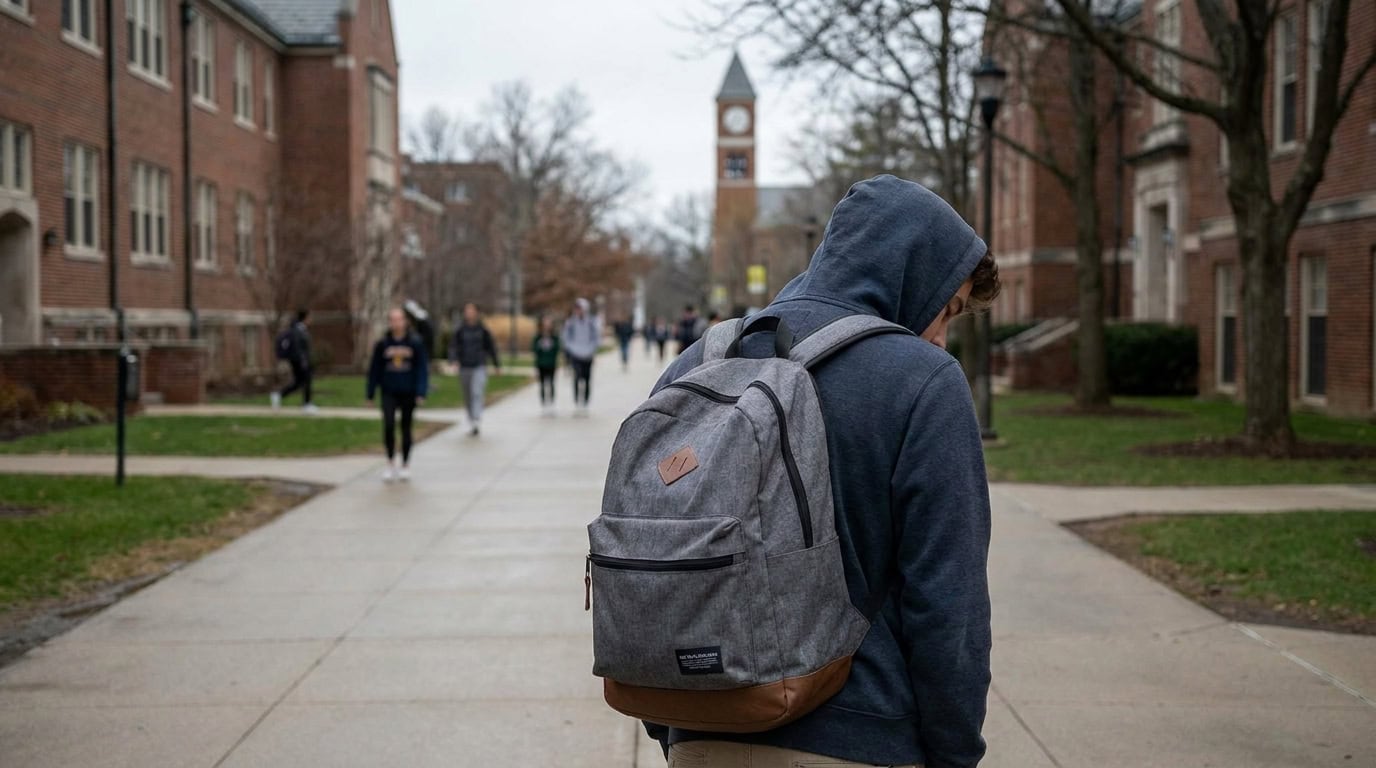
Immediate Risks of a College Student Drug Charge in Florida
Students facing drug charges in Florida face parallel proceedings that operate on different timelines and under separate rules. While the criminal justice system determines legal guilt, the university administration operates an independent disciplinary process. Because these tracks run simultaneously, campus consequences often occur long before a student enters a criminal courtroom.
The Dual Burden of Criminal and University Proceedings
Florida public universities maintain close communication with local law enforcement through established memorandums of understanding. These institutions often receive notifications when a student is booked into a county jail on drug-related charges. Once the university is notified, the dean of students typically initiates an internal investigation regardless of the criminal case status.
University disciplinary proceedings are administrative and function independently of the state court system. A student might face campus penalties even if a prosecutor drops the criminal charges. The school focuses on whether the student violated the university code of conduct rather than proving a crime beyond a reasonable doubt.
Managing both cases simultaneously requires a strategic approach. Prosecutors will not pause criminal proceedings for university hearings, and universities will not wait for state courts to reach a verdict before imposing disciplinary sanctions.
Loss of Housing and Interim Class Suspensions
Residential students face additional risk because university housing contracts typically include strict drug-free clauses. Upon notice of an arrest, housing departments often issue emergency evictions or interim bans from campus property. These actions can happen within days of the arrest, leaving students without a place to live or access to their belongings.
Being suddenly banned from campus housing forces students to scramble for off-campus accommodations, creating severe financial and logistical stress. More critically, an interim academic suspension can bar a student from attending classes, submitting assignments, or taking exams, which can lead to a complete loss of academic credit for the semester.
These emergency administrative measures are applied before a formal hearing occurs. Because universities prioritize campus safety and policy compliance, they take swift action that can disrupt a student's studies, often resulting in academic failure before the student has an opportunity to present a formal defense.
Bright Futures Scholarship Eligibility After a Drug Arrest (Florida Statute 1009.531)
A student will permanently lose their Florida Bright Futures scholarship if they are found guilty of, or plead no contest to, any felony drug charge. Misdemeanor drug convictions do not cause automatic forfeiture, but the resulting academic suspension can drop a student's GPA below the mandatory renewal thresholds.
The Florida Bright Futures Scholarship Program is a lottery-funded initiative designed to reward high school graduates for completing a specific curriculum and community service requirements. Florida Statute 1009.531 governs Bright Futures scholarship eligibility and sets strict rules for maintaining these funds. Because this program follows rigid state laws, a drug arrest often leads to the permanent loss of these awards.
Felony Convictions and Statutory Ineligibility
Florida Statute 1009.531(1)(e) outlines the general requirements for maintaining a Bright Futures award. According to these rules, a student is ineligible if they have been found guilty of, or pled nolo contendere to, a felony charge. The statutory exclusion remains in effect unless the student receives clemency from the Governor and Cabinet, sitting as the Executive Office of Clemency.
Florida Administrative Code Rule 6A-20.028 provides further clarification on how these rules apply to college students. A student loses their scholarship if they enter a no-contest plea to a felony charge, even if the judge withholds adjudication. Although a withhold of adjudication prevents a formal criminal conviction on an individual's record for most purposes, Florida administrative rules explicitly treat a withhold on a felony charge as a disqualifying event for Bright Futures eligibility.
Proper legal representation is necessary during plea negotiations to avoid these statutory traps. A felony plea of any kind generally results in the immediate and permanent disqualification from the program. Once the scholarship is lost due to a felony record, the financial burden of tuition falls entirely on the student.
Misdemeanor Marijuana and Renewal Thresholds
While a misdemeanor charge does not trigger the automatic felony exclusion under Florida Statute 1009.531, a conviction for possession of cannabis under 20 grams carries other severe collateral consequences. Under Florida Statute 893.13, possessing under 20 grams of marijuana is a first-degree misdemeanor punishable by up to one year in jail and a $1,000 fine. Crucially, under Florida Statute 322.055, any misdemeanor drug conviction results in a mandatory six-month driver's license suspension, which can severely impact a student's ability to commute to campus and maintain their classes.
A misdemeanor arrest disrupts daily life, frequently leading to missed classes and plummeting grades. If a student's unrounded and unweighted cumulative grade point average falls below 3.0 for Florida Academic Scholars or 2.75 for Florida Medallion Scholars, they lose their scholarship funding.
Students must also complete a specific number of credit hours based on their enrollment type each term. If an arrest leads to dropping classes, the student may face scholarship forfeiture for failing to meet earned hour requirements. While some students are permitted a one-time restoration for GPA issues in their first year, failing credit hour requirements usually ends eligibility.
Record Sealing and Juvenile Adjudications
There are specific exceptions within Florida law that allow students to protect their scholarship through record sealing or expungement. Under Florida Administrative Code Rule 6A-20.028, a student is not considered to have a felony conviction if a court order has sealed their record. Record sealing provides a legal pathway for students to remain eligible for state aid following a favorable case resolution.
Similar protections apply to individuals whose cases were handled within the juvenile court system. A student who was tried as an adult but adjudicated delinquent in a juvenile proceeding also avoids the felony disqualification. These administrative rules reinforce the importance of reaching a legal resolution that preserves the possibility of clearing a criminal record.
Achieving a result that allows for expungement requires a strategic approach from the moment the arrest occurs. If a student successfully has their plea removed from their record by a court, they can truthfully answer no to felony questions. This proactive legal step is often the only way to restore long-term eligibility for Florida state financial aid.
FAFSA Eligibility Drug Conviction Rules and Federal Aid
Federal student financial assistance is governed by Title IV of the Higher Education Act, which establishes the rules for Pell Grants. While state aid is strictly governed by Florida law, federal aid follows a separate set of evolving federal regulations. Recent legislative changes have significantly altered how drug offenses impact a student's ability to receive this aid.
Current FAFSA Guidelines Under the FAFSA Simplification Act
The FAFSA Simplification Act eliminated the historical drug conviction eligibility restriction, meaning the U.S. Department of Education has removed all questions regarding drug offenses from the application. Students are no longer required to disclose drug convictions when applying for federal student aid, and a history of drug charges no longer blocks access to Direct Student Loans, Pell Grants, or federal work-study, unless a federal drug abuse hold is actively in place.
Judicial Holds and Reject 19 Codes
While the FAFSA form no longer asks about drug convictions, the Anti-Drug Abuse Act of 1988 still authorizes state and federal judges to deny federal student aid benefits upon conviction of drug trafficking or possession. If a judge issues such a denial, the student is placed in a federal hold file managed by the U.S. Department of Education.
When an applicant's details match this hold file, the FAFSA Processing System rejects the application. Financial aid administrators identify this block as a 'Reject 19,' which generates Comment Code 009 or 055 on the student's FAFSA Submission Summary, barring them from receiving Title IV federal aid until the judicial hold expires or is formally lifted.
These judicial holds are relatively rare but remain a powerful tool for the court system in serious drug cases. They represent a direct link between a criminal conviction and the immediate suspension of financial assistance. Students facing trafficking charges or multiple possession counts are at the highest risk for this type of federal benefit denial.
Indirect Loss via Academic Standing
Drug charges frequently lead to a loss of federal aid through indirect means related to academic standing. To maintain eligibility for Title IV federal funds, a student must be enrolled at least half-time and meet their institution's Satisfactory Academic Progress standards. If a university suspends or expels a student following a drug arrest, the student's enrollment is terminated, halting federal aid disbursements immediately.
Losing active enrollment status can also trigger immediate repayment obligations for student loans that have already been distributed for that term. Consequently, navigating the campus disciplinary process is just as crucial to a student's financial survival as defending against the criminal charges.
Maintaining Satisfactory Academic Progress also requires students to complete at least 67% of their attempted coursework. The stress of a drug case can lead to failing grades or withdrawals, which may cause a student to fall below this percentage. Once a student fails to meet these institutional standards, they lose their eligibility for federal aid until they can regain good standing.
Navigating University Code of Conduct Hearings
Campus disciplinary proceedings are separate from criminal court and often move at a much faster pace. These hearings represent a distinct legal challenge that requires a different approach than a standard criminal defense. Students must understand the mechanics of these boards to avoid making mistakes that could end their academic careers.
How Florida University Student Conduct Committees Operate
University disciplinary boards at major Florida institutions use the "preponderance of the evidence" standard of proof. This administrative threshold is significantly lower than the "beyond a reasonable doubt" standard required for a criminal conviction. Under the preponderance standard, a student can be found responsible for a conduct violation if the committee determines there is a greater than 50% chance (more likely than not) that the infraction occurred.
Student conduct committees have the authority to impose a wide range of severe penalties based on their findings. These can include official reprimands, disciplinary probation, or the loss of specific campus privileges. In more serious cases involving drug distribution or repeat offenses, the committee may choose to impose suspension or permanent expulsion.
The lack of formal legal procedures in these hearings can be confusing for students and parents. There is typically no right to cross-examine witnesses in the same way allowed in a courtroom, and the rules of evidence are broader. Understanding these administrative nuances is necessary for presenting a coherent defense to the conduct officer or committee.
| Comparison Feature | Florida Criminal Court System | University Student Conduct Committee |
| Standard of Proof | Beyond a reasonable doubt (extremely high standard of guilt) | Preponderance of the evidence (more likely than not, which is a 51% threshold) |
| Role of Attorney | Full representation: your attorney can speak, argue, and cross-examine witnesses on your behalf | Advisor role only: your attorney can sit with you to advise but is typically barred from speaking directly to the committee |
| Typical Timeline | Several months to over a year to resolve charges | Extremely swift, often fully resolved within a few weeks of the incident |
| Potential Outcomes | Jail time, probation, court-ordered fines, permanent criminal record, or driver's license suspension | Disciplinary probation, suspension, campus housing eviction, or permanent expulsion |
| Rules of Evidence | Strict statutory rules of evidence: hearsay is generally excluded, and constitutional rights are protected | Broad, informal rules: hearsay is widely accepted, and there is no formal discovery process |
Self-Incrimination Risks
One of the most significant risks during a campus investigation is the potential for self-incrimination. Any verbal or written statements a student makes during a university conduct hearing can be subpoenaed by state prosecutors. These statements can then be used as evidence in the pending criminal case, potentially damaging the legal defense.
Struggling students often feel immense pressure to explain their side of the story to administrators in an attempt to remain enrolled, but speaking without legal counsel is highly risky. Under Florida law, any admissions made to a campus administrator or written in a disciplinary statement can be introduced by prosecutors in criminal court, holding the same evidentiary weight as a direct statement to law enforcement.
A criminal defense lawyer can help guide all communications with university conduct officers to mitigate these risks. Counsel can ensure that the student's response to the university does not inadvertently provide the state with evidence. Protecting the student's record in court must remain a priority while simultaneously addressing the university's concerns.
Legal Strategies to Protect Scholarship After Drug Arrest
An arrest for a drug offense is an accusation rather than a final judgment of guilt. There are several proactive legal strategies available in Florida that can help a student avoid a conviction and preserve their funding. By addressing the charges early, it's often possible to achieve a resolution that minimizes the impact on a student's education.
PTD and PTI Programs
Many judicial circuits in Florida offer diversion programs for first-time offenders facing misdemeanor or low-level felony drug charges. These programs, such as Pre-Trial Diversion or Pre-Trial Intervention, allow a student to earn a dismissal of charges. Participants must typically complete requirements like community service, drug education classes, or random screenings.
When a student completes a diversion program, the State Attorney's Office files a nolle prosequi, which means the charges are dropped. This outcome is highly favorable because it prevents a criminal conviction from appearing on the student's record. A full dismissal through diversion protects Bright Futures eligibility and maintains the student's standing for federal aid.
Securing entry into a diversion program requires prompt intervention. An attorney can present a comprehensive mitigation packet to the prosecutor (highlighting the student's clean record, academic achievements, and positive character) to negotiate enrollment before formal charges are even filed. Once the diversion program is completed and the charges are dismissed, the student becomes eligible to have their arrest record sealed or expunged.
Avoiding Felony Pleas
In cases where a complete dismissal is unattainable, plea negotiations must focus on avoiding any felony resolution, even with a withhold of adjudication. Because a felony plea of any kind disqualifies a student from Bright Futures, defense counsel must aggressively negotiate to reduce the charges to a misdemeanor.
If a drug charge is successfully reduced to a misdemeanor, a withhold of adjudication will not trigger automatic scholarship forfeiture under Rule 6A-20.028. However, the student must still satisfy any probationary requirements and maintain their academic standing to ensure they remain above the GPA and credit-hour renewal thresholds.
An experienced Florida criminal defense attorney manages the intersecting crises of a student drug arrest. Skilled counsel not only defends against formal state charges in court but also guides the student through the university's disciplinary timeline, preventing mistakes in one forum from damaging the other.
Your attorney will identify key constitutional defenses, such as challenging the legality of a vehicle search, a dorm room sweep, or the validity of a search warrant. If law enforcement violated your Fourth Amendment rights, filing a motion to suppress can exclude the drug evidence entirely, often forcing the state to dismiss all charges.
Speak To A Florida Defense Lawyer About Your Charges Today
A drug arrest in Florida creates an immediate threat to a student's Bright Futures scholarship, FAFSA eligibility, and university standing. While felony charges carry the risk of automatic disqualification from state aid, even misdemeanor charges can lead to scholarship loss through academic decline. Navigating the complex rules of Florida Administrative Codes and the FAFSA Simplification Act requires a strategic legal approach to avoid a permanent criminal record.
Early intervention by a dedicated defense attorney can help students secure entry into diversion programs that preserve their financial assistance. By addressing both the criminal court case and the university disciplinary process, it is possible to mitigate the damage caused by an arrest. Protecting your educational investment starts with building a strong defense against these accusations from the very beginning.
Weinstein Legal Team understands the high stakes involved for college students and their families. We provide aggressive representation and personalized advocacy to help you contest drug charges and defend your educational future. If you or your child is facing a drug arrest in Florida, contact us today for a confidential consultation to discuss how we can safeguard your legal rights and academic enrollment.