
- Fla. Stat. s. 316.193(1) makes it an offense to be "driving or in actual physical control" of a vehicle while impaired, so a parked car with the engine off can still support a DUI charge.
- Actual physical control is a question of fact for the jury in Florida. In Fieselman v. State, 566 So. 2d 768 (Fla. 1990), the Florida Supreme Court held that sitting behind the wheel heavily supports a finding of control, but that a key in the ignition does not decide it by itself.
- Moving to the rear seat and putting the keys somewhere you cannot reach, such as a locked trunk, weakens the state's case on capability, though neither step is a defense on its own.
- A first conviction carries the same penalties whether or not the car moved: under s. 316.193(2)(a), a fine of $500 to $1,000 and up to 6 months in jail, rising under s. 316.193(4) to $1,000 to $2,000, up to 9 months and a 6-month ignition interlock if the level was 0.15 or higher or a person under 18 was in the vehicle.
- Since October 1, 2025, ch. 2025-121 has made a first refusal of a lawful breath or urine test a second-degree misdemeanor under s. 316.1939, on top of the 1-year license suspension under s. 316.1932. Blood tests are not covered by s. 316.1939.
- Defenses include GPS or rideshare data showing the vehicle never moved, challenging the scope of a community caretaking welfare check, and proving the vehicle was inoperable.
Yes, you can be charged with DUI in Florida while asleep in a parked car. Fla. Stat. s. 316.193(1) makes it an offense to be "driving or in actual physical control of a vehicle" while impaired or at a breath or blood alcohol level of 0.08 or higher. The car does not have to move.
What the state still has to prove is actual physical control, and that is a fact question rather than a rule. Florida appellate courts have declined to make any single fact decide it. Where you were sitting, where the keys were, whether the engine was running and whether the car could be driven at all all feed into the answer, and cases with similar facts have come out differently.
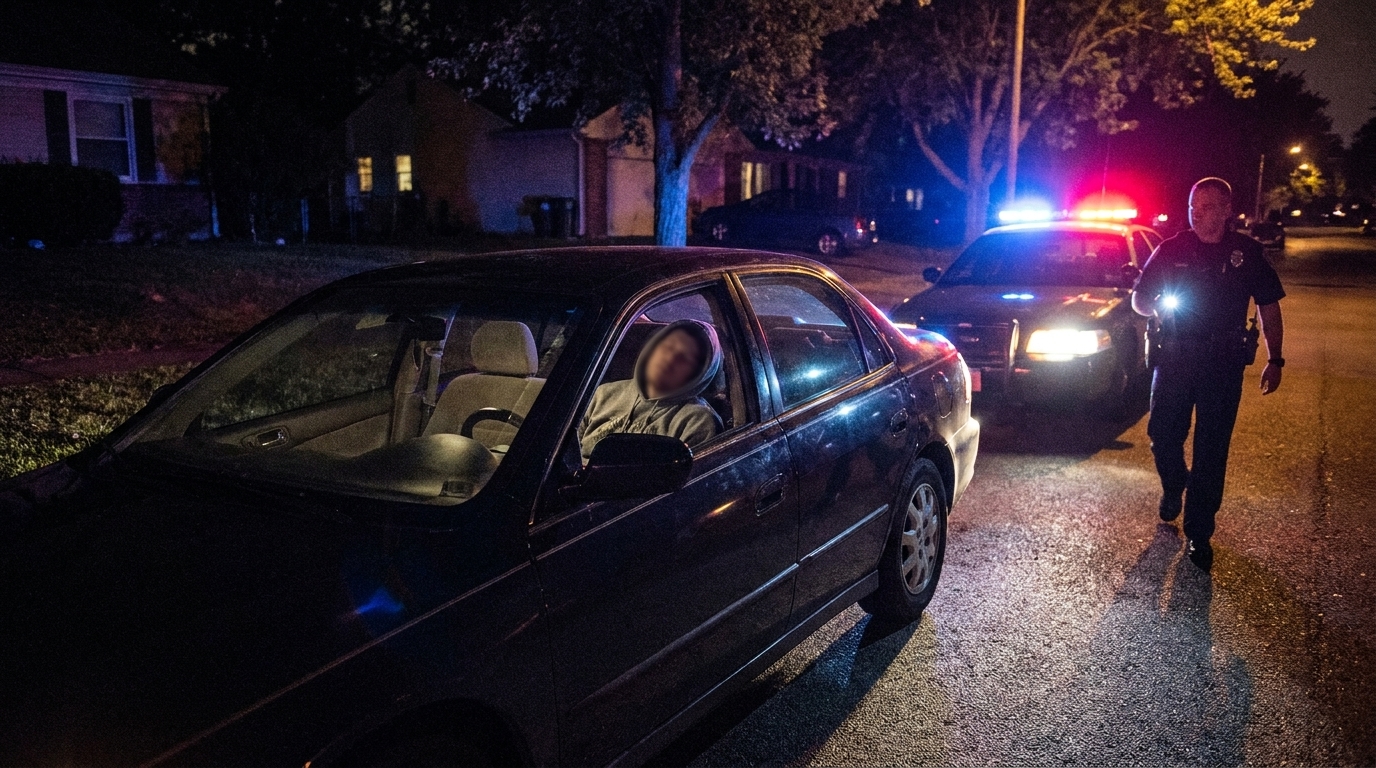
Understanding Florida's DUI Laws Beyond the Act of Driving
Most people associate a DUI charge with a vehicle moving down a highway or through a city intersection. However, Florida law is much broader than the mere act of operating a moving car. Florida Statute 316.193 establishes the legal thresholds for impairment.
The state uses a legal standard known as actual physical control to determine if a stationary person is violating the law. Prosecutors focus on this standard because the state's primary concern is public safety. Law enforcement officers are trained to identify situations where an intoxicated person has the potential to put a vehicle in motion at any moment.
Florida's legislative intent is to prevent accidents before they happen by removing impaired individuals from the vicinity of a vehicle's controls. Because of this preventative approach, you can be arrested for simply sitting in your car while impaired. Understanding how the state defines control is necessary for anyone who chooses to wait in their vehicle.
If you're facing these allegations, a Florida DUI defense attorney can help you navigate the system. Our team understands that these cases often involve responsible people who were trying to do the right thing. We work to ensure that your attempt to stay off the road doesn't result in a permanent criminal record.
What is Actual Physical Control (APC)?
Actual physical control is the central legal concept that allows Florida to prosecute individuals for DUI in parked cars. It serves as the pivot point upon which stationary DUI cases turn. The actual physical control standard identifies the defendant's capability to operate a motor vehicle.
The Legal Definition of APC in Florida
Florida's standard jury instruction defines actual physical control as being physically in or on the vehicle and having the capability to operate it, whether or not the person is actually operating it at the time. "Actual physical control" is the phrase Fla. Stat. s. 316.193(1) uses, alongside "driving". Being asleep does not by itself put you outside it, and it does not by itself put you inside it either.
The precedent for this definition allows officers to arrest a driver even when they find the driver asleep. These legal interpretations establish that the driver's physical presence, combined with the accessibility of the controls, provides a basis for an arrest. The state argues that an intoxicated person could wake up and begin driving in an instant.
Regulating the capability to operate a vehicle ensures road safety for all Florida citizens. If you find yourself in this situation, it's helpful to review common legal questions about criminal procedure. Knowing the definitions used by the state is the first step in building a defense.
How Courts Interpret Physical Control Without Movement
Judicial interpretation of control focuses heavily on whether the defendant had the present ability to start the engine and move the car. The courts don't require the prosecution to prove that the defendant intended to drive. They need only show that the defendant could have driven if they had chosen to.
The judicial interpretation of actual physical control is designed to be preventative, allowing law enforcement to intervene before an intoxicated individual decides to wake up and drive. The judicial system often favors the prosecution's view of control unless a lawyer presents a strong defense. Because the law aims to stop impaired driving before it starts, the definition of control remains broad.
If the state can prove you had the immediate means to operate the vehicle, they will likely pursue a conviction. When the state relies on these broad interpretations, you need professional legal representation to push back. An attorney can argue that the potential for movement was non-existent under your specific circumstances.
Florida Case Law and Precedent
Florida's courts have spent decades refining what actual physical control means through specific cases. These rulings come from various appellate districts, including the Second and Fourth District Courts of Appeal. These precedents provide the roadmap that both prosecutors and defense attorneys use today.
Fieselman v. State and the Ignition Standard
In Fieselman v. State, 566 So. 2d 768 (Fla. 1990), the defendant was found asleep behind the wheel of a car parked in a lot with a cold engine. The Florida Supreme Court held that whether he was in actual physical control was a question for the jury, not something a court could resolve as a matter of law.
The opinion cuts both ways, which is why both sides cite it. Sitting upright behind the wheel is, in the court's words, a circumstance heavily supporting a finding of control. But evidence that the key was in the ignition does not inexorably lead to that conclusion. Fieselman is not authority that keys equal control; it is authority that a jury decides the question on the whole picture.
Baltrus v. State and Keys in Hand
In Baltrus v. State, 571 So. 2d 75 (Fla. 4th DCA 1990), the defendant was in a car parked in a restaurant lot with the car keys in his hands, and the Fourth District upheld the conviction. Later Florida decisions describe the inquiry the same way: whether the keys were in the ignition or near enough to be used to start the vehicle and drive away.
The practical lesson is that holding the keys is not safer than leaving them in the ignition. Neither position is decided by a rule, and both leave the question with a jury on the rest of the facts.
The Essential Criteria for a DUI Charge in a Stationary Vehicle
When a vehicle is not in motion, police officers cannot rely on moving violations like speeding or swerving to justify an arrest. Instead, they must rely on specific criteria and physical evidence to build a case for actual physical control. The following technical breakdown explains how law enforcement and prosecutors construct their arguments.
The Critical Role of Key Placement
The concept of constructive possession of car keys is a primary factor in establishing actual physical control. If an officer finds the keys in the ignition, the law almost always presumes that the occupant is in control of the vehicle. This remains true even if the engine is completely off and the occupant is in a deep sleep.
Scenarios involving other key locations, such as the dashboard or the center console, also affect the strength of the prosecution's case. If the keys are in the driver's pocket or sitting on the seat next to them, the state will argue the keys were within reach. Proximity to the keys establishes the capability to operate the vehicle and satisfies the requirements of the DUI statute.
Legal nuances regarding whether the keys were within reach can often determine the outcome of a case. If a person places the keys in a difficult-to-access location, such as the trunk or a locked glove box, the argument for control becomes much weaker. Prosecutors look for any evidence that suggests the intoxicated person had an immediate path to starting the engine.
The Driver's Position Inside the Vehicle
The specific location where an individual is found inside the car has significant legal implications. Sitting in the driver's seat often leads to the strongest claims of control from law enforcement. Even if the seat is fully reclined and the person is unconscious, being behind the wheel creates a strong inference of control.
In contrast, sleeping in the passenger seat or the back seat may provide a different legal narrative. While these positions don't offer an automatic defense, they make it harder for the state to prove control over the vehicle's operation. Many people choose the back seat as a strategic choice to sleep it off, and this can become a point of contention in court.
Courts examine the driver's position to determine whether they could easily reach the pedals and steering wheel. If an individual is found in the back of a large van or SUV, the distance from the controls may help a defense attorney. However, the proximity of the keys remains a factor regardless of which seat the person occupies.
Modern Challenges: Push-to-Start and Keyless Entry Systems
Automotive technology has significantly complicated the application of actual physical control laws in Florida. In the past, the "keys in the ignition" standard was a clear and objective measure of control. With the rise of proximity keys and push-to-start buttons, this standard is quickly becoming obsolete in modern vehicles.
A tech-savvy prosecutor might argue that having a key fob anywhere in the cabin satisfies the requirement for physical control. Because the car can be started with the push of a button as long as the fob is present, the capability to drive is always active. Even having the key fob in a pocket while standing near the car could potentially lead to an APC argument.
Remote start features also introduce new challenges for individuals trying to use their cars for climate control while sleeping. Many people start their cars remotely to run the air conditioning while they rest inside. An officer seeing a running car with an impaired person inside will likely presume the person is in control of the vehicle.
These technological shifts mean that the physical act of inserting a key is no longer the only way to prove control. Defendants with modern vehicles may face more aggressive prosecution because the barrier to starting the car is lower. Lawyers must now understand the technical specifics of keyless systems to defend these modern DUI cases effectively.
Hybrid and Electric Vehicle Challenges
Electric vehicles (EVs) and hybrids present unique problems for law enforcement and defense teams. These cars don't have a traditional internal combustion engine that produces heat while running. An officer cannot simply feel the hood to determine if the car was recently operated.
Law enforcement may use electronic system logs or dashboard light activity to prove the vehicle was active. If the car is plugged into a charger, it might complicate the argument for immediate driving capability. However, if the car is "on" and ready to shift into gear, the state will likely argue for actual physical control.
Defense attorneys must investigate the EV's specific power state during the encounter. If the vehicle was in "camp mode" or a similar stationary setting, it may provide a basis for a DUI parked-car defense. Technical knowledge of EV software is becoming a required part of modern criminal defense.
The Welfare Check Doctrine and Community Caretaking
Police officers often approach stationary vehicles under the guise of a welfare check to ensure the driver is safe. Known as the community-caretaking doctrine, this legal principle allows officers to initiate contact without reasonable suspicion of a crime. They may claim they wanted to see if you were experiencing a medical emergency or mechanical trouble.
A legal boundary exists where a community-caretaking encounter becomes a custodial interrogation or a criminal investigation. If the officer moves from checking your health to demanding a breathalyzer without new evidence, your rights may have been violated. Defense attorneys look for this transition point to file motions to suppress evidence gathered during the stop.
You should be aware that anything you say during a welfare check can quickly become evidence for a DUI charge. If the officer smells alcohol or sees an open container, the encounter shifts from a safety check to a criminal investigation. Recognizing this shift is how you protect your Fourth Amendment rights against unreasonable searches.
Circumstantial Evidence Used by Florida Prosecutors
In the absence of a moving violation, the state of Florida relies heavily on circumstantial evidence to prove its case. Prosecutors use various physical indicators and environmental factors to suggest intoxication.
Engine Heat and Recent Operation Indicators
Officers frequently use physical observations, such as a warm hood or warm tires, to argue their case in court. These indicators suggest that the defendant had recently been driving the car before pulling over to sleep. By establishing recent operation, the officer can imply that the defendant was impaired while the car was in motion.
Physical indicators, such as engine heat, are used to link a parked car to recent operation. For example, if an officer finds a car parked on the side of a highway with a ticking engine, they will assume the driver just stopped. The heat from the exhaust or engine serves as a silent witness to the vehicle's recent activity.
While engine heat is a common piece of evidence, it is not always definitive or indisputable. A defense lawyer might argue that someone else drove the car to that location. However, in most initial police reports, these physical signs are used to justify the officer's decision to investigate further.
Vehicle Location: Public Roadway vs. Private Property
Where the car is parked shapes how the law reads the situation. If a car is found on the shoulder of a highway or stopped in a traffic lane, there is a strong presumption of impairment. Being found on a public thoroughfare suggests the driver was a direct threat to other motorists.
The legal analysis changes if the vehicle is safely parked in a legal spot within a private parking lot or a residential driveway. If the vehicle is off the roadway and not blocking traffic, the argument for public danger begins to weaken. Prosecutors have a harder time proving that an intoxicated person in a private driveway was about to become a threat.
Despite these differences, Florida law still allows for arrests on private property if actual physical control is established. Being in a parking garage or a private lot does not provide total immunity from a charge. The location is simply one of many factors that a judge or jury will consider when weighing the evidence.
Physical Manifestations of Impairment
Observations made by the officer upon waking the individual are foundational to building probable cause. When an officer approaches a parked car, they look for bloodshot eyes, slurred speech, and the smell of alcohol. These physical manifestations of impairment suggest that the person's normal faculties were compromised.
The presence of open containers or alcohol packaging inside the vehicle adds another layer of evidence. If an officer sees empty beer cans or liquor bottles in plain sight, they'll include these details in their report. These items contribute to the narrative that the person was consuming alcohol and had control over the car.
These observations are combined with the actual physical control factors to create a comprehensive case for guilt. The officer will typically ask the individual to perform field sobriety tests after they are awake. The results of these tests form the basis for the formal DUI charge and subsequent legal proceedings.
The Role of Body-Worn Camera Footage in Stationary DUI Cases
Defense attorneys use body-worn camera footage to challenge an officer's claim of actual physical control. This video provides a direct record of the defendant's alertness and coordination upon being woken. It can often contradict the officer's written description of slurred speech or staggered walking.
Attorneys look for specific visual cues, such as the officer's initial tone and whether they followed proper protocol. If the video shows the driver was alert and oriented, the state's claim of impairment becomes much harder to prove. This footage is also used to evaluate whether the officer had a legitimate reason for the initial welfare check.
Evidence from these cameras can be the difference between a conviction and a dismissal. If the officer failed to document the exact location of the keys on camera, the defense can challenge their testimony. In many cases, the video serves as the most objective piece of evidence available to the court.
The Implied Consent Law and Stationary Vehicles
Florida's Implied Consent Law applies to anyone who accepts the privilege of driving in the state. This law mandates that you agree to submit to approved chemical tests of your breath, blood, or urine. Many people don't realize that this agreement also applies when the car is parked.
If an officer has probable cause to believe you were in actual physical control of a vehicle while impaired, the officer can request a test. Refusing carries two separate consequences, and people routinely hear about only one of them.
The first is administrative. Under Fla. Stat. s. 316.1932, refusing a lawful breath or urine test suspends your driving privilege for 1 year, or 18 months if your license was already suspended, or you were fined under the boating statute (Florida Statute 327.35215), for an earlier refusal. The Department of Highway Safety and Motor Vehicles imposes that suspension whatever happens in the criminal case.
The second is criminal, and it changed on October 1, 2025. Chapter 2025-121, Laws of Florida amended Fla. Stat. s. 316.1939 so that a first refusal of a lawful breath or urine test is itself a second-degree misdemeanor, punishable by up to 60 days in jail and a $500 fine. A later refusal is a first-degree misdemeanor when your license was already suspended, or you were fined under the boating statute (Florida Statute 327.35215), for refusing a breath, urine, or blood test, and the officer told you that refusing again would be a first-degree misdemeanor. Section 316.1939 covers breath and urine only; refusing a blood test is not charged under it. Anything you read saying a first refusal is only a license matter describes the law before October 2025.
In a parked car case, the probable cause for the request usually rests on the circumstantial evidence described above. The refusal itself is admissible against you in a criminal proceeding under s. 316.1932(1)(a)1.a.
The Penalties for an Actual Physical Control DUI Conviction
If you are convicted of a DUI while in a parked car, the consequences are the same as a traditional DUI conviction. Florida does not offer lighter sentences just because the vehicle was not in motion. A conviction will result in a permanent criminal record that can impact your future for years.
For a first conviction, Fla. Stat. s. 316.193(2)(a) sets a fine of not less than $500 and not more than $1,000, and imprisonment of not more than 6 months. The $1,000 to $2,000 range belongs to a second conviction, not a first.
If the blood or breath alcohol level was 0.15 or higher, or a person under 18 was in the vehicle, s. 316.193(4) raises a first conviction to a fine of $1,000 to $2,000, up to 9 months in jail, and mandatory placement of an ignition interlock device for not less than 6 continuous months. A first conviction that falls outside s. 316.193(4) does not carry a mandatory interlock. Section 316.193(2)(a)3. makes the device mandatory for at least 1 year on a second conviction.
In addition to fines and jail time, you'll be required to attend a DUI school and perform community service. Your insurance rates will likely skyrocket, and you'll have to pay for the installation of an interlock device.
Impact of a DUI on Professional Licenses
An APC DUI conviction can be devastating for individuals who hold professional licenses in Florida. Doctors, nurses, pilots, and commercial drivers (CDL holders) face strict reporting requirements to their respective boards. A criminal conviction can lead to the suspension or revocation of your right to work.
The Florida Board of Nursing and other regulatory bodies view alcohol-related arrests with significant concern. They may require you to enter into a monitoring program or undergo substance abuse evaluations. Even if you don't lose your license, the disciplinary action becomes part of your public professional record.
For CDL holders, even a first-time conviction can result in a one-year disqualification of their commercial driving privileges. This often means the immediate loss of employment for those in the trucking or transportation industry. Protecting your professional future requires a proactive and aggressive legal defense from the start.
Common Misconceptions About "Sleeping It Off" in Florida
There is a widespread myth that sleeping in a car is a safe harbor that protects you from DUI charges. Many people believe that as long as they aren't driving, they are doing the responsible thing. While the intention to avoid driving is positive, Florida law does not provide an automatic exception for this behavior.
While many people search for "sleeping-in-car laws" to find a safe way to rest, they often discover that Florida does not provide a legal loophole for those in the driver's seat. It's a harsh irony that someone who stays in their car can face the same penalties as a reckless driver. The law doesn't reward the choice to sleep in the driver's seat if the keys are still accessible.
Believing the 'safe harbor' myth often leads individuals to be honest with officers about their impairment. They might tell the officer they are just sleeping it off, which serves as a confession of impairment and control. Without a clear understanding of the law, people often inadvertently provide the state with the evidence needed for a conviction.
Step-by-Step Guide: What to Do If You Are Too Impaired to Drive
If you find yourself in a situation where you cannot safely drive, taking specific steps can minimize your risk of an APC arrest. Your priority should be to remove any inference that you are in control of the vehicle. Following these guidelines can help you avoid a difficult legal encounter.
- Call a rideshare service or a friend to take you home instead of staying with your car.
- If you must stay in the car, move to the rear-most seat and stay away from the steering wheel.
- Place your keys in a locked exterior container or the trunk, where they aren't easily accessible.
- Avoid turning on the engine or using the car's electronic systems for climate control or music.
By placing physical distance between yourself and the controls, you make it harder for the state to argue that you lack capability. If an officer does approach, remember your right to remain silent. Politely provide your identification but decline to answer questions about how much you've had to drink or why you're there.
Effective Defense Strategies for Parked Car DUI Charges
Cases involving a stationary vehicle are often more defensible than standard DUIs because the state lacks direct evidence of driving. There is more room for a defense attorney to challenge the officer's assumptions and the prosecutor's narrative. Various legal strategies can be employed to highlight the lack of control.
Challenging the Assertion of Control
A primary defense strategy is to argue that the defendant did not have actual physical control of the vehicle. A lawyer can highlight scenarios where the keys were intentionally hidden or stored in a way that made operation impossible. If the keys were locked in the trunk, the claim of capability is significantly weakened.
Where the person was sitting also matters when challenging the assertion of control. If the defendant was sleeping in the back seat with no intention of moving, the defense can argue they were using the car as a shelter. This lack-of-capability defense focuses on the physical reality of the situation during the police contact.
Attorneys may also present evidence that the individual had no intention of driving until they were completely sober. By showing that the defendant took active steps to prevent themselves from driving, the defense can create a reasonable doubt. A successful DUI parked-car defense often hinges on proving that the keys were inaccessible.
How to Build a DUI Parked Car Defense Using GPS Data
Defense teams can use modern digital evidence to prove that a vehicle remained stationary for a long period. Rideshare receipts from services like Uber or Lyft can show when you were dropped off at your vehicle. Rideshare receipts support the argument that you intended to use the car only as a place to rest.
GPS pings from your smartphone or the vehicle's internal system can also verify your location over several hours. If the data shows the car never moved after you arrived, the prosecution's claim of recent driving weakens. GPS data provides a factual timeline that can contradict an officer's subjective observations of a warm engine. Taking a proactive approach with digital data turns your decision to sleep into powerful exculpatory evidence.
The Inoperable Vehicle Defense
The defense of inoperability is a powerful tool when the vehicle is physically unable to be moved. If a car has a major mechanical failure, it may not meet the legal definition of a motor vehicle. A person cannot be in actual physical control of a vehicle that is incapable of functioning as a car.
Defense attorneys may use expert testimony from mechanics to prove that the car was dead at the time of the arrest. If the officer found the person in a car that required a tow truck, the prosecution's case becomes very difficult to maintain. This defense turns the vehicle's technical status into a central legal hurdle for the state.
Even minor issues like a completely dead battery or a lack of fuel can be used to argue against capability. If the defendant could not have started the engine under any circumstances, the element of control is missing. Successfully arguing inoperability requires a thorough investigation into the vehicle's mechanical history.
The Community Caretaker Doctrine and Illegal Search
The Fourth Amendment provides protections against unreasonable searches and seizures that apply to individuals in parked cars. If the police didn't have a valid reason to approach the vehicle, the entire investigation might be illegal. A defense lawyer can file a motion to suppress any evidence gathered during an unlawful encounter.
Officers often claim they were performing a welfare check under the Community Caretaker Doctrine. This allows them to approach a vehicle to ensure the safety of an occupant who appears to be in distress. However, a welfare check can turn into an illegal investigation if the officer exceeds the scope of their original purpose.
If there was no reasonable suspicion of a crime, the court may rule that the officer had no right to require the person to submit to tests. Suppressing evidence, such as breathalyzer results, can lead to a complete dismissal of the charges. In many cases, beating these charges begins with questioning why the officer approached you in the first place.
FAQ Section: DUI and Parked Cars in Florida
Many people have specific questions about where and when they can be arrested for APC DUI. Florida's laws apply across many different environments, some of which might surprise you. Here are answers to common questions about sleeping in a vehicle.
Can I be arrested for DUI if I'm sleeping in my car at a Florida rest area?
Yes, you can be arrested at a rest area if the officer finds you in actual physical control of the vehicle. Rest areas are on public property and are heavily patrolled by the Florida Highway Patrol. Officers often check parked cars for impaired individuals to prevent them from returning to the highway while intoxicated.
What happens if I'm caught sleeping in my car at a public beach?
Sleeping in your car at a beach can lead to a DUI if the same criteria for actual physical control are met. Additionally, many beaches have local ordinances against overnight parking or sleeping in vehicles. An officer approaching you for a parking violation can quickly shift their focus to a DUI investigation if they smell alcohol.
Does it matter if my car was running to use the heater or air conditioning?
The engine running is one of the strongest indicators of actual physical control. Even if you only intended to use the climate control, the state views a running engine as proof that the vehicle was ready to move. Leaving the engine running makes the prosecution's case significantly easier to prove in court.
Protect Your Freedom with a Weinstein Legal Team Defense Strategy
Being charged with a DUI while sleeping in a parked car is a serious legal matter that requires professional intervention. Florida's actual physical control laws are complex and allow the state to pursue convictions even without evidence of driving. You need a legal team that understands these nuances and is prepared to challenge the prosecution's evidence at every turn.
Our firm recognizes that an APC DUI charge can feel unfair, especially when you were trying to do the responsible thing. We have extensive experience defending clients against these types of charges throughout Florida. Our firm identifies weaknesses in the state's case and develops a strategy to protect your future and freedom. We offer the aggressive representation needed to fight APC charges and secure your livelihood.
If you are facing charges for a parked car DUI, don't wait to seek help for your case. We are ready to start your free case review. Call us today at 888.626.1108 to speak with a criminal defense lawyer 24/7, or click here to start your free case review online.