
- Under Florida premises liability law, resort owners owe the highest duty of care to business invitees, requiring them to proactively inspect for and resolve physical structural defects and in-room hazards.
- To successfully establish legal liability for a hotel room injury, guests must prove the establishment had actual or constructive notice of the dangerous condition using evidence like maintenance logs and routine inspection records.
- Common liability claims at Florida resorts frequently stem from ignored structural failures, such as defective balconies with corroded hardware, broken furniture, uncalibrated plumbing, and unsafe bathroom fixtures.
- Because Florida operates under a modified comparative negligence standard, an injured resort guest is completely barred from recovering any financial damages if they are found to be 51 percent or more at fault for their accident.
- Victims of a Florida resort accident must immediately document physical evidence, seek medical evaluation, and consult a premises liability attorney before the strict two-year statute of limitations expires.
If you suffered an injury at a Florida resort, identifying who is legally responsible for structural defects and in-room hazards is critical for recovering your damages. While Florida's hospitality industry is a vital pillar of the state's economy, resort operators must adhere to strict safety regulations. High guest turnover and consistently high visitor volumes inevitably lead to wear and tear that resort management may overlook, creating severe safety risks for unsuspecting guests.
Guests who face physical dangers due to hidden hazards are protected by premises liability doctrines and state statutes. Holding a property owner accountable for structural failures and maintenance neglect requires a clear understanding of the specific legal duties resorts owe to their visitors.
Understanding Florida Premises Liability Law For Hotel and Resort Guests
Premises liability law in Florida requires property owners to maintain safe conditions to prevent accidents. Under Chapter 509 of the Florida Statutes, hotels are defined as public lodging establishments and are subject to specific regulatory oversight by the Florida Department of Business and Professional Regulation. This legal framework ensures that businesses profiting from tourism are held to standards that prioritize the physical safety of their patrons.
As one of the most visited destinations in the country, Florida has a massive hospitality sector governed by strict regulatory oversight. When a public lodging establishment fails to meet the minimum sanitation and safety standards set by Chapter 509 of the Florida Statutes, it can be held liable for resulting damages. A resort owner's legal responsibility extends to all common areas, such as lobbies, hallways, pools, and spas, as well as private guest suites.
Duty of Care Owed to Business Invitees in Florida Lodging
Under Florida premises liability law, a business invitee is a person invited onto a property for a commercial purpose, such as a paying guest at a resort or hotel establishment. Business invitees receive the highest category of visitor protection under the state framework. Florida property owners owe the highest duty of care to business invitees who are on the premises to generate revenue for the business.
Resorts must meet minimum operating standards and actively inspect their premises to identify dangerous conditions. They aren't just required to avoid creating new hazards. They must also promptly repair any discovered conditions or provide an adequate warning to guests.
Under Florida law, proving a breach of this duty requires demonstrating that the resort failed to act as a reasonably prudent property owner would under similar circumstances. Rather than merely reacting to reported issues, resort operators are legally required to maintain a proactive inspection schedule to identify and repair potential hazards before they cause harm to guests.
Distinguishing Physical Structural Defects From Transitory Foreign Hazards
Florida law makes a clear distinction between transitory foreign hazards and physical structural defects. Florida Statute Section 768.0755 applies when someone falls at a business establishment due to a transitory foreign substance, such as a liquid spill on a lobby floor. These claims often hinge on proving how long the substance was present before the accident occurred.
Physical structural defects involve collapsing fixtures, rotted framing, or permanent failures in the building infrastructure. While transitory substance claims focus on temporary spills, structural defect claims are often analyzed under broader common law premises liability standards. These cases provide a strong legal foundation because physical flaws typically exist over extended periods. They often point toward systemic inspection failures rather than a single accidental spill.
A structural failure at a Florida resort often indicates that the business neglected its maintenance obligations. Unlike transitory spills, structural issues are rarely sudden; they typically develop over months or years of deferred maintenance and neglect. Because these physical flaws are permanent, they often provide compelling evidence of long-term, systemic negligence during premises inspections.
Common Hotel Room Injury Liability and Structural Defects at Florida Resorts
Decorative stucco, luxury finishes, and fresh paint in Florida resorts can easily mask underlying structural decay, wood rot, and hazardous maintenance shortfalls. In coastal environments, salt air and extreme humidity accelerate the deterioration of metal fasteners, concrete foundations, and wood framing. While a guest suite may appear modern and safe, hidden defects can quickly cause catastrophic failures.
To help you understand your rights, the table below outlines the most common structural defects and in-room hazards at Florida resorts, along with their typical causes and the governing state regulations:
| Hazard Type | Typical Structural Defect / In-Room Failure | Governing Florida Regulation or Code |
| Elevated Balconies & Railings | Rusting metal brackets, corroding fasteners, wood rot, and concrete spalling on high-rise balconies. | Fla. Stat. § 509.2112 & FAC Rule 61C-3.001 |
| Bathroom Surfaces & Fixtures | Unetched, slippery tub basins and loose, improperly anchored grab bars. | FAC Rule 61C-1.004(6) & ANSI/NFSI B101.4 |
| Guest Room Furniture | Cracked frames, unstable bed supports, and unanchored heavy furniture prone to tipping. | Florida Common Law Premises Liability |
| In-Room Vermin (Bed Bugs) | Failure to inspect or treat active bed bug infestations in mattresses and upholstery. | Fla. Stat. § 509.221(7) |
| Mechanical & Utility Systems | Faulty anti-scald shower valves, uncalibrated water heaters, and exposed electrical wiring. | Fla. Stat. § 509.221(3) & FAC Rule 61C-1.004(2) |
Defective Balconies, Guardrails, and Structural Failures
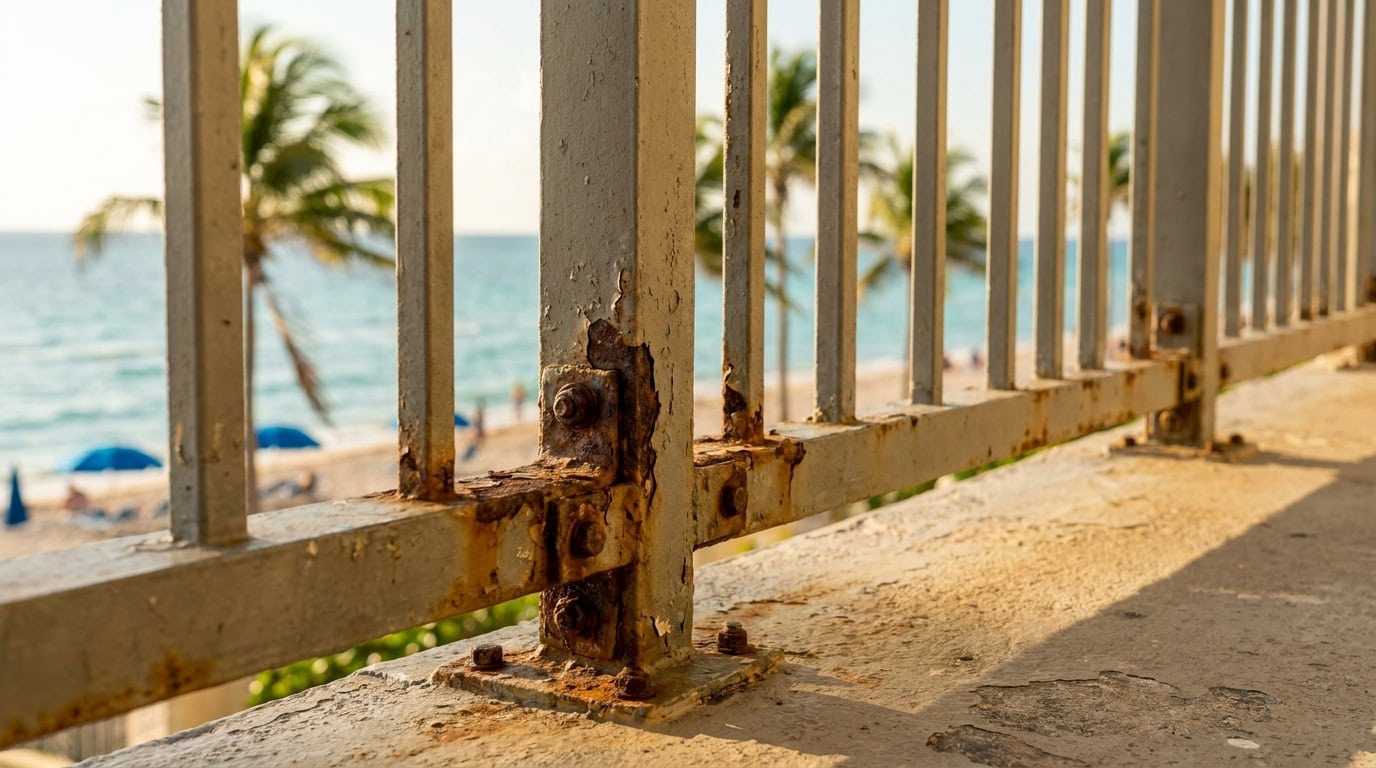
Under Florida Statute Section 509.2112, public lodging establishments three stories or taller must undergo mandatory balcony inspections every three years. This law requires a licensed professional engineer or architect to visually inspect all elevated balconies, platforms, stairways, and railings, and file Form DBPR HR-7020 (Certificate of Balcony Inspection) with the Division of Hotels and Restaurants. In coastal areas, high salt exposure routinely causes wood rot, corrosion of metal bolts, and concrete spalling at handrail anchor points. When a resort fails to perform these triennial inspections or ignores signs of deterioration (such as loose fasteners, unstable railings, or cracking concrete), a single failed bolt can lead to a catastrophic balcony collapse or fall.
Falls from balconies can result in severe fractures or head trauma, including traumatic brain injuries. Establishing negligence in these cases often involves citing building code violations and structural engineering standards. Cutting corners on construction materials directly jeopardizes guest safety.
Broken In-Room Furniture and Unsafe Fixtures
High turnover rates in resort suites lead to accelerated wear and tear that housekeepers and maintenance technicians frequently overlook between check-ins. When guests encounter broken beds, cracked seating, or unanchored heavy furniture, the results can be physically devastating. Hotel room injury liability often hinges on whether the resort followed a rigorous inspection protocol before the guest arrived.
Resorts have been found liable for injuries caused by guests tripping over furniture in guest rooms or collapsing chairs. Beyond mechanical failures, Florida Statute 509.221(7) requires establishments to protect guests from vermin such as bed bugs. Any room found to be infested must be fumigated and renovated before it is rented to another guest.
Proving a resort had notice of broken furniture often involves analyzing the timeline of room check-ins and housekeeping logs. A broken chair joint or a detached headboard is a blatant hazard that should be immediately detected during a standard safety sweep between guests. When a resort rushes room turnover and bypasses basic safety checklists, it fails to meet its legal standard of care.
Hazardous Bathroom Fixtures and Unsafe Shower Designs
Hotel bathrooms are among the most common locations for serious slip-and-fall accidents in lodging establishments. Water pooling on high-gloss stone tile or polished porcelain surfaces creates an immediate hazard. According to the Consumer Product Safety Commission, bathtub and shower structures consistently rank among the most hazardous household and commercial products due to the high risk of severe slip injuries.
To mitigate these risks, industry safety standards such as ANSI/NFSI B101.3 establish slip-resistance thresholds, stating that walking surfaces should maintain a wet dynamic coefficient of friction of 0.42 or greater to be considered safe. Additionally, the ANSI/NFSI B101.4 standard specifically outlines testing and safety criteria for bathtubs and shower structures. A hotel bath slip hazard frequently arises when a tub basin lacks factory-installed slip-resistant etching or when the resort neglects annual slip-resistance treatments, directly violating these established safety thresholds.
Grab bars are another common point of failure, as they must be installed horizontally and support a specific load weight to be effective. When these fixtures are improperly anchored, or the tub surface is worn smooth, the risk to the guest increases significantly. Failing to comply with the administrative regulations governing these safety features constitutes evidence of negligence in Florida.
Electrical, Plumbing, and Appliance Defects
Hidden in-room hazards often involve malfunctioning water heaters, scalding water valves, and faulty electrical wiring. Uncalibrated plumbing fixtures can release hot shower water that exceeds safe temperature limits, causing severe burns. Hotels are liable for these injuries when they fail to maintain water systems or ignore warning signs of thermal instability.
Defective small appliances provided by the resort, such as coffee makers or hair dryers, also pose risks of electric shocks and fire. If a resort provides an appliance with a frayed cord or a malfunctioning internal circuit, it has breached its duty to provide a safe environment. These mechanical failures often result from neglecting routine maintenance cycles for in-room electronics.
Establishing Legal Liability: Actual vs. Constructive Notice
Establishing notice is the pivotal legal hurdle in any Florida resort injury lawsuit. A guest must prove that the hotel management knew or should have known about a physical hazard before the injury occurred. Without proving one of these forms of notice, it's difficult to hold a property owner financially accountable for the damages.
Actual notice is established when resort staff or management had direct, documented knowledge of a dangerous condition. This often occurs when a previous guest submits a written complaint about a loose railing or a malfunctioning fixture in a specific room. If the hotel records show the complaint but no repair followed, the establishment has actual knowledge of the risk.
Establishing Constructive Notice Through Lack of Reasonable Inspections
Constructive notice applies when a guest can show that a defect existed long enough that reasonable care and inspection would have uncovered it. This standard is frequently used in cases involving a structural failure at a Florida resort in which the damage was gradual. If a balcony railing was rusting for months, a jury may find that the resort should have known about the danger.
Fulfilling the property owner's maintenance duty in Florida requires an inspection schedule that matches the property's use. If a resort cannot produce records showing that a room was inspected for months, constructive notice is easier to establish. The law assumes that a reasonable business owner would find and fix obvious structural issues over time.
The Role of Hotel Maintenance Logs and Routine Inspection Records
The legal discovery process allows a Florida hotel accident attorney to examine internal resort documentation to prove notice. Housekeeping logs, engineering work orders, and routine inspection checklists are all vital pieces of evidence. These records often reveal gaps in maintenance or recurring hazards that management chose to overlook.
In modern resort litigation, this digital paper trail is incredibly specific. Most major resorts use specialized Hotel Service Optimization Systems (such as HotSOS or Quore) to track maintenance requests and guest complaints. A Florida hotel accident attorney will formally demand these electronic work orders, Property Management System logs, and internal repair history reports. If these digital files show that a guest complained about a loose railing or a broken fixture days prior, but the work order was marked completed without actual repairs, actual or constructive notice is immediately established.
Overcoming Defense Tactics and Florida Comparative Fault Rules
Resort operators and their insurance carriers use several common legal defenses to avoid financial liability after an in-room injury. Their primary goal is to minimize the amount of money they must pay to the injured party. Understanding these tactics is necessary for building a case that can withstand aggressive legal challenges.
Insurers routinely rely on the "open and obvious" defense doctrine, arguing that the hazard was so visible that any reasonable guest should have seen and avoided it. Under Florida law, however, while an open and obvious danger may relieve a property owner of their duty to warn, it does not completely discharge their separate, non-delegable duty to maintain the premises in a reasonably safe condition. A skilled legal team will focus heavily on this structural maintenance duty to counter the defense's efforts to deflect liability.
Navigating Florida's Modified Comparative Negligence Standard
Florida uses a modified comparative fault rule, which significantly impacts personal injury recovery. Under this system, an injured guest can recover damages only if their proportion of fault does not exceed 50%. If a guest is found to be 51% or more at fault for their own injury, they are barred from receiving any compensation.
If a guest is partially at fault, their total financial recovery is reduced by their specific percentage of negligence. This makes thorough evidence collection essential to prevent insurance companies from unfairly assigning fault to the victim. Our team carefully analyzes comparative fault rules to protect your recovery.
Under Florida's modified comparative negligence framework established by Section 768.81 of the Florida Statutes, the 51% bar is absolute. For example, if a jury determines that an injured guest was 50% at fault for using a damaged balcony rail and the resort was 50% at fault, the guest can still recover half of their total damages. However, if the jury assigns just 51% of the fault to the guest, the guest is legally barred from recovering any compensation whatsoever. Insurance adjusters aggressively exploit this rule to escape liability entirely, making meticulous evidence collection vital.
Types of Compensation Available for Resort Injury Victims
Victims of hotel negligence can recover various forms of compensation depending on the severity of their injuries. These damages are generally classified into two primary categories:
- Economic Damages: Quantifiable financial losses, including past and future medical bills, emergency room costs, physical therapy and rehabilitation expenses, lost wages, and loss of future earning capacity.
- Non-Economic Damages: Intangible, subjective losses, such as physical pain and suffering, mental anguish, permanent impairment or disfigurement, emotional distress, and loss of capacity for the enjoyment of life.
Critical Steps To Take After Suffering an In-Room Injury at a Florida Resort
The immediate actions a guest takes after an in-room injury strongly influence the ultimate success of their legal claim. Evidence in a hotel room can be altered or removed within hours of an accident. Taking the right steps in the first few minutes can make the difference between a successful settlement and a denied claim.
- Report the injury immediately: Notify the resort's general manager or security team. Do not leave the premises or check out until you have done so.
- Demand a written incident report: Request that resort staff create a formal, written report on the spot. Explicitly ask for a physical copy or a digital scan of the document for your own records before you leave.
- Identify and document witnesses: Collect the names, phone numbers, and email addresses of any guests, staff members, or bystanders who witnessed the incident or saw the immediate aftermath.
- Photograph and film the scene: Take high-resolution photos and video of the defective fixture, broken furniture, or hazardous area from multiple angles, capturing close-ups of the wear and tear and the wider room context.
- Avoid signing any liability waivers: Resort managers or insurance adjusters may try to hand you a document, release, or settlement voucher on the spot. Refuse to sign anything or give a recorded statement until you consult with legal counsel.
Documenting Physical Evidence and Hidden Room Defects
Preserving physical evidence inside the hotel room is the most important task for an injured guest. You should take detailed photographs and video footage of the defective fixture, balcony rail, or broken furniture from multiple angles. Photographic documentation must happen before resort staff can repair the scene or move the items.
If personal property was damaged during the incident, these items should be safely retained. Do not throw anything away, as the physical state of your belongings can serve as evidence of the force involved. Clear visual evidence makes it difficult for the resort to later claim the hazard did not exist.
Digital evidence is often the hardest to dispute in a courtroom or during settlement negotiations. Capturing the exact state of the room at the time of the injury prevents the hotel from cleaning or fixing the issue. The visual record acts as a permanent witness to the conditions that led to your harm.
Seeking Immediate Medical Evaluation and Consulting Legal Counsel
Obtaining prompt medical care establishes an unbroken link between the resort hazard and your documented injuries. Even if an injury seems minor at first, internal damage or concussions may not show symptoms until hours later. A medical record created immediately after the accident is much harder for insurance companies to challenge.
Recent changes to Florida law under House Bill 837 (HB 837) have reduced the statute of limitations for general negligence actions from 4 years to 2 years. Under Florida Statutes Section 95.11(4)(a), this shortened deadline applies to all claims accruing on or after March 24, 2023. Failing to file a lawsuit within this strict two-year window will completely bar you from seeking recovery.
To secure essential evidence before it is overwritten, a Florida resort injury lawyer will immediately draft and send a formal spoliation letter. This legal directive requires the resort to preserve all relevant digital surveillance footage, electronic keycard entry logs, balcony inspections, and maintenance logs related to the room. Early legal intervention ensures that crucial evidence does not disappear during routine server overwrites or room repairs.
Speak With A Florida Injury Attorney At Weinstein Legal Team
Proving legal liability in complex resort injury claims requires a deep understanding of premises liability law, statutory regulations, and industry-specific maintenance standards. When resort operators cut corners, ignore structural wear, or bypass triennial inspections, they must be held accountable for the resulting harm.
Weinstein Legal Team knows how to navigate Florida's challenging modified comparative negligence laws, demand internal maintenance logs, and preserve crucial evidence before the resort can repair the scene.
Our expertise in Florida premises liability law allows us to pursue the compensation you deserve after a resort accident aggressively. We fight tirelessly to secure the best possible outcomes for clients facing the consequences of property owner negligence. Contact us today for a free, confidential case evaluation to enforce your rights and demand full compensation from negligent resort operators.