
- A Florida traffic homicide investigation is a criminal inquiry rather than a crash report. It opens when a collision kills someone or the injuries are expected to, and it is built toward vehicular homicide under Florida Statute 782.071 or DUI manslaughter under Florida Statute 316.193.
- Investigators reconstruct the crash with 3D laser scanning, total station mapping, drone photogrammetry and linear momentum calculations. Event Data Recorder telemetry is pulled with the Bosch retrieval tool, and in Florida that download needs a search warrant or consent first.
- Under Florida Statute 316.1933, an officer with probable cause to believe an impaired driver was involved in a crash causing death or serious bodily injury must require a blood sample and the driver has no right to refuse. Officers increasingly obtain a warrant first.
- The accident report privilege in Florida Statute 316.066 keeps a driver's compelled crash-report statements out of a criminal trial, but it is not absolute. Section 316.066(4) still allows an officer to testify, and breath, urine and blood results taken under Sections 316.1932 or 316.1933 are admissible.
- Under the changing hats doctrine from State v. Norstrom, an officer moving from the crash investigation to a criminal one must announce the switch before questioning continues. A failure to do so can get the statements that follow suppressed.
- These cases run in months rather than days. Toxicology backlogs, third-party mechanical inspections and reconstruction processing routinely put months between the crash and the State Attorney's filing decision.
A Florida traffic homicide investigation (THI) is a specialized criminal inquiry triggered when a motor vehicle collision results in a fatality or life-threatening injury. Unlike standard accident reports, a THI is a technical forensic process designed to build a criminal case for felony charges like vehicular homicide or DUI manslaughter.
The investigative process relies heavily on technical expertise, including forensic accident physics and toxicology analysis, to reconstruct the exact events of a crash. The resulting inquiry determines whether criminal negligence or impairment was a significant factor in the tragedy. Early intervention by a Florida criminal defense attorney is critical to ensure that your constitutional rights remain protected throughout the police inquiry.
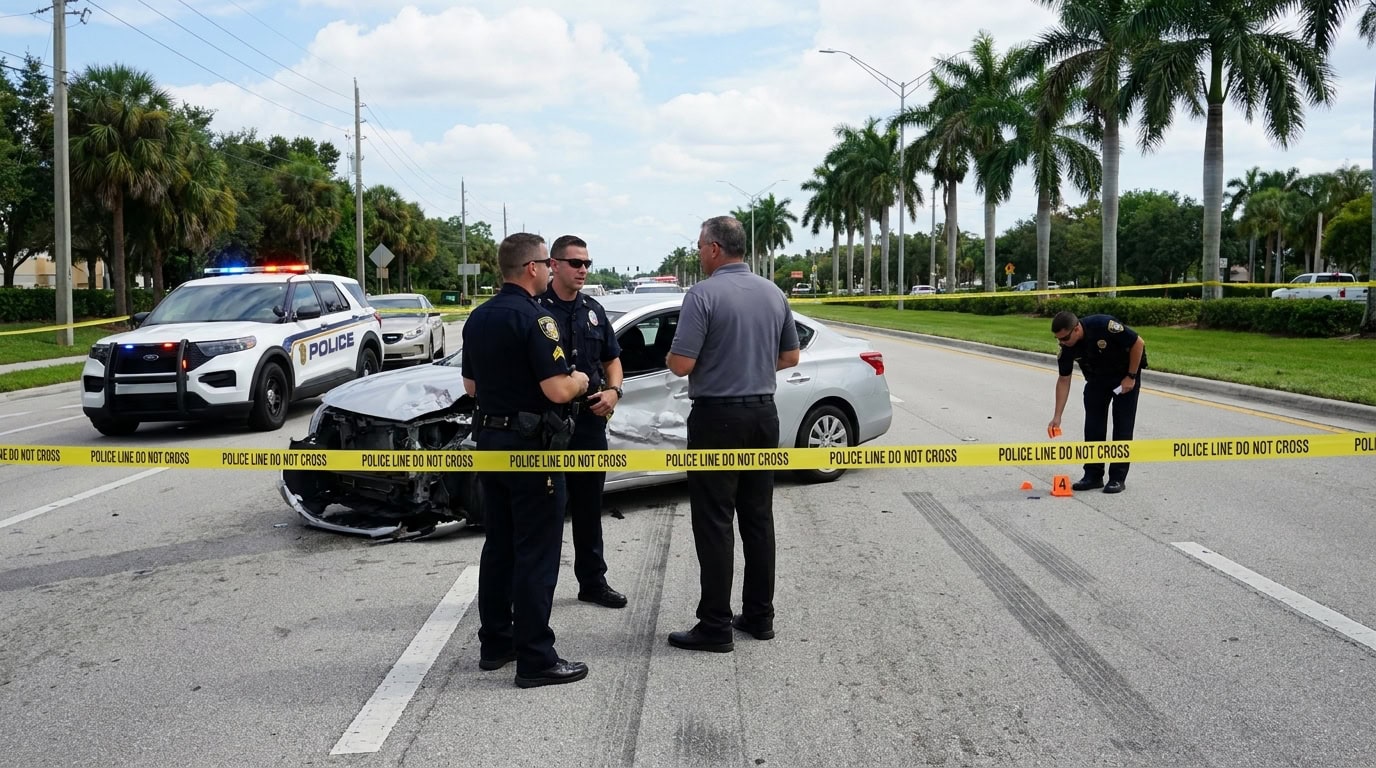
Traffic Homicide Investigation vs. Routine Crash Reports: Key Differences
The goals and methods of a traffic homicide investigation differ drastically from a standard collision report.
| Feature | Routine Crash Report | Traffic Homicide Investigation (THI) |
| Primary Goal | Determine civil liability and resolve insurance claims | Uncover evidence for severe felony prosecutions |
| Investigating Unit | Standard patrol officers | Specialized homicide and forensic units |
| Level of Detail | Basic measurements and simple traffic infractions | Millimeter-accurate 3D mapping and mechanical inspections |
Identifying the Trigger Events for a THI Call-Out
Under Florida Highway Patrol Policy 17.04, a Traffic Homicide Investigator must be summoned for any crash involving the actual or impending death of any person, for pursuit-related crashes involving serious bodily injury or death, and for any crash the National Transportation Safety Board responds to. Responding patrol officers must immediately secure the perimeter, halt any on-scene assessments, and preserve all transient physical evidence. Once dispatched, the FHP Traffic Homicide Squad or local agency THI assumes full jurisdictional control of the scene to ensure forensic integrity.
A call-out can also occur when an individual is transported to a hospital under a trauma alert. Patrol officers maintain constant communication with emergency medical staff to monitor the victim's status. Many local police department policies require officers to check with hospital staff at regular intervals for updates on the victim's condition. If medical professionals determine that the injuries are life-threatening or terminal, the investigation immediately shifts into a formal traffic homicide inquiry.
The Primary Goal: Building a Potential Criminal Case
Unlike routine traffic crash reports governed by civil procedures, a THI focuses strictly on uncovering evidence of criminal conduct. Investigators evaluate driver behavior, speed, and toxicology to determine if there is probable cause for severe charges such as vehicular homicide (under F.S. § 782.071) or DUI manslaughter (under F.S. § 316.193). Every measurement, interview, and forensic file is gathered specifically to build a trial-ready case for the State Attorney's Office.
Evidence gathered during this phase helps prosecutors build cases for severe felony charges. Investigators actively look for signs of reckless driving or evidence supporting a DUI manslaughter charge. A skilled Florida criminal defense attorney must review these forensic findings early to identify errors in the state's vehicular manslaughter narrative.
The On-Scene Response: Division of Labor in a Fatal Crash Investigation Process
The fatal crash investigation process relies on a strict, highly structured division of labor among specialized law enforcement personnel. This coordinated approach prevents the contamination of physical evidence while ensuring that every forensic detail is thoroughly documented. Each participating officer, investigator, and technician has a specific mandate under Florida law and agency guidelines to protect the integrity of the potential criminal prosecution.
First Responders and Patrol Officers: Securing the Scene
First-responding patrol officers must immediately stabilize the crash site and render aid. Once medical emergencies are addressed, officers establish a rigid physical perimeter to protect fragile evidence, identify witnesses, and obtain initial statements before the details fade from memory.
Officers must also prioritize preserving short-lived evidence that can be destroyed by weather or traffic. This includes fragile items, such as fluid spills, light debris, and tire marks on the pavement. Florida Highway Patrol (FHP) crash policy requires responding officers to protect the scene from contamination until the specialized unit arrives. They must also document the names of all responding medical personnel who entered the scene during the rescue phase.
The Lead Traffic Homicide Investigator: Managing the Inquiry
The lead Traffic Homicide Investigator takes full control of the scene upon their arrival. This specialized officer has completed dedicated crash-investigation training, such as the 80-hour At-Scene Traffic Crash/Traffic Homicide Investigation course taught by the Institute of Police Technology and Management, and acts as the central point of contact for all other units while managing the on-scene inquiry.
These specialized officers apply principles of linear momentum, vector analysis, and vehicle dynamics to oversee the forensic documentation. Acting in accordance with the FHP Traffic Homicide Investigation Manual, the lead investigator makes critical on-scene determinations regarding suspected driver impairment and coordinates the specialized forensic mapping units. Their primary duty is compiling the comprehensive final THI report, which must withstand intense judicial scrutiny during felony trials.
Crime Scene Technicians and Forensic Support: Physical Evidence Collection
Crime scene technicians provide essential forensic support to the lead investigator during police evidence collection at accident scenes. They photograph the scene from every side and approach angle before anything is moved. These images serve as a permanent record of the scene before any vehicles are moved or debris is cleared. Technicians document the final rest positions of all vehicles involved in the collision.
Technicians also document biological evidence and meticulously map out debris fields. They examine specific vehicle components, such as seat belts and airbags, to verify whether safety systems were functional. This level of detail helps determine the mechanical condition of the vehicles and the occupants' actions at the moment of impact. The technicians use specialized tools to ensure that all measurements are accurate to the millimeter.
The Critical Role of the Medical Examiner in Fatality Cases
The Medical Examiner (ME) has a defined job in every Florida traffic homicide investigation. While police officers focus on the mechanics of the vehicles, the ME focuses on the physical state of the deceased. The lead investigator must notify the ME immediately upon confirming a fatality, as determining the official cause and manner of death is a necessary element of a homicide prosecution.
The ME examines the body to identify injuries sustained during the impact and conducts toxicology screenings to determine if impairment was a factor. These physical findings are directly incorporated into the final traffic homicide report. In our practice, we frequently collaborate with independent medical experts to review these autopsy findings, seeking alternative explanations, such as a pre-existing medical event, that could legally exonerate the defendant.
The Science of Criminal Case Reconstruction and Accident Physics
Criminal case reconstruction combines advanced mathematics and digital forensics to recreate the exact movements of every vehicle involved. While mechanical data reveal the vehicles' physical trajectory, mandatory toxicology testing reveals why a driver may have failed to react in time.
Calculating Speed, Momentum, and Vehicle Dynamics
Investigators use the laws of physics to determine how a crash occurred. Specifically, they apply the principles of linear momentum and its conservation to calculate pre-impact speeds. These calculations allow the state to argue whether a driver exceeded the speed limit or was driving too fast for conditions. Tire marks indicate the driver's steering inputs during the moments before the collision.
Different types of tire marks provide specific clues about driver input. Yaw marks can indicate that a driver was steering sharply, while skid marks help determine deceleration rates. By measuring these marks, investigators can map the vehicle's path and determine when the driver first attempted to react. A defense attorney will hire an independent physicist to check the math used in these momentum calculations.
High-Tech Scene Mapping: 3D Laser Scanning and Drones
Reconstruction teams now utilize 3D laser scanners and total stations to map crash scenes with millimeter precision. These tools capture a digital representation of the entire area, including the road's topography and the positions of all evidence. The total station captures coordinate data to create the computer-generated reconstruction diagram. This technology removes much of the human error associated with manual tape measurements.
Aerial drone photogrammetry is also used to provide a bird's-eye view of the collision site. These digital files are later imported into computer-aided design software to generate detailed scale diagrams. The diagram must show travel paths, collision positions, and secondary impacts. These diagrams give the courtroom a clear, professional visual representation of the crash.
Accessing Digital Evidence: Event Data Recorders (EDR) and Vehicle Telematics
Most modern vehicles are equipped with an Event Data Recorder (EDR) or "black box." To extract this digital evidence, Florida investigators must first secure a search warrant or obtain consent before utilizing specialized hardware, typically the Bosch Crash Data Retrieval (CDR) tool. This telemetry provides a highly reliable, objective record of the vehicle's mechanical state in the critical seconds leading up to, during, and immediately following the collision impact.
The extracted telemetry provides concrete data points, including:
- Throttle position percentage
- Braking status and application pressure
- Steering angle inputs
- Seatbelt usage
- Exact vehicle speed at the moment of impact
Attorneys heavily scrutinize this data to determine if the mechanical findings contradict the officer's narrative.
How Witness Testimony Compares to Digital Evidence
While witness statements provide a subjective narrative, digital data from Event Data Recorders and total station mapping offer objective facts. Investigators prioritize electronic evidence over human recollection, as trauma often distorts the memories of those involved in a fatal collision. Defense attorneys routinely contrast flawed witness testimony against concrete digital findings to expose inaccuracies in the state's case.
DUI Manslaughter Investigation: Mandatory Testing and Blood Collection
When an investigator suspects that alcohol or controlled substances were involved, the nature of the inquiry shifts. The presence of impairment converts a standard inquiry into an aggressive DUI manslaughter investigation. This shift brings additional legal requirements and mandatory testing procedures that the state must follow. Failure to comply with these strict procedural rules can lead to the suppression of evidence in court.
Probable Cause and Mandatory Blood Draws Under F.S. § 316.1933
Under Florida Statute Section 316.1933, if law enforcement has probable cause to believe a driver operated a vehicle involved in a crash causing death or serious bodily injury while under the influence, they must require a blood sample. This is mandatory, meaning the driver has no legal right to refuse. While the statute permits the use of reasonable force to obtain the sample, officers increasingly secure a search warrant first to comply with constitutional search and seizure standards established under the U.S. Supreme Court's ruling in Missouri v. McNeely.
Officers frequently obtain a medical blood warrant to avoid potential legal challenges related to the use of force. This warrant safeguards the admissibility of the blood sample in future court proceedings. The probable cause standard is notably lower than the burden of proof required for a conviction. Once that threshold is met, the driver's right to refuse testing is effectively suspended under Florida law.
When an officer assesses probable cause for impairment, they look for specific indicators at the scene:
- Observations of the driver's speech and balance
- The presence of an alcoholic odor
- Open containers visible inside the vehicle
- Drug paraphernalia in plain view
If the driver is unconscious, Florida law allows for a blood draw without their active consent. A defense attorney's primary role during this phase is to challenge whether the officer's documented observations legally met the probable cause threshold before the officer requested a warrant.
The Process and Complexities of Toxicology Analysis
Once drawn, the blood samples are analyzed by the Florida Department of Law Enforcement (FDLE) or an authorized regional toxicology laboratory using headspace gas chromatography-mass spectrometry (GC-MS). Defense attorneys closely examine the timing of the draw. If several hours passed between the crash and the blood extraction, the state's toxicologist must rely on a scientifically controversial method known as retrograde extrapolation to estimate the driver's blood alcohol concentration (BAC) at the actual time of driving, providing a key opportunity for defense challenges.
Analyzing these results can be complex, especially when drugs like marijuana are involved. Tests can detect active Delta-9 tetrahydrocannabinol (THC) as well as inactive metabolites that remain in the system for days. This often leads to significant legal battles regarding whether the driver was actually impaired at the exact time of the collision. Expert witnesses are often required to explain how these chemical levels relate to the driver's state at the moment of impact.
The Intersection of Florida Law: The Crash Report Privilege and Changing Hats
Florida law includes a unique statutory framework designed to balance the state's need for information with the driver's constitutional rights. These rules ensure that individuals can comply with reporting requirements without being forced to incriminate themselves. Anyone involved in a traffic homicide investigation needs to understand how these protections work. These rules prevent the state from using your mandatory cooperation against you in a felony trial.
Understanding the Florida Accident Report Privilege (F.S. § 316.066)
Florida law requires a driver in a crash to stay at the scene and hand over his name, address, and vehicle registration to the other driver and to the investigating officer. Section 316.061 requires a driver to stop and remain at the scene after a crash that only damages a vehicle or other property, and Section 316.027 governs leaving the scene of a crash involving injury or death. Section 316.062 sets the duty to give that identifying information and to render reasonable assistance to anyone hurt. Section 316.066 governs the written crash report itself, and it is where the accident report privilege lives. Because this statement is mandatory, the law protects the driver through the accident report privilege. This privilege ensures that statements made for the report cannot be used against the driver in a criminal trial. This protection is a direct reflection of the Fifth Amendment right against self-incrimination.
The purpose of this law is to encourage people to provide honest accounts of accidents to improve road safety. It prevents the state from using a person's compelled speech as a weapon in a later prosecution. The privilege is not absolute. It covers the report and statements made to complete it, and Section 316.066(4) still lets an officer testify at a criminal trial about what a driver said, so long as that does not violate the driver's privilege against self-incrimination. Physical evidence is outside it altogether. The statute says plainly that breath, urine, and blood results taken under Section 316.1932 or Section 316.1933 are admissible.
The Changing Hats Doctrine: Moving from Accident to Criminal Inquiry
To protect a driver's constitutional privilege against self-incrimination, the Florida Supreme Court in State v. Norstrom (613 So. 2d 437) and subsequent appellate rulings like State v. Marshall (695 So. 2d 686) established the 'changing hats' doctrine. Under this rule, if the same officer handles both the civil accident investigation and the subsequent criminal inquiry, they must formally conclude the accident phase and explicitly notify the driver that they are transitioning to a criminal investigation.
The officer is required to make an explicit, verbal announcement that they have finished the accident report. They might say they are now switching hats to a criminal investigation for DUI or reckless driving. This notification is meant to alert the driver that the accident report privilege no longer protects their subsequent statements. Failure to properly notify the driver of this transition can result in statements being suppressed in court.
The Transition to Miranda Warnings
Once the hat-switch occurs and the suspect is in custody, the officer must read the Miranda warnings. This is the critical moment where a driver must decide whether to invoke their right to silence and request an attorney before further questioning proceeds.
Statements made after a proper transition and a valid Miranda waiver are generally admissible as evidence. If the officer fails to provide these warnings while the suspect's freedom is restricted, the resulting statements may be thrown out. The timing of when a person is considered in custody is often a point of heavy litigation. A defense attorney will review bodycam footage to ensure the officer followed the proper protocol.
In our practice defending vehicular homicide cases across Florida, we frequently see officers strategically delay the "changing hats" announcement to keep un-Mirandized suspects talking. Reviewing officer bodycam footage to identify the exact minute the accident investigation ended and the criminal inquiry truly began is often our most critical step in getting self-incriminating statements suppressed before trial.
The Timeline and Progression of a Florida Traffic Homicide Investigation
A fatal collision initiates a timeline that can be incredibly slow and taxing for everyone involved. These investigations aren't resolved in days, but rather unfold over several grueling months. This delay often leaves individuals in a state of extreme anxiety while they wait to see if formal charges will be filed. Understanding the stages of this timeline can help you manage expectations during the legal process.
Why Do Traffic Homicide Investigations Take Several Months?
Traffic homicide investigations require extensive coordination between multiple state and private entities, which inherently delays the legal process:
- Technical Data Processing: Rendering 3D mapping files and verifying multi-point momentum calculations require significant laboratory time.
- Third-Party Inspections: Investigators frequently coordinate with outside mechanical experts or vehicle manufacturers to rule out mechanical defects.
- Toxicology Backlogs: State forensic laboratories often face massive backlogs, delaying blood or urine test results by several weeks.
The timing varies with laboratory testing, reconstruction and the charging decision, and it is common for months to pass before the State Attorney makes a final filing decision.
Filing Decisions: Presenting the Case to the State Attorney's Office
Once the lead investigator completes the Traffic Homicide Field Packet and the final report, the file is sent to the local State Attorney's Office. An Assistant State Attorney then reviews the technical reconstruction and all witness statements. Their job is to determine whether the evidence is sufficient to prove a crime beyond a reasonable doubt. The potential consequences of these charges often include significant mandatory prison sentences.
The prosecutor must also weigh the toxicology results and the driver's behavior at the scene. They may decide to file formal charges for vehicular homicide, which is a second-degree felony in Florida. They could also pursue DUI manslaughter if the evidence of impairment is sufficiently strong. This final decision is the culmination of months of investigative work and will dictate the future of the legal case.
Why a Criminal Defense Attorney Matters During an Active Investigation
Waiting until an arrest warrant is issued before hiring a criminal defense attorney is a critical mistake. The pre-arrest phase is when the state builds its case, and a suspect is most vulnerable to procedural errors. Early legal intervention is one of the most effective ways to protect your rights and potentially influence the outcome of the investigation. Your attorney can prevent you from making statements that the state will use as evidence.
Intervening Early: Protecting Your Rights Before Formal Charges
A defense attorney can immediately take over all communications with the lead investigator upon being hired. This prevents the client from inadvertently making self-incriminating statements or accidentally waiving their accident report privilege. By acting as a buffer, the attorney ensures that the client does not provide any information that could be used against them. They also ensure that any short-lived evidence that favors the defense is preserved.
The defense team also begins its own investigation while the evidence is still fresh. This includes locating and interviewing key witnesses whom the police might not have thoroughly questioned. They also work to secure nearby business surveillance recordings and scene footage before they are overwritten or deleted. This proactive approach can often uncover evidence that contradicts the state's initial theory of the crash.
Investigating the Investigators: Challenging the Science and Math
A skilled defense firm will hire independent accident reconstruction experts and physics specialists to review the state's work. These independent experts scrutinize the investigator's momentum calculations and skid mark evaluations. They look for mathematical errors or faulty assumptions that might have led to an incorrect conclusion about the crash. If the state's physics are flawed, the entire criminal case may collapse.
Challenging the data downloaded from the vehicle's Event Data Recorder is also a common defense strategy. Experts may identify software glitches or physical impossibilities that dismantle the prosecution's theory of speed. By providing an alternative, scientifically backed explanation, the defense can create significant doubt in the state's case. This technical defense is often the difference between a conviction and an acquittal.
Request a Confidential Case Evaluation with Weinstein Legal Team
A Florida traffic homicide investigation is an intense, scientifically complex, and life-altering process. The state uses substantial resources to build a case that could result in severe prison time. Weinstein Legal Team understands the inner workings of the Florida Highway Patrol and local police investigations.
We have the experience needed to challenge the state's reconstruction and forensic evidence from the very beginning. We work tirelessly to identify procedural errors and protect the constitutional rights of every client we represent. Contact us today for a free, confidential case evaluation to ensure your rights are protected.