
- Because Florida resorts often overwrite security footage within three to seven days, immediately preserving digital evidence after a vacation injury is critical.
- Out-of-state tourists must act quickly to comply with Florida's strict two-year statute of limitations for filing negligence-based personal injury lawsuits.
- Under Florida's modified comparative fault system, an injured victim is legally barred from recovering financial compensation if they are found to be more than 50 percent at fault for the accident.
- Sending a formal spoliation letter to the property owner is the most effective legal method to prevent the destruction of crucial hotel CCTV surveillance footage.
- Obtaining emergency medical care at a local Florida facility immediately after a resort injury establishes a verifiable timeline that prevents insurance adjusters from using a gap-in-treatment defense.
- Hiring a local Fort Lauderdale personal injury attorney allows out-of-state victims to seamlessly manage their premises liability claims and conduct on-the-ground investigations remotely.
Whether you suffer a slip and fall near a pool deck, experience an assault due to negligent security, or sustain injuries from broken hotel furniture, it's important to seek prompt medical care and secure thorough documentation of your injuries and the scene. Preserving evidence for a Florida vacation injury is a time-sensitive process that must occur before you return home.
Because property conditions change and security footage is often overwritten within days, getting as much documentation as possible after suffering an injury at a resort or hotel is the best way to protect your right to compensation.
Why Immediate Evidence Preservation Is Critical After a Vacation Injury in Florida
Building a premises liability claim against a Florida property owner requires beating the clock. According to data released by Visit Florida, the state welcomed a record-breaking 143.3 million visitors in 2025, continuing a trend of high-volume travel that keeps hotels and resorts operating at peak capacity.
Because hotels and resorts operate on these high-turnover schedules, staff members often repair physical hazards within hours. Hotels also routinely overwrite digital security logs to make room for new data.
The Perils of Delay: Transient Hazards and Overwritten Hotel Closed-Circuit Television Footage
Digital evidence is particularly vulnerable to the passage of time because of how modern security systems operate. Most businesses in Fort Lauderdale and throughout Broward County use loop recording systems that automatically overwrite old video data in as little as 3 to 7 days.
Some larger resorts may keep footage for up to 30 days. However, no Florida law requires a private business to retain security video footage for any specific period. Without a prompt demand to preserve it, the most compelling proof of negligence may be permanently deleted.
Understanding Your Status as an Out-of-State Visitor Under Florida Law
Out-of-state tourists and international visitors enjoy the same legal protections as Florida residents under the state's premises liability laws. You do not have to be a resident of the state, or even a United States citizen, to file a personal injury lawsuit within the Florida court system.
Securing this evidence before departure helps keep your claim strong even after you return home. Comprehensive, immediate documentation prevents corporate defense attorneys from exploiting your physical absence or claiming that your injuries occurred elsewhere during your journey back.
Dealing With Florida Commercial General Liability Policies
Most Florida resorts, hotels, and theme parks carry high-limit Commercial General Liability policies. The moment a serious accident is reported, corporate CGL insurers deploy specialized risk-management adjusters and defense teams to the scene to mitigate their financial exposure. Capturing your own unedited, contemporaneous evidence before checking out is your only shield against their immediate damage-control efforts.
Critical Florida Legal Statutes Affecting Out-of-State Injury Victims
Out-of-state visitors must realize that Florida's specific laws dictate the filing deadlines and fault standards for their claims. These statutes apply regardless of the laws in a victim's home state or country. Knowing these statutes before you board your flight home keeps your claim alive.
| Statute / Rule | Legal Standard | Impact on Out-of-State Victims |
| Statute of Limitations (House Bill 837) | Strict two-year filing window for negligence-based personal injury claims. | You must initiate formal legal action within two years of the injury date or permanently lose your right to seek damages. |
| Modified Comparative Fault (Section 768.81) | 50% bar standard. Your percentage of fault reduces damages. | If a jury finds you more than 50% responsible for your own injury, you are legally barred from recovering any financial compensation. |
| Transitory Foreign Substances (Section 768.0755) | Plaintiff must prove actual or constructive knowledge of the hazard. | It is not enough to show that you slipped; you must prove the business knew or should have known about the liquid or hazard. |
Navigating Florida's Two-Year Statute of Limitations for Personal Injury
Under House Bill 837, the timeframe for filing a negligence-based personal injury lawsuit in Florida was significantly reduced to just two years. This abbreviated timeline forces out-of-state victims to act quickly to protect their rights while placing a high priority on preserving immediate evidence.
This deadline applies to all causes of action accruing on or after March 24, 2023. Failing to file within this period results in a permanent forfeiture of your right to seek damages. Because time passes quickly during medical recovery, early legal consultation is essential to avoid missing this critical cutoff.
Florida's Modified Comparative Fault Rule and the 50% Bar Standard
Florida follows a modified comparative fault system governed by Section 768.81 of the Florida Statutes. Under the comparative fault rule, a victim's financial award is reduced by their percentage of responsibility for the accident. For example, if a jury finds that a person was 20% responsible for their fall, they would receive only 80% of the total damages awarded.
The most restrictive part of this law is the 50% bar, which completely bars recovery for some victims. Any plaintiff found to be more than 50% at fault for their own injury is legally barred from recovering any financial compensation at all. Defense teams often argue that tourists were distracted or reckless while on vacation to exploit this rule.
Proving Notice Under Florida Statute Section 768.0755 for Transitory Foreign Substances
When an injury involves a transitory foreign substance, such as a liquid spill, Florida Statute Section 768.0755 places a heavy burden of proof on the injured party. The plaintiff must establish that the business establishment had actual or constructive knowledge of the dangerous condition. Simply showing that a liquid was on the floor and that you fell is legally insufficient to establish liability.
Timestamped photos and maintenance records are the most effective tools for proving a hazard existed long enough that the business should have discovered it through reasonable care. This detailed documentation allows a legal team to build a timeline that meets the high evidentiary bar set by Florida's premises liability statutes.
How to Document a Slip-and-Fall Scene Before Leaving Florida
Following these immediate steps to document a slip-and-fall scene ensures that crucial data is captured before the property owner can alter the setting. Practical on-scene documentation serves as the primary factual backbone of a personal injury case, providing specific details that memories alone cannot recreate.
Essential On-Scene Evidence Checklist
- Photograph the exact hazard and surrounding area.
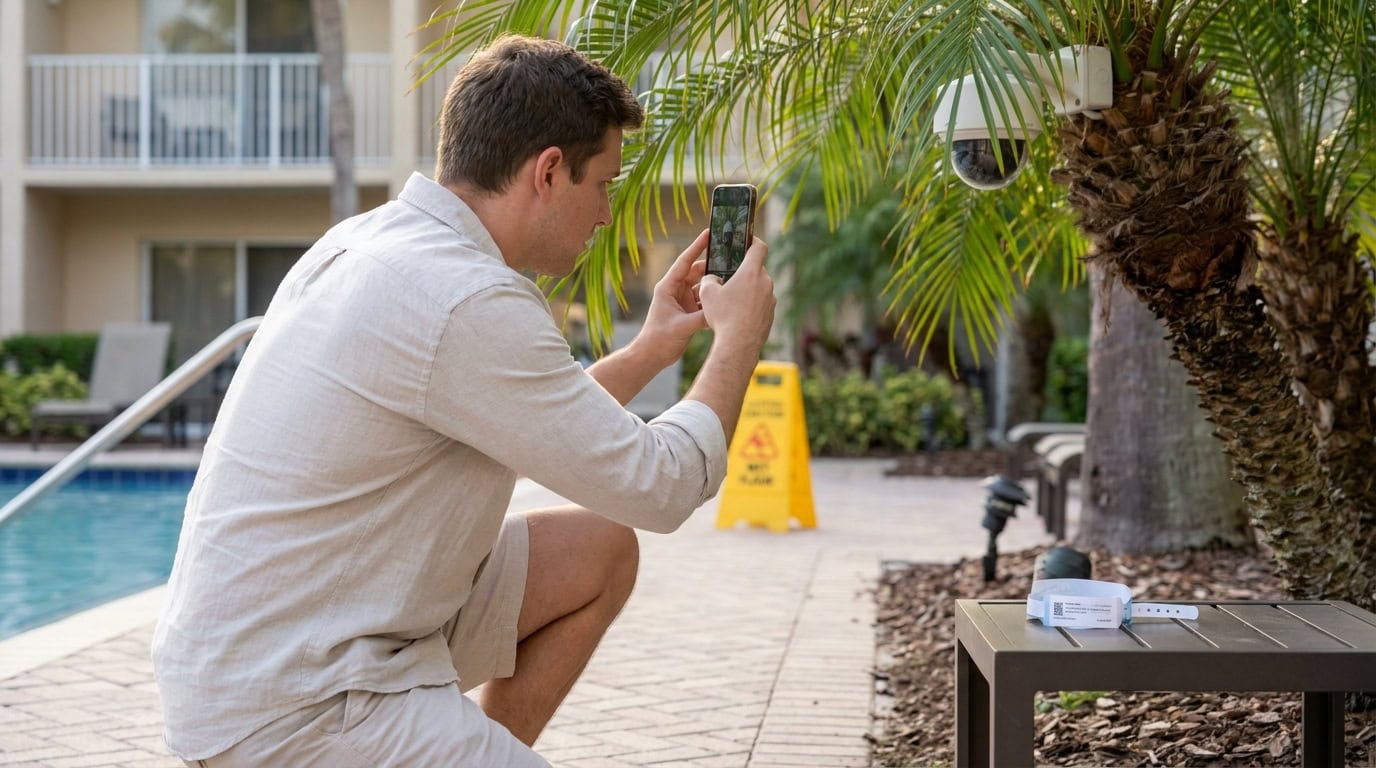
- Identify and photograph nearby security cameras.
- Collect contact information from independent witnesses.
- Request a formal incident report and tracking number.
- Bag unwashed clothing and footwear worn during the accident.
Using Your Smartphone to Record Evidence of Hazardous Property Conditions
A smartphone is the most effective tool for capturing a comprehensive visual record of the accident location. Take wide-angle photos to establish the overall setting and context of the area. These broad shots should show the hazard in relation to nearby exits, signs, or landmarks.
Supplement these shots with high-resolution close-ups of the specific danger, such as a leaking ice machine or an uneven step. Video footage can also provide a more dynamic perspective than still photography. A short video walk-through can document the ambient lighting, weather conditions, and sound levels at the time of the accident.
Preserving Physical Apparel, Footwear, and Belongings Unaltered
The clothing and shoes worn during the accident can serve as physical proof of the property's condition. Defense attorneys frequently attempt to shift blame onto the victim by alleging that worn shoe treads caused the incident. By keeping these items exactly as they were, a victim can refute these claims with tangible evidence.
Unwashed clothing may retain substances like floor wax, chemical cleaning compounds, or grease. Forensic experts can test these residues and assess the coefficient of friction of your footwear to prove a floor was non-compliant with safety standards. Immediately after the accident, place your unwashed garments and uncleaned shoes into a sealable plastic bag to prevent contamination.
Gathering Witness Contact Details and Immediate On-Scene Statements
Independent witness testimony is often the most credible form of evidence in a premises liability claim. Fellow vacationers or even resort employees may have seen the accident or observed the hazard earlier in the day. These individuals provide a neutral account of the events that contradicts the property owner's version of the story.
Secure their full legal names, phone numbers, and email addresses before they check out of the property. Asking for a permanent home address is also a smart step. These individuals are often willing to help if you approach them calmly right after the incident.
Demanding Official Incident Reports and Property Records
Official business records and corporate incident reports help establish that a property owner had immediate notice of an injury. These documents create a formal paper trail that is difficult for a corporation to ignore later in the process. Requesting these records while you're still on the property helps keep the details fresh.
Requesting Incident Reports and Documenting Staff Refusals
The first step after an injury is to request a Florida hotel incident report from a manager or security officer. The report must include the precise date, time, and exact physical location of the accident. You should also include a clear description of the hazardous condition and a brief narrative of the injuries sustained.
Insist on receiving a printed or digital copy of the completed incident report before leaving the office. If the manager refuses, you must at least secure the official incident tracking number. The tracking number acts as a vital identifier your legal team can use to subpoena the full document later.
It is common for property management or corporate security to refuse to provide a copy of an incident report. If this happens, meticulously note the date, time, and physical descriptions of all staff members involved in the refusal. These details can later be used to demonstrate a lack of transparency or cooperation.
Avoid signing any documents that contain release-of-liability clauses or waivers while still on-site. Conversely, document any spontaneous verbal statements made by employees, as these can serve as powerful evidence. Under Florida Statute Section 90.803(18)(e), statements made by a business's employee or agent concerning a matter within the scope of their employment are admissible as an exception to the hearsay rule.
Securing Surveillance Video Footage Through Formal Spoliation Letters
A spoliation letter notifies a property owner of their duty to preserve evidence. Closed-circuit television footage is frequently the most definitive piece of evidence in a premises liability case. It can show the exact moment of the fall and how long the danger existed before the accident occurred.
What Is a Spoliation Letter and How Does It Protect Surveillance Camera Footage?
A spoliation letter is a formal legal preservation demand sent directly to the property owner, its management, and its insurance carrier. This document serves as an explicit directive to halt the routine purging of digital video recordings, security logs, and electronic keycard data. By issuing this letter, you establish a legal duty for the business to preserve specific, time-sensitive electronic records.
The demand should be sent via certified mail with return receipt requested and via electronic mail to create an indisputable record of receipt. The document must specify the exact date, time frame, and physical locations of interest (such as a specific elevator, pool deck, or lobby entrance). Sending this notice immediately is the only reliable way to prevent automated loop-recording systems from overwriting vital footage.
Legal Obligations and Consequences of Spoliation Under Florida Law
Once a property owner receives formal written notice, they can no longer claim vital footage was lost to 'routine maintenance.'
If a commercial property owner destroys evidence after receiving a spoliation letter, Florida courts may impose significant evidentiary sanctions. These sanctions are designed to punish the party that failed to preserve the evidence. In some cases, a jury instruction permits the jury to presume that the missing video evidence would have been unfavorable to the property owner.
Obtaining Florida Emergency Medical Records and Immediate Care Documentation
Local medical records establish the causation of the injury. Seeking prompt medical treatment in Florida ensures necessary healthcare intervention and creates a primary medical record. Many vacationers attempt to wait until they return home, but this delay can be used against them by insurance companies.
Securing On-Site Paramedic, Emergency Room Discharge, and Local Urgent Care Records
Injured vacationers should be evaluated by local emergency medical services or an urgent care center before traveling back home. If injuries are severe enough to require hospitalization, wait until you are medically cleared for travel. Prompt, localized treatment prevents your physical condition from worsening during a long flight or drive.
Before leaving the Florida medical facility, request complete copies of all discharge summaries and physician notes. It is also important to secure copies of diagnostic imaging reports and paramedic run sheets. These documents provide an indisputable baseline timeline that connects the trauma to the specific date of the vacation accident.
Establishing Causation and Preventing Insurer Gaps-in-Treatment Defenses
Insurance adjusters frequently use any delay in seeking medical care to devalue or deny a claim. They may argue that a lack of immediate treatment indicates your injuries were minor or that the injury actually occurred during your transit home. Establishing an immediate, local medical paper trail is critical to proving causation.
Once you return home, transition immediately to your local primary care physician or specialists to maintain a continuous, uninterrupted record of care. A steady stream of treatment documentation demonstrates a serious commitment to recovery and prevents defense attorneys from arguing that your condition has resolved or is unrelated to the resort accident.
How Remote Representation Helps Preserve Evidence and Build Your Case
Partnering with an experienced local personal injury law firm allows injured tourists to pursue claims without having to remain in Florida. Local attorneys understand the nuances of regional court systems and have the resources to conduct on-the-ground investigations. Local legal support is crucial for tourists focused on healing at home.
The Role of a Personal Injury Attorney in On-the-Ground Investigations
A local attorney takes decisive action the moment an out-of-state victim retains them. They can dispatch private investigators to inspect the accident site while conditions are still relatively fresh. These investigators can take professional measurements and look for secondary evidence that a visitor might have missed.
Managing Out-of-State Claims Without Returning to Florida
Modern legal technology makes it much simpler for tourists to manage their Florida injury claims from their home state. Virtual client consultations and electronic document-signature portals enable seamless communication. Victims can transmit evidence, such as photos and medical records, through secure digital channels from anywhere.
A local attorney handles all direct communications with insurance adjusters, shielding you from high-pressure tactics. Most personal injury claims settle through negotiation before a lawsuit needs to be filed. As a result, most out-of-state visitors never have to return to Florida for routine case proceedings.
If a case proceeds to formal litigation, you may need to appear in person for events such as depositions, mediation, or a compulsory medical examination. However, under modern Florida civil procedure rules, many of these proceedings can now be conducted virtually via video conference. If a physical appearance is required, your legal team will coordinate blocks of time to minimize your travel and consolidate necessary appointments.
Speak To A Lawyer About Your Florida Vacation Injury Claim Today
The success of an out-of-state visitor's personal injury claim depends heavily on the actions taken immediately following an accident. Documenting hazards, requesting official records, and issuing spoliation demands are essential steps to secure vital evidence before you return home. By seeking prompt local medical care and acting well before the two-year statute of limitations expires, you protect your legal rights before departing the state.
Weinstein Legal Team provides dedicated representation for those injured anywhere in the State of Florida. We operate on a contingency-fee basis, which means you owe no attorney's fees unless we recover money for you. Contact us today for a free, confidential case evaluation with a personal injury lawyer.