
Florida's drug-free zone enhancements are in Fla. Stat. 893.13(1)(c) through 893.13(1)(h), and they reach one kind of conduct: selling, manufacturing or delivering a controlled substance, or possessing it with intent to sell, manufacture or deliver, within 1,000 feet of a protected location. Each of those paragraphs raises the base offense by one felony degree.
Simple possession is not enhanced by location. Possession is charged under Fla. Stat. 893.13(6), which contains no drug-free zone provision, so being near a school does not turn possession of 20 grams or less of cannabis into a felony. Keep reading for which locations actually count, what the state has to prove, and where drug offenses charged with a zone count get challenged.
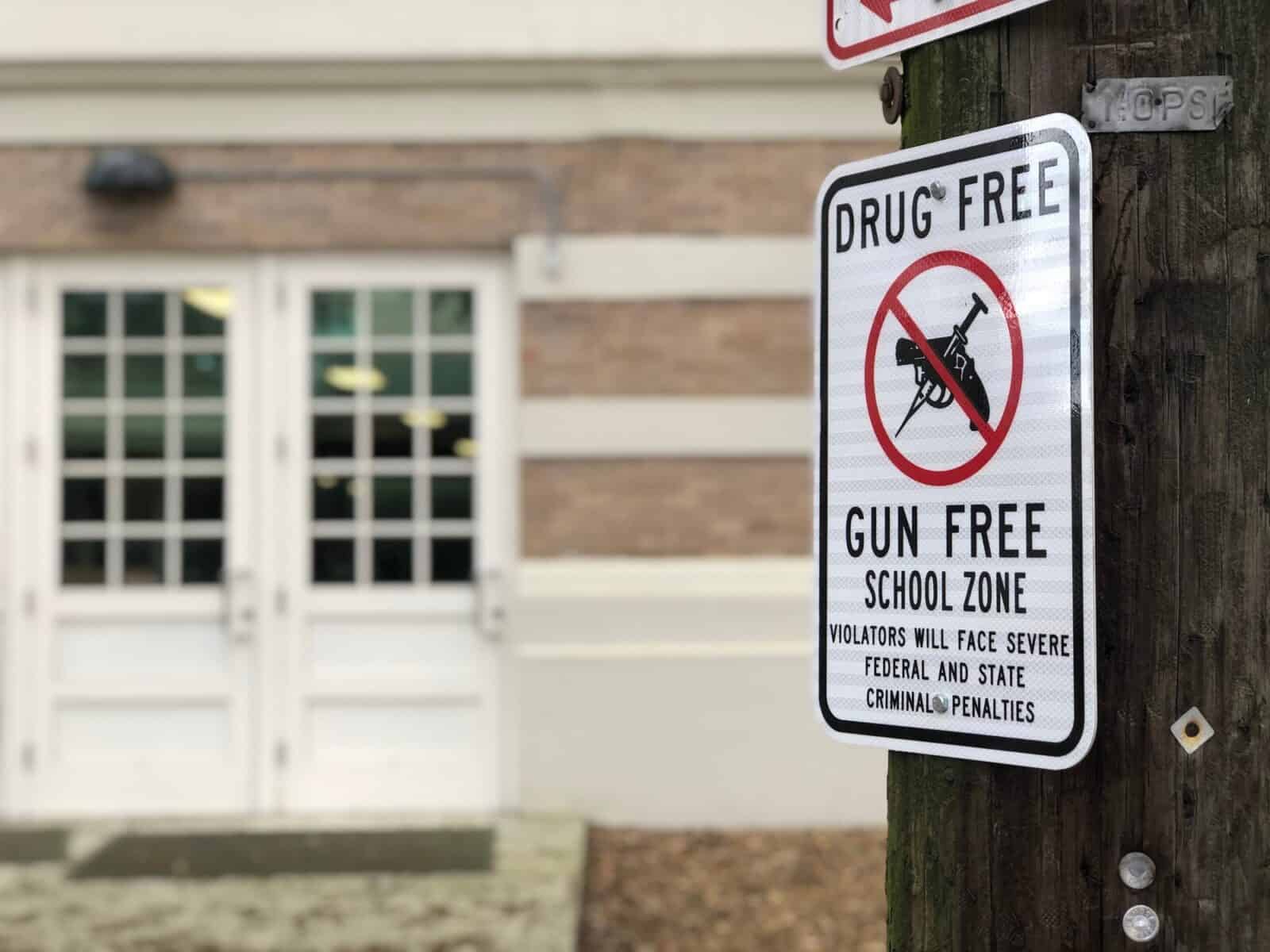
What Are Drug-Free Zone Enhancements in Florida?
Florida's drug-free zone provisions are separate offenses rather than a sentencing add-on. Fla. Stat. 893.13(1)(c) through 893.13(1)(h) each describe the same conduct as the base offense in Fla. Stat. 893.13(1)(a) with a location element bolted on, and each carries a higher felony degree.
Nothing about that is automatic. The location is an element the state has to charge and prove beyond a reasonable doubt, exactly like the identity of the substance and the intent to sell. If the state cannot prove the offense happened within 1,000 feet of a qualifying location, the zone count fails and what is left is the base offense.
The size of the jump depends on the substance. For the drugs listed in Fla. Stat. 893.03(1)(a), (1)(b), (1)(d), (2)(a), (2)(b) or (2)(c)5., which is where cocaine and most opioids sit, sale inside a zone goes from a second-degree felony to a first-degree felony, so the statutory maximum moves from 15 years to 30. For the drugs listed in Fla. Stat. 893.03(1)(c), (3) or (4), which is where cannabis sits, it goes from a third-degree felony to a second-degree felony, so the maximum moves from 5 years to 15.
Protected Locations Under Florida's Drug-Free Zone Laws
Florida law designates several types of locations as protected zones where drug offenses carry enhanced penalties. Each category of protected location has specific definitions and distance requirements that determine whether an enhancement applies.
For a defendant facing drug charges with potential enhancements, whether the enhancement applies turns on exactly what constitutes each type of protected zone.
School Zones
Fla. Stat. 893.13(1)(c) covers the real property comprising a child care facility as defined in Fla. Stat. 402.302, or a public or private elementary, middle or secondary school. It applies only between the hours of 6 a.m. and 12 midnight. A sale at 2 a.m. outside a high school is not reached by the school half of that paragraph.
Colleges and universities are a different paragraph. Fla. Stat. 893.13(1)(d) covers the real property comprising a public or private college, university or other postsecondary educational institution, and it applies at any time of day.
Two further points. School does not have to be in session, and the state does not have to prove any intent to sell to students or any involvement of a minor. But under Fla. Stat. 893.13(1)(c)3., the child care facility part does not apply at all unless the owner or operator has posted a sign of not less than 2 square feet identifying the property as a licensed child care facility, in a conspicuous place where it is reasonably visible to the public.
Public Parks and Recreational Facilities
The park provision is the second half of Fla. Stat. 893.13(1)(c), and it enumerates three things: a state, county or municipal park, a community center, and a publicly owned recreational facility. Playgrounds and youth centers are not separately listed, and a privately owned park is not covered. Unlike the school half, this one applies at any time of day.
Community center is defined in the same paragraph as a facility operated by a nonprofit community-based organization for the provision of recreational, social or educational services to the public. A commercial gym or a private clubhouse does not meet that definition.
The statute measures from the real property comprising the park, so the whole parcel counts rather than just the fenced area. The state does not have to prove anyone was using the park or that the defendant knew where the boundary ran.
Places of Worship and Religious Facilities
Fla. Stat. 893.13(1)(e) covers a physical place for worship at which a church or religious organization regularly conducts religious services. The test is regular religious services, so a building that used to be a church and is now something else does not qualify, and neither does a hall rented for a one-off service.
The wording is worth reading closely. Where Fla. Stat. 893.13(1)(c), (1)(d), (1)(f) and (1)(h) all measure from the real property comprising the protected location, Fla. Stat. 893.13(1)(e) measures from a physical place for worship. That is a narrower starting point, and in a case that turns on a few feet it is the first thing to check.
Services do not have to be in progress when the offense happens.
Public Housing Facilities
Fla. Stat. 893.13(1)(f) covers the real property comprising a public housing facility, at any time of day. The statute defines that term narrowly: real property, as defined in Fla. Stat. 421.03(12), of a public corporation created as a housing authority under part I of chapter 421. Privately owned housing that happens to receive a subsidy, a Section 8 building, or an income-restricted development is not automatically a public housing facility, and whether a given property was created as a housing authority under chapter 421 is a checkable public fact.
This enhancement was created to protect residents of public housing communities from drug trafficking and associated violence. Critics have noted that this particular enhancement disproportionately impacts defendants from lower-income backgrounds, as public housing is typically located in economically disadvantaged areas where residents are already subject to heightened police surveillance.
Convenience Stores and Gas Stations
Fla. Stat. 893.13(1)(e) also covers the area within 1,000 feet of a convenience business as defined in Fla. Stat. 812.171. That definition is tighter than it sounds. A convenience business is a place primarily engaged in the retail sale of groceries, or both groceries and gasoline, that is open for business at any time between 11 p.m. and 5 a.m., and that is licensed by the Division of Alcoholic Beverages and Tobacco under one of the chapters the section lists. Fla. Stat. 812.171 then excludes a business that is solely or primarily a restaurant, one that always has at least five employees on the premises between 11 p.m. and 5 a.m., one that has at least 10,000 square feet of retail floor space, and one in which the owner or a family member works those hours. Any of the four takes the location out of the zone.
This enhancement is somewhat unique to Florida and was added to address drug activity that often occurs around late-night retail establishments. The legislative rationale was to protect business owners, employees, and customers from drug-related crime and violence.
How Penalties Are Enhanced in Drug-Free Zones
When a drug offense occurs within a designated drug-free zone, Florida law automatically increases the severity of the potential penalties. These enhancements vary based on the type of drug offense and the specific substance involved.
Does a Drug-Free Zone Enhance a Simple Possession Charge?
No. Simple possession is charged under Fla. Stat. 893.13(6), and that subsection contains no location provision. Possession of a controlled substance stays a third-degree felony under Fla. Stat. 893.13(6)(a), and possession of 20 grams or less of cannabis stays a first-degree misdemeanor under Fla. Stat. 893.13(6)(b), whether or not it happened across the street from a school.
Every drug-free zone paragraph in Fla. Stat. 893.13(1)(c) through 893.13(1)(h) uses the same verbs: sell, manufacture or deliver, or possess with intent to sell, manufacture or deliver. Location adds nothing to a possession charge on its own.
Where location does bite a possession case is indirectly. The quantity, the packaging, the scales and the cash that persuade a prosecutor to charge intent to sell are the same facts that open the door to the zone count. In those cases the fight is over intent first and location second.
Sale and Distribution Charges in Drug-Free Zones
The impact of drug-free zone enhancements is even more severe for sale and distribution offenses. The sale of controlled substances like cocaine, methamphetamine, or opioids is typically a second-degree felony punishable by up to 15 years in prison. When committed within a drug-free zone, these offenses become first-degree felonies with a maximum penalty of 30 years imprisonment.
There is one mandatory minimum in the drug-free zone paragraphs, and it is narrower than it is usually described. Under Fla. Stat. 893.13(1)(c)1., a person who sells or delivers one of the substances named in Fla. Stat. 893.03(1)(a), (1)(b), (1)(d), (2)(a), (2)(b) or (2)(c)5. inside a school or park zone commits a first-degree felony and must be sentenced to a minimum term of imprisonment of 3 calendar years, unless the offense was committed within 1,000 feet of the real property comprising a child care facility.
Cannabis is not on that list. Cannabis is described in Fla. Stat. 893.03(1)(c), so selling it in a school zone falls under Fla. Stat. 893.13(1)(c)2., a second-degree felony carrying no mandatory minimum. The zones in Fla. Stat. 893.13(1)(d), (1)(e), (1)(f) and (1)(h) carry no mandatory minimum for any substance.
Even small-scale sales can result in decades-long prison sentences when drug-free zone enhancements apply. A first-time offender who sells a small amount of drugs to an adult friend within 1,000 feet of a protected location can face the same penalty range as someone who committed armed robbery or sexual battery, despite no violence or direct harm to others.
Trafficking Charges in Drug-Free Zones
Drug trafficking charges in Florida are prosecuted under Fla. Stat. 893.135, which sets mandatory minimum terms and fines by substance and by weight. Those minimums are already the heaviest sentences in the drug statutes.
Fla. Stat. 893.135 contains no drug-free zone provision. There is no location multiplier for trafficking, and a trafficking mandatory minimum does not go up because the conduct happened near a school or a park. If you have been told a trafficking minimum was increased by a school zone, ask which statute does that, because Fla. Stat. 893.135 does not.
What can happen is that the state charges a trafficking count under Fla. Stat. 893.135 and a zone count under Fla. Stat. 893.13 arising from the same investigation. Those are different offenses with different elements, and how they interact in a particular case is a question for the defense lawyer reading the charging document.
How Prosecutors Prove Drug-Free Zone Enhancements
To apply drug-free zone enhancements, prosecutors must prove beyond a reasonable doubt that the alleged offense occurred within the protected distance of a qualifying location. This typically involves specific measurement procedures and various forms of evidence to establish the exact location of the offense and its proximity to protected areas.
Measurement Methods
Fla. Stat. 893.13 sets the 1,000-foot figure but does not prescribe how to measure it. In practice the state measures a straight line from the offense location to the protected property, which covers considerably more ground than a walking route would, and the defense is entitled to test both the method used and the two endpoints chosen.
Law enforcement typically conducts these measurements using specialized equipment such as surveying wheels, laser distance meters, or GPS devices. In some cases, they may bring in certified surveyors to take precise measurements, especially when the alleged offense occurred near the 1,000-foot boundary line.
Florida criminal defense attorneys can challenge these measurements by conducting independent verification, questioning the equipment used, or disputing the starting and ending points of the measurement. Small discrepancies can make the difference between an enhanced charge and a standard charge.
Evidence Used to Establish Location
Prosecutors typically use multiple forms of evidence to establish that an offense occurred within a drug-free zone. The most common include officer testimony about where the arrest occurred, GPS coordinates from police vehicles or body cameras, and maps showing the location of the arrest in relation to protected areas. They may also introduce property records to establish the boundaries of protected locations and photographs documenting the proximity.
In court, prosecutors often present visual aids such as enlarged maps with the protected zones clearly marked and the alleged offense location highlighted. They may overlay measurement data on these maps to visually demonstrate that the offense occurred within the 1,000-foot boundary. Some jurisdictions use specialized mapping software that can precisely calculate distances between locations.
These forms of evidence can have weaknesses that skilled defense attorneys can exploit. Officers may estimate locations rather than documenting exact coordinates, maps may be outdated or inaccurate, and measurement methods may not follow the statutory requirements.
Legal Defenses Against Drug-Free Zone Enhancements
Several effective legal strategies can be employed to challenge drug-free zone enhancements. These defenses can potentially remove the enhancement even when the underlying drug charge cannot be defeated entirely.
Developing a strong defense against these enhancements requires thorough investigation, legal expertise, and attention to technical details that many defendants might overlook.
Challenging Distance Measurements
One of the most effective defenses against drug-free zone enhancements involves disputing the prosecution's distance measurements. Defense attorneys can hire independent surveyors to conduct their own measurements using precise equipment and documented methodologies. These independent measurements sometimes reveal that the alleged offense actually occurred beyond the 1,000-foot boundary.
The endpoints are usually a better target than the method. Fla. Stat. 893.13(1)(c), (1)(d), (1)(f) and (1)(h) measure from the real property comprising the protected location, while Fla. Stat. 893.13(1)(e) measures from a physical place for worship. Which parcel line or which building face the state started from, and where exactly it fixed the offense, are both facts an independent measurement can contradict.
Inconsistencies in police reports regarding the exact location of the alleged offense can also provide grounds for challenging enhancements. Officers sometimes document approximate locations rather than precise coordinates, or different officers may report different locations in their documentation.
Questioning the Protected Status of Locations
Another effective defense strategy involves challenging whether the alleged protected location actually qualified as a drug-free zone at the time of the offense. For school zones, defense attorneys can investigate whether the facility was operational as a school or whether it had been closed, abandoned, or repurposed for non-educational use.
For public parks, the defense might investigate whether the area was officially designated as a park by the appropriate government entity. Some areas that appear to be parks may actually be private property or undeveloped land without official park status.
Religious facilities can also be scrutinized to determine if they were actively used for religious purposes at the time of the alleged offense. A building that was formerly a church but has been converted to another use or abandoned would not qualify as a protected zone, even if it still appears to be a religious facility from the outside.
Constitutional Challenges
Drug-free zone statutes attract a well-known criticism. In a dense city the 1,000-foot circles overlap until most of the map is inside one, so the enhancement falls hardest on defendants in urban neighborhoods and lightest on defendants in suburbs where the zones are far apart.
That is a real argument to make at sentencing and to the legislature. It is not a defense that has struck down Fla. Stat. 893.13(1)(c) through 893.13(1)(h) in Florida, and no one should build a case around the assumption that it will. The two things that genuinely move these cases are the location element and the intent element.
Lack of Knowledge Defense
In Florida, prosecutors generally do not need to prove that a defendant knew they were in a drug-free zone for the enhancement to apply. The law creates what is essentially a strict liability enhancement based solely on geographic location, regardless of the defendant's awareness or intent regarding the protected zone.
However, in some specific circumstances, lack of knowledge can become relevant to the defense strategy. If the protected location was not clearly marked, was not visible from the location of the alleged offense, or was not reasonably identifiable as a protected zone, these facts might support broader legal arguments about the application of the enhancement or potential constitutional challenges.
Collateral Consequences of Drug-Free Zone Convictions
Beyond the immediate penalties of incarceration and fines, convictions with drug-free zone enhancements carry significant collateral consequences that can impact defendants long after they've completed their sentences.
Drug convictions with enhancements often result in permanent felony records that can severely limit employment opportunities. Many professions require licenses that exclude individuals with drug felonies, including healthcare, education, and financial services. Even jobs without licensing requirements often conduct background checks and may automatically reject applicants with drug convictions.
Housing options become significantly restricted, as many landlords and public housing authorities deny applications from individuals with drug felony convictions. This can force individuals to live in areas with fewer resources and opportunities, perpetuating cycles of disadvantage.
Federal student aid is no longer suspended because of a drug conviction. Congress repealed that provision in the FAFSA Simplification Act and the drug conviction question was removed from the FAFSA, so a Florida drug felony does not by itself close off federal aid. State and local benefit programs run their own eligibility rules, so check the specific program rather than assuming a blanket bar.
Speak to a Drug Defense Attorney Today
A drug-free zone count under Fla. Stat. 893.13(1)(c) through 893.13(1)(h) raises the base offense by one felony degree, and in the school and park zone it can add a 3-year mandatory minimum for the substances listed in Fla. Stat. 893.13(1)(c)1. Because the location is an element rather than a sentencing factor, it can be contested like any other element.
If you are charged with a zone count, three questions come first. Does the location actually qualify under the paragraph the state charged. Was the offense inside 1,000 feet on a measurement that will survive an independent check. And for a school or a child care facility, does the time of day fall between 6 a.m. and 12 midnight, and was the required sign posted.
The criminal defense attorneys at Weinstein Legal Team are available 24/7 to review your case. Call us today at 888.626.1108 to speak with an experienced drug defense attorney, or click here to start your free case review online.