
- Florida Statute 768.0706 gives a multifamily residential property owner a rebuttable presumption against liability for a third party's criminal act if the owner substantially implemented the security measures the statute lists.
- Those measures include a camera system at entry and exit points that keeps retrievable video for at least 30 days, parking lot lighting averaging at least 1.8 foot-candles per square foot measured 18 inches above the surface, a 1 inch deadbolt on each dwelling unit door, and locking devices on windows and exterior sliding doors.
- The owner also had to have a Crime Prevention Through Environmental Design assessment completed by January 1, 2025 and no more than three years old, and had to train employees in crime deterrence and safety by that same date, with anyone hired later trained within 60 days.
- Florida Statute 95.11(5)(a) allows two years to file a negligent security suit for a cause of action accruing after March 24, 2023, cut from four years by HB 837.
- The presumption is a defense, not immunity. Section 768.0706(3) puts the burden on the owner to prove the measures were in place, and proof that cameras, lights, or locks were not maintained defeats it.
Section 768.0706 of the Florida Statutes changed how a victim of a crime at a rental property recovers. An owner who substantially implements the security measures the statute lists gets a presumption against liability for crimes third parties commit on the premises. That presumption is rebuttable and it is not immunity, and rebutting it starts with knowing exactly what the statute asks for.
Surviving a violent crime at your apartment complex leaves a lasting mark, and Florida's updated negligent security rules make the legal half of it harder than it used to be. A case now turns on what the owner did and did not do, measured against a checklist the Legislature wrote out in detail.
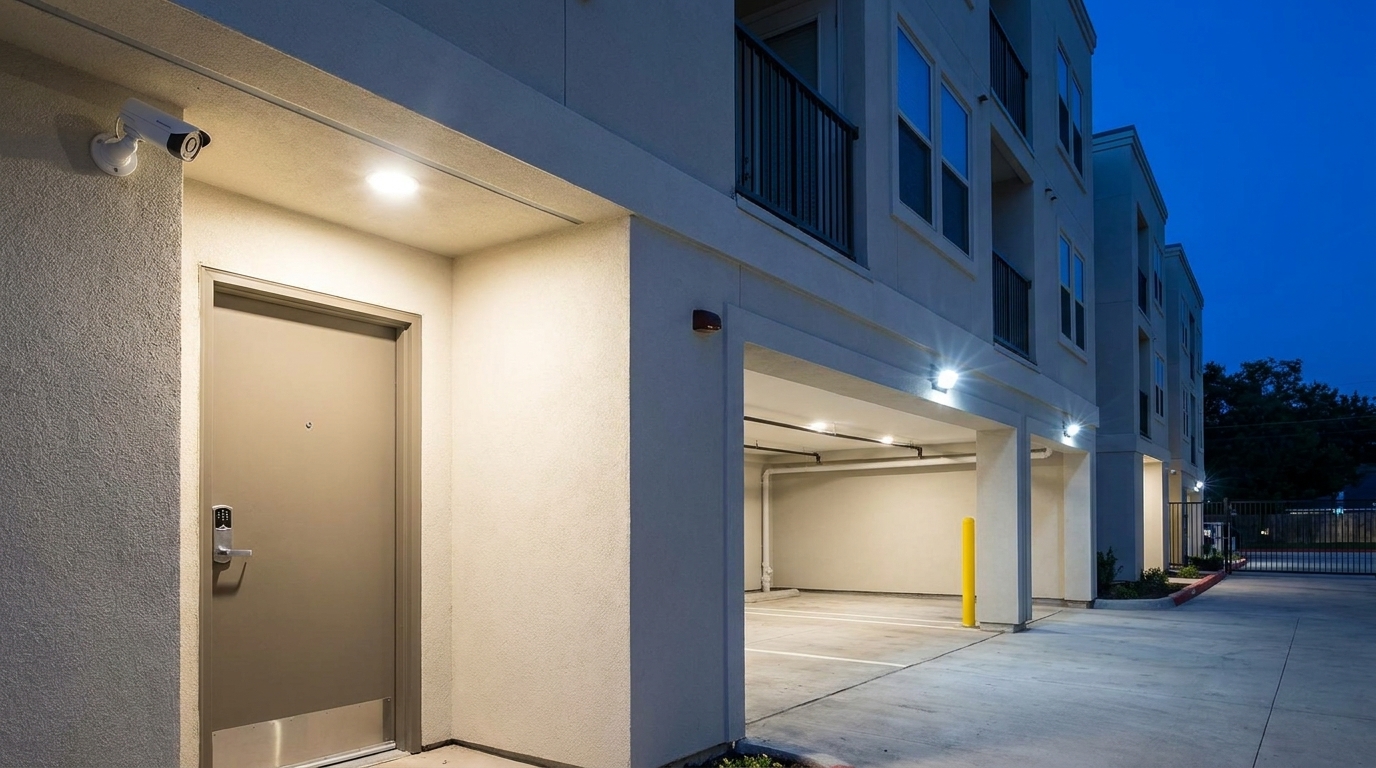
What is F.S. 768.0706? Understanding the Florida Landlord Liability Presumption
Florida Statute 768.0706 represents a landmark shift in how negligent security cases are litigated across the state. By creating a specific framework for property owners to follow, the legislature has redefined the standard of care required for multifamily residential properties. The updated legislation places a heavy emphasis on proactive security measures. It shifts the focus toward statutory compliance in the event of a lawsuit involving landlord liability for third-party crime.
The Definition of Multifamily Residential Property Under Florida Law
The protections offered by this statute don't apply to every type of rental unit or housing structure in Florida. Under Florida law, a multifamily residential property is defined as a residential building or group of buildings, such as apartments or townhouses, consisting of at least five dwelling units located on a single parcel with a distinct identification number. This definition includes typical apartment complexes and condominiums that meet the unit count threshold.
A parcel is further defined as real property assigned a distinct identification number by the county property appraiser. This specific classification excludes single-family homes, duplexes, and smaller rental properties from the scope of Florida Statute 768.0706. Identifying the exact classification of the property where a crime occurred is the first critical step for an injured victim's legal team.
What is the Presumption Against Liability?
The core of this law is the establishment of a rebuttable presumption against liability for property owners who comply with the statute. If a landlord shows it substantially implemented the required measures, the court presumes the landlord is not responsible for criminal acts third parties committed on the property. Nothing about that is automatic. Section 768.0706(3) puts the burden of proof on the owner to demonstrate the measures were actually in place. The legal presumption provides a significant procedural advantage to the defense in the early stages of litigation.
The implementation of this rule shifts the burden of proof onto the injured victim, who must now present evidence to overcome the initial legal defense. In a typical negligence case, the plaintiff proves the defendant failed to act reasonably. Under the new statute, the owner must first prove they met the security standards to gain the presumption, after which the plaintiff must work to rebut that standing.
However, the term rebuttable means the presumption isn't an absolute bar to financial recovery. A presumption can be rebutted if a legal team shows that the security measures were merely superficial or that the landlord was negligent in other respects. While the hurdle is high, a strategic approach using forensic evidence can still lead to a successful outcome for the victim.
Section 768.0706(5) says the section does not establish a private cause of action. It is a defense, not a grant of immunity. An owner who proves compliance with the physical and operational standards gets the presumption and nothing beyond it, and the tenant's underlying negligence claim still exists. Florida Statute 768.0706 governs multifamily residential property owners who seek this protection.
The Physical F.S. 768.0706 Security Standards for Florida Apartments
To earn the legal shield provided by the state, landlords must adhere to a strict and objective checklist of physical hardware and environmental standards. The law outlines explicit F.S. 768.0706 security standards that must be present on the property at the time a crime occurs:
- A security camera system at points of entry and exit that records video and keeps it retrievable for at least 30 days.
- A lighted parking lot at an average of at least 1.8 foot-candles per square foot, measured 18 inches above the surface, from dusk until dawn or on a photocell.
- Lighting in walkways, laundry rooms, common areas and porches, from dusk until dawn or on a photocell. The statute sets no foot-candle number for these.
- At least a 1 inch deadbolt in each dwelling unit door.
- A locking device on each window, each exterior sliding door, and any other door not used for community purposes.
- Locked gates with key or fob access along pool fence areas.
- A peephole or door viewer on each dwelling unit door that has no window in it and no window next to it.
These requirements are designed to provide a baseline level of protection for residents through technology and physical barriers.
1. Video Surveillance Systems at Entry and Exit Points
One of the primary requirements under the statute is the installation of a functioning security camera system at all points of entry and exit. These systems are intended to act as both a deterrent to criminals and a tool for law enforcement following an incident. A property owner cannot simply install cameras that don't work or are positioned incorrectly if they wish to claim the statutory shield.
One detail decides most camera disputes, and it is how long the footage lives. Systems must record and retain retrievable video footage for at least 30 days to assist law enforcement in offender identification. If a landlord fails to preserve this footage or has broken cameras at critical access points, they may be disqualified from receiving the presumption against liability.
2. Comprehensive Parking Lot and Walkway Lighting Requirements
Lighting is one of the most technical aspects of the new security standards. The statute requires that parking lots be illuminated at an average intensity of at least 1.8 foot-candles per square foot. This measurement must be taken at 18 inches above the surface and maintained from dusk until dawn to ensure clear visibility throughout the night.
This average intensity requirement is often significantly higher than many older municipal codes, which might only require 1.0 foot-candle or less. The discrepancy creates a specific technical opening for plaintiffs if a landlord only follows outdated local ordinances rather than the new state statute. If your attorney finds that the average light levels fell below 1.8 foot-candles, the landlord's liability shield may vanish.
Inadequate lighting is a common security lapse that criminals exploit to find cover and stalk potential victims. When a crime occurs, a plaintiff's attorney will often hire specialized lighting engineers to conduct a professional light-level study of the premises. Beyond the average intensity, experts also look for lighting migration and shadows that create dangerous dark spots near building entrances.
3. High-Security Deadbolts and Window Locking Devices
Physical security within the individual rental units is also a mandatory component of the state standards. The statute requires at least a one-inch deadbolt lock on every dwelling unit door to prevent forced entry. This requirement ensures that every tenant has a basic level of mechanical security at the primary entrance of their home.
In addition to deadbolts, the law requires functioning locking devices on all windows and exterior sliding doors. These devices must be in good working order to be considered compliant with the security standards. A landlord's ongoing failure to repair broken window locks or replace worn-out sliding door mechanisms can serve as evidence of negligence that strips away their legal protection.
The Operational Protocols: Crime Prevention Through Environmental Design (CPTED) Assessments and Employee Training
A landlord cannot secure a liability shield simply by installing physical hardware and then ignoring the property's daily operations. Florida law requires ongoing operational compliance, which includes professional property assessments and structured employee education. This combination of environmental design and human awareness forms the backbone of a landlord's defense against third-party claims for crime.
The Role of a CPTED Assessment in Florida Law
To qualify for the presumption, an owner had to have a CPTED assessment completed for the property by January 1, 2025. The statute does not order anyone to get one. It withholds the liability shield from owners who did not. This assessment, which stands for Crime Prevention Through Environmental Design, must be no more than three years old to remain valid. A certified CPTED practitioner conducts the security assessment to identify vulnerabilities.
The assessment must be performed by a law enforcement agency or a Florida CPTED Practitioner designated by the Florida Crime Prevention Training Institute of the Department of Legal Affairs. These practitioners are often former law enforcement officers with specialized training in environmental security. Their reports usually deal with blind spots, landscaping and access control, although the statute itself prescribes no contents for the report.
To keep the presumption, the owner must remain in substantial compliance with the assessment, which is what paragraph (2)(b) says in as many words. It's not enough to have the report on file if the suggestions were never implemented. An attorney will often compare the property's current condition with the assessment to identify discrepancies that could invalidate the landlord's defense.
CPTED principles focus on using natural surveillance, access control, and territorial reinforcement to deter criminal activity. For example, an assessment might suggest trimming high bushes that provide hiding spots or improving the layout of fences to direct foot traffic. If the practitioner recommended these changes but the landlord ignored them, the presumption of non-liability may be defeated in court.
Mandatory Employee Crime Deterrence and Safety Training Protocols
The third condition is training. An owner had to give proper crime deterrence and safety training to its existing employees by January 1, 2025, and anyone hired after that date has to be trained within 60 days of the hire date. This ensures that everyone working on the premises understands the security measures in place.
The curriculum has to familiarize staff with the security principles, devices and measures in paragraph (2)(a), and it must be reviewed at least every three years and updated as necessary. The owner can ask the law enforcement agency or the CPTED practitioner who did the assessment to review the curriculum. A landlord's failure to properly train their staff can leave the property vulnerable and expose the owner to significant legal liability.
How Florida's Broader Tort Reforms (HB 837) Impact Apartment Crime Lawsuits
F.S. 768.0706 does not exist in a vacuum and must be viewed alongside the broader changes to Florida's legal system. This statute was part of a massive tort reform package under HB 837, which dismantled several long-standing legal protections for injured victims. The practical result is that a negligent security case costs more to prove than it did before 2023.
The Apportionment of Fault to Criminal Actors (F.S. 768.0701)
Florida Statute 768.0701 changed the rules regarding fault allocation in negligent security cases. Under the previous legal framework, the intentional criminal actor who committed the assault was usually not included on the jury's verdict form. This allowed the negligent property owner to be held fully responsible for the damages if their security failures enabled the crime.
The new law now requires juries to consider the fault of all contributing parties, including the non-party criminal actor. Defense attorneys often exploit this rule to shift the vast majority of blame onto the perpetrator, who is often never caught or has no assets. This can lead to a significant reduction in the amount of compensation a victim can recover from the landlord.
An experienced plaintiff's lawyer works to keep the trial's focus on the landlord's systemic security failures rather than the criminal's intent. By demonstrating that the crime was entirely foreseeable and preventable, the attorney can argue that the landlord's negligence was the primary cause of the harm. This strategy is necessary for ensuring the jury holds the property owner accountable for their specific omissions.
The Shift to Modified Comparative Negligence (The 51% Rule)
Florida has transitioned from a pure comparative negligence state to a modified comparative negligence state. Under the new 51% rule, if an injured plaintiff is found to be more than 50% responsible for their own harm, they are completely barred from recovering any financial compensation. This is a drastic change that places much more risk on the victim.
Defense attorneys will actively look for ways to blame the victim for the incident to trigger this rule. They may claim the victim walked in a poorly lit area or ignored posted security warnings. Having an advocate is key to protecting a victim's rights and ensuring their reputation isn't unfairly tarnished during litigation.
The Shortened Statute of Limitations for Negligence Actions
HB 837 also introduced a reduction in the time limit allowed to file a lawsuit in the state of Florida. The legislature reduced the statute of limitations for general negligence claims from four years to two, at Section 95.11(5)(a). This shorter window puts intense pressure on injured victims and their families during a time when they're already struggling.
Gathering evidence, interviewing witnesses, and hiring forensic experts must now be completed in half the time previously allowed. If a lawsuit isn't filed within this two-year window, the victim may lose their right to seek compensation forever. Immediate legal action is now more vital than ever to ensure all procedural deadlines are met and evidence is preserved.
Comprehensive Evidence Checklist for Florida Negligent Security Claims
Building a successful case under the new standards requires meticulous evidence collection to challenge the landlord's presumption of non-liability. Because the landlord bears the initial burden of proving they implemented the security measures, your legal team must be prepared to conduct a counter-audit. A well-documented apartment complex security lawsuit relies on technical data that contradicts the owner's claims of compliance.
1. Immediate Site Inspection and Lighting Audit
The first step in any negligent security investigation is conducting an independent lighting study as soon as possible. Lighting engineers use precision meters to measure foot-candles at 18 inches above the walking surface across the entire parking lot. They don't just look at the average; they identify dark pockets where shadows from palm trees or architectural features provide cover for criminals.
Documentation of burned-out bulbs or non-functional photocells can immediately invalidate a landlord's claim of compliance. If your legal team can prove that the average intensity fell below the 1.8 foot-candle threshold on the night of the crime, the landlord loses their liability shield. This technical data is often the most objective evidence available in a premises liability trial.
2. Spoliation Letters and Digital Forensics
Securing surveillance footage is a race against time, as many digital recording systems overwrite data within 30 days. Your attorney must immediately send a formal spoliation letter to the property owner and the property owner's management company. This letter legally mandates the preservation of all video recordings, gate access logs, and internal communications from the date of the incident.
Beyond the footage itself, an attorney will examine the camera angles to ensure they provide a clear view of all entry and exit points. If a camera was positioned poorly or obstructed by overgrown landscaping, the landlord hasn't met the statutory requirement for a functioning system. Digital gate logs can also show if unauthorized visitors were frequently entering through broken or propped-open barriers.
3. Maintenance Logs and CPTED Review
Maintenance records and work orders provide a paper trail of the property's historical security failures. An attorney will audit these logs to see how long it typically took for the landlord to repair broken locks or replace burned-out lights. A pattern of deferred maintenance suggests that the security hardware was non-functional on the night of the assault.
Your legal team will also subpoena the property's mandatory CPTED assessment and compare it to the actual state of the premises. If the practitioner recommended specific changes that the landlord failed to implement, the owner cannot claim substantial compliance. This gap between the professional recommendations and the landlord's actions is a powerful tool for rebutting the presumption against liability.
4. Police Reports and Dispatch Records
Law enforcement documentation provides an unbiased foundation for any negligent security claim. Your attorney will secure the initial police report, 911 call transcripts, and historical dispatch records for the property. These records establish a documented history of crime on the premises, proving that the landlord knew or should have known about the ongoing risks to tenant safety.
How Crime Victims Can Still Sue a Negligent Landlord
The protections now available to property owners are real, but they are not immunity. Many apartment complexes fall short of the law's strict standards in ways that an attorney can exploit to secure justice for the victim. Understanding how to challenge a landlord's claim of compliance is the key to winning an apartment complex security lawsuit.
Substantial Compliance Is Not Absolute Immunity
The law doesn't grant automatic immunity simply because a landlord claims to have security measures in place. It merely creates a presumption of non-liability if the landlord can show they substantially implemented the required measures. This means the landlord carries the initial burden of proving their compliance to the court before they can benefit from the shield.
The term substantial is a subjective standard that remains open to legal interpretation by judges and juries. A personal injury attorney can challenge a landlord's claim of compliance by demonstrating that their security programs were superficial or poorly integrated. If the security measures existed only on paper but weren't functional in reality, the presumption can be defeated.
Proving Under-Maintained Systems and Broken Equipment
Property management companies frequently struggle with deferred maintenance, which can lead to a failure in security infrastructure. While a landlord may have once installed cameras, lights, and locks to look compliant, they often fail to keep them in working order. Proving that the equipment was broken on the night of the crime is a common way to overcome the liability shield.
Real-world examples of maintenance failures include burned-out parking lot bulbs that leave large areas in total darkness. In other cases, security cameras may have been disconnected or out of service for weeks before the incident occurred. Security gates that remain propped open for the convenience of staff or residents are another frequent breach of protocol.
If a landlord fails to maintain their security infrastructure, they lose their presumption against liability. Documentation of past repair requests or maintenance logs can show a pattern of neglect that the landlord failed to address. This allows the victim to hold the owner accountable for the security gaps that enabled the criminal to access the premises.
Why You Need a Florida Negligent Security Attorney to Fight for You
On the other side of one of these cases sits a management company, its insurer, and a defense firm that litigates them full time. They will use every tool the 2023 changes handed them. Matching that takes a firm that has actually tried premises liability cases under the current rules.
When you are filing a lawsuit for apartment complex assault in Florida, you face a team of defense lawyers ready to use the 51% rule against you. They will argue that the crime was unpredictable or that you were at fault for your own injuries. An attorney with a documented record of litigating Florida premises liability cases under HB 837 knows how to dismantle these arguments.
Learning how to hire a negligent security lawyer in Fort Lauderdale is a necessary step for victims seeking full financial recovery. A skilled attorney will launch an immediate investigation to secure vital evidence before it's lost. We employ aggressive litigation tactics to uncover hidden maintenance failures and prove that the landlord's compliance was only a facade.
The attorney will also request local police dispatch records to identify patterns of criminal activity in the area. Interviewing neighbors and auditing local crime databases helps build a narrative of foreseeability that is important for the case. Thorough evidence collection ensures the landlord cannot hide behind a false claim of compliance.
Frequently Asked Questions About Florida's Apartment Negligent Security Laws
Understanding your rights under Florida's new apartment negligent security laws is the first step toward seeking justice following the enactment of HB 837.
Can I still sue my landlord if I was assaulted in my Florida apartment complex?
You can still file a lawsuit against your landlord, but the legal pathway is now more challenging. If a landlord has failed to maintain their security systems or has neglected the physical and operational requirements under F.S. 768.0706, they can still be held liable. Your legal team must work to show that the landlord was not in substantial compliance with the law or was otherwise negligent.
What is the statute of limitations for a negligent security lawsuit in Florida?
The statute of limitations for a negligent security lawsuit in Florida is now only two years from the date the criminal incident occurred. This timeframe was reduced from four years to two by the passage of HB 837, creating a much tighter deadline for victims. Waiting too long to consult with an attorney can result in losing your right to seek compensation forever. Detailed information about filing timelines can be found by reviewing the statute of limitations for a negligence lawsuit.
How does a CPTED assessment protect a property owner from liability?
A CPTED assessment identifies environmental vulnerabilities that criminals could exploit and provides a blueprint for making the property safer. If a property owner obtains this assessment from a certified practitioner every three years and remains in substantial compliance with its recommendations, they meet a core requirement for the liability shield. This document serves as part of the evidence the landlord uses to prove they took proactive steps to deter crime.
Can a landlord still be held liable if they have cameras and deadbolts?
Physical security hardware alone isn't enough to grant a landlord absolute immunity from a lawsuit. If the cameras were broken, the lighting was inadequate, the staff was untrained, or the landlord ignored a documented history of violent crime, they can still be held responsible. The presence of hardware is only one part of the statutory requirements, and all measures must be maintained to provide legal protection.
What is the modified comparative fault rule in Florida?
The modified comparative fault rule bars an injured victim from recovering any compensation if they're determined to be more than 50% responsible for the incident. This rule is a major shift in Florida law that defense attorneys often invoke to blame the victim and avoid paying damages. Having strong legal representation is key to ensuring the blame is properly placed on the negligent property owner.
Speak To Weinstein Legal Team Today About Your Premises Liability Claim
Florida's new security standards have provided landlords with a significant liability shield, but this protection isn't absolute. Success in a negligent security claim now depends on a victim's ability to prove that a property owner failed to maintain the strict physical and operational standards required by law. While the hurdles are high, holding negligent property owners accountable is still possible when you utilize an evidence-based legal strategy to challenge their compliance.
Weinstein Legal Team handles Florida premises liability claims, including negligent security cases against apartment complexes and other multifamily properties. We work with forensic security consultants to test whether an owner actually met the seven measures in Florida Statute 768.0706 or only says it did. If you were injured on a Florida rental property, we can review what the owner did and did not do before the attack. Schedule your free, confidential case review to ensure your rights are protected before the two-year statute of limitations expires.