
- Property owners and managers owe business invitees a duty to keep a parking lot or garage in reasonably safe condition and to warn of hidden dangers, and that duty covers the shared lot, not just the store.
- Under Florida Statute 768.0755, a person who slips on a transitory foreign substance in a business establishment has to prove the business had actual or constructive knowledge of it. Subsection (2) preserves the common-law duty of care owed by whoever is in possession or control of the premises.
- Florida is a modified comparative negligence state. Fault reduces recovery in proportion, and Florida Statute 768.81(6) bars a party found greater than 50 percent at fault for his or her own harm from recovering anything. That bar arrived with chapter 2023-15 and applies to cases filed after March 24, 2023.
- South Florida rain, humidity and salt air break down asphalt and concrete quickly, producing potholes, oil slicks lifted to the surface by rainwater, water pooling at clogged drains, shifted wheel stops and unlit garage bays.
- A commercial tenant's duty usually stops at its leased space and the immediate approach to its door, so a fall out in the shared lot normally falls on the landlord, the management firm, or a maintenance contractor whose own work created the hazard.
- Surveillance footage is overwritten within days or weeks, and Florida Statute 95.11(5)(a) gives two years to file a negligence suit on a claim accruing after March 24, 2023, or four years on one that accrued before then.
- A fall in a government parking lot follows different rules. Section 768.28(6)(a) makes written notice of the claim a condition of suing at all, with three years to present it and four years to file the suit under Section 768.28(14), and Section 768.28(5)(a) caps recovery at $200,000 to any one person and $300,000 for everyone hurt in the same incident.
A simple trip to a Florida shopping plaza can quickly end in the emergency room. If you slip and fall in a poorly maintained parking lot, you are suddenly stuck with mounting medical bills and zero answers about who is responsible. Busy retail hubs and multi-level garages across Broward County often contain hidden hazards that lead to life-altering accidents.
Fault usually comes down to paperwork: maintenance logs, the lease that says who sweeps the lot, and the local code that sets how bright a garage has to be. This page covers who owes you a duty, what you have to prove under Section 768.0755, and how the deadlines work.
Understanding Florida Premises Liability Law in Parking Facilities
Florida premises liability is a legal framework that holds property owners and managers responsible for injuries that occur on their property due to unsafe conditions. To secure compensation, a plaintiff must prove the owner owed a duty of care, breached that duty, and directly caused the victim's injuries.
Property owners and operators have a legal obligation to maintain safe conditions for those who enter their property. They must take reasonable measures to fix or warn about dangerous conditions they knew or should've known about. When a defendant's negligence is the direct and foreseeable cause of a fall, the owner is typically held liable for the resulting physical and financial damages.
The Legal Duty of Care Owed to Commercial Invitees in Florida
Under Florida law, visitors are classified to determine the level of care they're owed. Business invitees receive the highest level of protection under this legal system. Shoppers, diners, office workers, and visitors to commercial centers are considered invitees because their presence provides a potential economic benefit to the business.
A property owner owes a duty of care to the commercial invitee. Florida's legal standard imposes dual duties on property owners and managers in commercial parking environments. They must maintain the parking lot and garage in a reasonably safe condition while providing adequate warnings for any latent or non-obvious dangers. This duty of care extends to both public and private property, ensuring businesses remain accountable for the safety of their designated parking zones.
Meeting this standard of care requires owners to conduct proactive inspections of their parking facilities rather than waiting for an accident to occur. A business can't claim ignorance of a hazard if a reasonable inspection would've revealed the danger. By failing to identify and rectify foreseeable risks, the property owner breaches their duty to the invitees who rely on the facility's safety.
Proving Actual or Constructive Knowledge Under Florida Statute § 768.0755
Section 768.0755 is a proof rule, not a liability rule. If you slip on a transitory foreign substance in a business establishment, such as spilled car fluids or tracked-in rainwater, you have to prove the business had actual or constructive knowledge of the dangerous condition and should have taken action to remedy it. Subsection (2) then says the statute does not affect any common-law duty of care owed by whoever is in possession or control of the premises, so the duty to maintain the lot survives the proof rule.
Transitory foreign substances in a parking lot often include rainwater mixed with motor oil or leaked coolant from parked vehicles. In the South Florida climate, these substances create a low-friction surface that's difficult to see through the glare of the sun or during a storm. Foreseeability is frequently argued when a storm is predicted, as property managers should anticipate pooling water in known low spots or near clogged drains.
Evidence showing that an employee or manager was specifically aware of the danger before the fall establishes actual knowledge. This might involve a witness who saw an employee walk past a spill, or a customer report that was ignored. In these cases, the business clearly failed to act on information that a hazard existed on the premises.
Constructive knowledge is more common. Plaintiffs prove it by showing that the hazard existed for a period long enough that the business should've discovered it. A plaintiff can also establish constructive notice by demonstrating that the hazard occurred regularly and was therefore foreseeable. Attorneys often use maintenance logs and surveillance footage to show the business failed to conduct routine inspections that would've identified the slick surface.
The Open and Obvious Doctrine vs. Comparative Negligence in Florida
Defense attorneys frequently use the open and obvious doctrine to argue that a hazard was so visible that the victim should've avoided it. They claim that if a reasonable person could see the danger, the property owner's duty to warn is diminished or eliminated. However, Florida courts have clarified that an open and obvious danger doesn't automatically excuse a property owner from their duty to maintain safe premises.
Florida operates under a comparative negligence system, which directly affects how damages are awarded in slip-and-fall cases. Any fault attributed to the victim will proportionally reduce their financial recovery based on their percentage of blame. For example, if a victim is found to be 20% at fault for failing to see a puddle, their total compensation would be reduced by 20%.
Section 768.81(6) bars a plaintiff found more than 50% at fault for their own harm from recovering anything. That bar came in with House Bill 837, chapter 2023-15, and applies to cases filed after March 24, 2023, so a case filed before that date is still governed by pure comparative fault. Either way, the evidence of what the owner failed to do is what keeps your share of the blame down. An experienced lawyer works to minimize the comparative fault assigned to the victim by highlighting the property manager's failure to address the underlying hazard.
Common Injuries Sustained in South Florida Parking Lot Falls
Parking lot surfaces are unforgiving, consisting primarily of abrasive asphalt or reinforced concrete. When a person falls onto these materials, the impact often causes serious medical emergencies requiring long-term care. The severity of these injuries dictates the eventual value of a personal injury claim.
Traumatic brain injuries (TBIs) occur frequently when a victim's head strikes the pavement or a concrete wheel stop. These injuries can range from mild concussions to permanent cognitive impairment that prevents a return to work. Diagnostic imaging and neurological evaluations are necessary to document the full extent of brain trauma in a premises liability case.
Hip fractures and pelvic injuries are common among older adults who fall in commercial parking areas. These injuries often require surgical intervention, such as a total hip replacement, and months of physical therapy. For many victims, a hip fracture leads to a permanent loss of mobility and a significant reduction in their quality of life.
Spinal disc herniations are another frequent outcome of a sudden slip on a low-friction surface. The jarring motion of a fall can cause the jelly-like center of a spinal disc to push through a tear in the tougher exterior. This often leads to chronic pain, numbness in the extremities, and the potential need for spinal fusion surgery or long-term pain management.
Common Hazards in South Florida Commercial Parking Lots and Garages
The unique environmental conditions in South Florida accelerate the physical deterioration of parking facilities and pose constant safety risks. Intense humidity, heavy tropical rain, and coastal salt air cause asphalt and concrete to break down faster than in other climates. When combined with heavy vehicle traffic, these conditions result in hazards that catch pedestrians off guard.
Sprawling shopping plazas in Sunrise and multi-level parking structures in downtown Fort Lauderdale must account for these rapid changes. Maintenance crews often struggle to keep up with the pace of decay caused by the subtropical climate. When they fall behind, small defects quickly transform into dangerous traps for unsuspecting shoppers and office workers.
Accumulation of Oil, Car Fluids, and Slippery Residues
Vehicle fluid leaks are a primary source of slick, hazardous conditions in commercial parking lots. When property managers fail to regularly pressure-wash or sweep their facilities, motor oil and transmission fluid build up on the smooth asphalt. These residues create a low-friction surface, making it difficult for pedestrians to navigate safely when walking to or from their vehicles.
These oil slicks become dangerous during the frequent rainstorms that characterize the South Florida climate. Water causes the oil to rise to the surface, creating an invisible, slick layer on the pavement. Pedestrians often can't see these hazards in the rain, leading to sudden, violent falls on the greasy surface.
Improper Drainage and Pooling Water (The South Florida Rain Factor)
Poor drainage designs and neglected infrastructure frequently lead to hazardous water pooling in pedestrian walking lanes. South Florida downpours require high-capacity drainage systems to move large volumes of water away from areas with foot traffic. When storm drains become clogged, or the asphalt sinks due to poor grading, deep puddles form and remain long after the rain stops.
These deep pools of water pose significant slip-and-fall risks and can also obscure structural hazards. A pedestrian steps into what looks like a shallow puddle and finds a pothole or sharp debris under the surface. Property owners are negligent if they allow these drainage issues to persist in areas where people are expected to walk.
Damaged Wheel Stops, Potholes, and Cracked Asphalt
Structural trip-and-fall hazards are common in exterior lots that don't receive consistent maintenance. Wheel stops are the concrete barriers at the front of parking spaces that frequently crack or shift out of alignment over time. If these barriers lose their anchoring pins, they can slide into pedestrian paths, creating unexpected obstacles that are difficult to see at night.
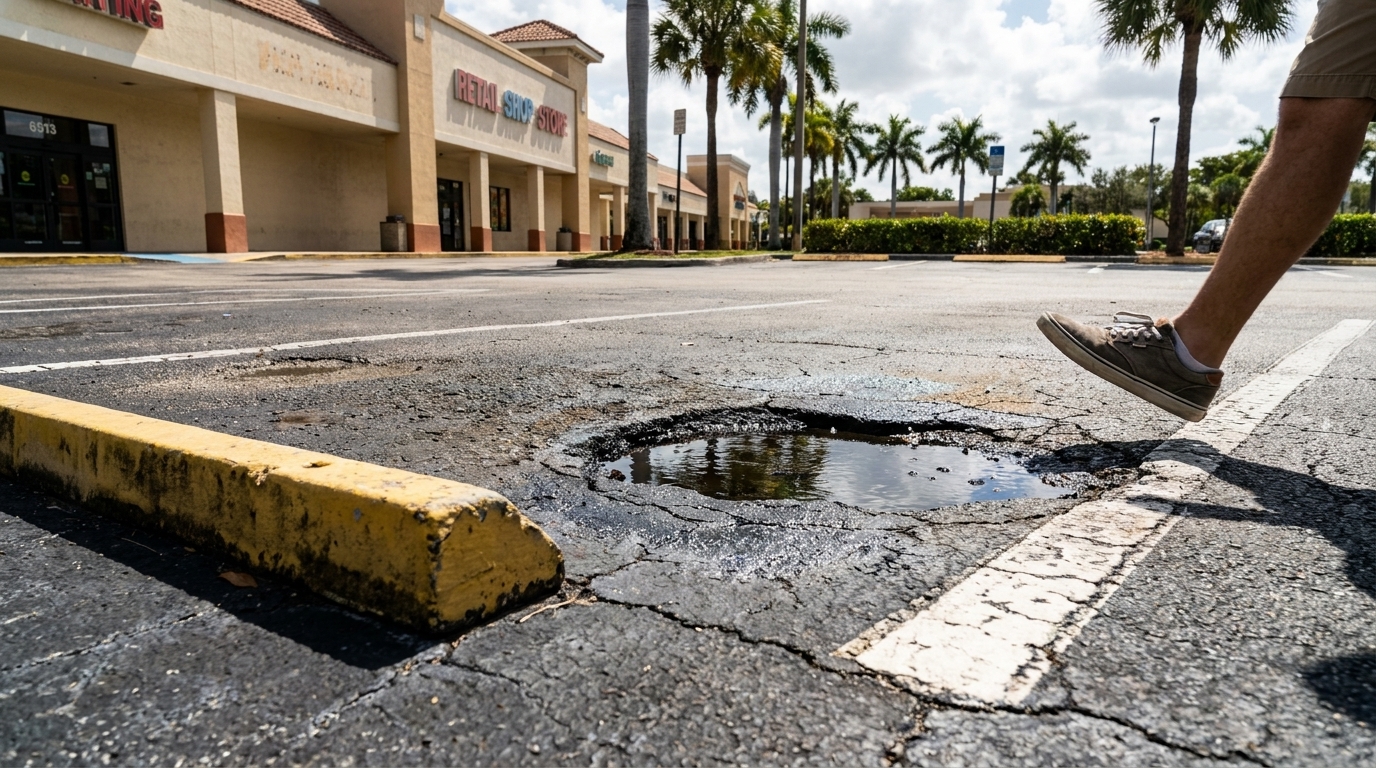
The constant weight of heavy vehicles combined with the shifting sandy soil of Florida leads to severe asphalt cracking and deep potholes. Property managers have a duty to patch these holes promptly to prevent pedestrian injuries. If a hole is left open for weeks or months, it serves as clear evidence that the management team neglected its maintenance responsibilities.
Poor Lighting and Blind Spots in Parking Garages
Multi-story parking structures are inherently dark environments that require consistent, high-intensity lighting. When a facility has burnt-out bulbs or poorly positioned fixtures, the resulting shadows create dangerous blind spots for pedestrians. Commercial parking garage liability is often linked to these inadequate illumination levels in stairwells, walkways, and elevator vestibules.
Bad lighting makes oil slicks, level changes, and debris nearly impossible to see. Aging fixtures throw a dim yellow cast that leaves whole bays of the garage in shadow. A property owner who fails to maintain the lighting system creates an actionable premises liability claim when a visitor falls due to poor visibility.
Unmarked Concrete Slabs and Gate-Arm Anchors
Unmarked physical obstructions represent a frequent and hidden hazard in many commercial garages. Security gates often rely on concrete anchor slabs that protrude from the ground to support the gate-arm mechanisms. If these slabs are left unpainted, they blend seamlessly with the surrounding gray pavement, making them a significant trip hazard for unsuspecting walkers.
Leaving these raised edges unpainted, when bright yellow or orange paint costs almost nothing, is hard for an owner to defend. Whether a particular unmarked anchor breaches the duty of care is a jury question, and it turns on how much foot traffic crosses it and whether anyone had tripped there before. Without these safety measures, the property owner is responsible for any injuries caused by the camouflaged obstruction.
Negligent Security and Criminal Acts in Parking Facilities
Beyond physical hazards, commercial property owners in South Florida must also protect visitors from foreseeable criminal acts. Negligent security claims arise when a parking lot or garage lacks adequate lighting, security patrols, or functioning surveillance cameras, resulting in assaults or robberies. If a property has a history of crime, the owner's failure to implement proper security measures constitutes a severe breach of their duty of care.
While these environmental risks are common, the legal challenge lies in establishing the entity responsible for the property's upkeep.
Who Is Liable? Unraveling Possession and Premises Control
Determining liability for a parking lot injury is a complex process that depends on who had actual possession and control over the area. In many commercial centers, multiple corporate entities share the property, making it difficult to pinpoint the negligent party. Identifying the entity responsible for the specific square footage where the fall occurred is the foundation of any successful claim.
Possession and control aren't always held by the same company that owns the land. Leasing agreements often shift the burden of maintenance to third parties or specific tenants. A thorough legal analysis must be conducted to ensure the correct party is named in a personal injury lawsuit.
Determining the Liability of Commercial Landlords and Management Firms
In most commercial lease structures, the landlord retains ownership and operational control over the property's common areas. This typically includes the shared parking lots, sidewalks, and multi-story garages used by all visitors to the center. The landlord oversees common areas and is ultimately responsible for ensuring these spaces remain free of hazards.
Landlords often hire property management companies to handle the facility's daily operations and inspections. These firms are tasked with overseeing third-party vendors and responding to reports of dangerous conditions. A property management company can be held directly liable if it neglects reported hazards or fails to supervise the maintenance of the common areas adequately.
Landlords often use Common Area Maintenance fees to fund the upkeep of the parking facilities. Since they collect these fees from tenants, they have a clear financial and legal obligation to provide a safe environment for the public. When they fail to use these funds for necessary repairs, they expose themselves to significant liability for any resulting slip-and-fall accidents.
Commercial Tenants and the Immediate Approach Rule
A commercial tenant's duty to maintain safe conditions is generally limited to their leased premises and the immediate approach to their entrance. Consequently, a restaurant or grocery store is responsible for the sidewalk directly in front of its doors. If a patron slips on a substance in this specific area, the tenant may be held liable for the injury.
However, if a patron falls 40 or 50 feet away in the shared parking lot, the tenant store is typically not responsible. Courts analyze the lease boundaries to determine where the tenant's control ends and the landlord's control begins. Unless the tenant exercised active control over the parking spot or created the hazard themselves, the landlord usually remains liable.
There are exceptions when a tenant's business operations directly create a hazard in the common area. For example, if a grocery store employee spills liquid while pushing carts through the lot, the store can be held accountable. In these instances, the tenant's staff's active negligence overrides the general rule of common area maintenance.
Filing a Claim for Third-Party Property Maintenance Negligence
Commercial properties frequently contract out specialized tasks like parking lot sweeping, line striping, and pressure washing to independent businesses. These third-party maintenance contractors can be brought into a slip-and-fall claim if their active negligence caused the accident. Maintenance contractors create new risks if they perform their duties poorly.
Active negligence might mean restriping a lot with paint that has no anti-skid aggregate in it, so the fresh lines turn slick the first time it rains. A contractor might also leave behind dangerous chemical residues or large amounts of standing water after pressure washing a garage. In these cases, the contractor is directly responsible for the hazard they introduced to the environment.
A contractor can also be held liable for failing to perform their contractual duties as scheduled. If a lighting company is contracted to replace burnt-out bulbs weekly but fails to do so for a month, they share the blame for a fall in a dark garage. Attorneys look for these breakdowns in safety protocols to ensure all negligent parties are held accountable.
Handling Claims Against Municipal and Government Parking Lots
When a slip-and-fall occurs in a parking lot owned by a government entity, the legal process becomes much more restrictive. Municipal parking lots, such as those owned by the City of Fort Lauderdale or Broward County, are subject to sovereign immunity laws. These laws provide the government with specific protections that aren't available to private commercial property owners.
If you fall on government property, Section 768.28(6)(a) makes written notice of the claim a condition of suing at all. You have three years from the date the claim accrues to present it, and two years if the claim is for wrongful death, and the suit itself has four years under Section 768.28(14), or two for wrongful death. Section 768.28(5)(a) then caps what the government pays at $200,000 to any one person and $300,000 for everyone hurt in the same incident, and anything above that has to go through the Legislature as a claim bill.
Failure to provide this official notification within the prescribed timeframe can lead to the permanent forfeiture of your right to sue. The government uses this period to conduct its own investigation and determine if a settlement is appropriate. Navigating these administrative hurdles requires precise legal timing to ensure your claim remains valid under state law.
How a South Florida Slip and Fall Lawyer Investigates Your Case
A victim of a parking lot fall should never attempt to negotiate with commercial insurers without professional legal assistance. Insurance companies for large commercial centers use tactics such as requesting recorded statements before a victim has consulted counsel. Attorneys use forensic methods and legal discovery tools to uncover the evidence needed to prove liability and secure a fair settlement.
A dedicated lawyer minimizes comparative fault by highlighting the property manager's failure to address the underlying hazard. This investigation starts the moment you hire a firm to represent your interests. Every piece of evidence, from digital video to physical pavement samples, is meticulously analyzed.
Deciphering Commercial Lease Agreements
The first step an experienced slip-and-fall lawyer takes is to demand and review the property's commercial lease agreement. These dense contracts contain critical information about which entity holds the non-delegable duty to keep the parking lot safe. By scrutinizing these agreements, a lawyer can identify the specific roles assigned to the landlord and the tenants.
Lawyers look specifically for indemnification clauses and maintenance carve-outs that define each party's financial responsibilities. These documents also include precise definitions of common area maintenance and describe how repair costs are allocated. Identifying these details early in the process prevents the wrong entity from being sued and ensures the claim is directed at the correct corporate office.
Subpoenaing Property Management Contracts
Lawyers investigate the relationships between property owners and third-party vendors by analyzing service agreements and work orders. The legal team subpoenas internal maintenance logs to reveal the frequency of inspections. If a sweeping company was supposed to visit the lot daily but skipped three days, the lawyer can pinpoint the breakdown in safety.
Analyzing work orders also shows if the property manager was aware of a defect but delayed the necessary repair. A history of repeated service calls for the same pothole or broken light indicates that the property owner was on notice of a persistent problem. Such maintenance data is how a claimant establishes constructive knowledge and shows that the defendant failed to provide a permanent fix.
Securing Surveillance Footage and Maintenance Logs
Commercial centers and parking garages maintain extensive closed-circuit television systems that often capture the exact moment of a fall. However, this footage is regularly overwritten within days or weeks as part of standard security protocols. A lawyer must act quickly to send a formal spoliation letter to the property owner to preserve this video evidence legally.
Surveillance footage can show how long a hazard existed before the victim arrived, and that is what constructive knowledge rests on. If the video shows a spill that sat for two hours without employee intervention, the claim of constructive knowledge becomes much stronger. Maintenance logs and sweep schedules are also requested to verify if the staff actually performed the inspections they claimed to have completed.
Utilizing Engineering and Safety Experts
Personal injury attorneys collaborate with forensic engineers and walkway safety experts to conduct scientific on-site investigations. These experts use specialized equipment, such as tribometers, to measure the coefficient of friction on parking lot surfaces and painted lines. Safety experts use light meters to calculate the precise illumination levels in parking garages.
If the light levels are below the required threshold under local building codes, this provides scientific evidence of the owner's negligence. These expert findings are difficult for insurance companies to dispute and often lead to faster and more substantial settlements for the victim. Objective data from engineering experts removes the guesswork from a premises liability claim.
A Detailed Guide to Recoverable Damages in Florida
Victims of a parking lot slip-and-fall are entitled to seek compensation for both their tangible financial losses and their intangible suffering. Quantifying these damages requires a thorough review of medical records, employment history, and expert testimony regarding future needs. Florida law allows recovery of several categories of damages in a premises liability action.
Economic damages include all quantifiable financial losses resulting from the accident. Economic compensation covers hospital stays, surgical costs, prescription medications, and any specialized medical equipment needed for recovery. You can also recover lost wages if your injuries prevent you from performing your job duties during your rehabilitation.
Non-economic recovery includes compensation for physical pain, mental anguish, and the loss of enjoyment of life. Because these damages are subjective, attorneys often rely on testimony from family members and friends to demonstrate how the injury has changed the victim's daily life.
Calculating the total value of a claim involves projecting future expenses that may arise years after the accident. If a victim requires lifelong physical therapy or home health assistance, those costs must be factored into the final settlement demand. A comprehensive damages analysis ensures that a victim doesn't settle for an amount that fails to cover their long-term needs.
The Role of Local Building Codes in Broward and Miami-Dade
Local building codes in Broward and Miami-Dade counties provide the technical standards that property owners must meet to ensure public safety. These ordinances dictate everything from the maximum slope of a sidewalk to the minimum brightness of a parking garage light fixture. Building codes dictate lighting standards in Fort Lauderdale and surrounding cities.
If a parking lot walkway has a slope that's too steep, it may violate the Americans with Disabilities Act (ADA) and local safety codes. Such a violation can serve as a basis for proving negligence per se, meaning the owner is automatically considered negligent for failing to follow the law. Forensic engineers compare the physical dimensions of the accident scene to these specific local standards.
Lighting requirements are particularly strict in multi-story parking structures to prevent shadows that hide hazards. Codes specify the exact number of foot-candles required in pedestrian paths, stairwells, and elevator vestibules. When a property owner fails to meet these illumination standards, they create an environment in which a slip-and-fall is almost inevitable.
Steps to Take Immediately After a Parking Lot Fall in South Florida
- Seek Immediate Medical Attention: A professional medical evaluation should always be your top priority after a parking lot fall. Even if your injuries seem minor, conditions like soft tissue damage, concussions, or internal bruising may not show symptoms for several hours. A medical visit creates an official and uncontestable record that links your injuries directly to the accident in the parking lot.
- Document the Scene and Hazard: If you're physically able to do so, gather as much evidence at the scene as possible using your smartphone. Take high-resolution, wide-angle, and close-up photographs of the hazard, such as an oil slick, a pothole, or an unlit area. Be sure to document the absence of wet floor signs and obtain the names and contact information of anyone who witnessed the fall.
- Report the Incident to Property Management or Store Manager: Notify the store manager or parking garage security immediately to file a formal incident report before you leave the premises. Stick strictly to the facts of what happened and avoid admitting fault or saying you're fine while the report's being drafted. Request a physical copy of the completed report so you have a record of the official notification for your legal records.
- Preserve Your Physical Evidence: When you return home, place the exact shoes and clothing you were wearing at the time of the fall into a secure bag. Do not wash or alter these items, as dirt, grease stains, or water marks serve as vital physical evidence of the hazard. If the defense argues your shoes were worn out, having the actual footwear available for inspection can quickly debunk their claims.
- Contact an Experienced Fort Lauderdale Personal Injury Attorney: Consult with a qualified premises liability attorney before you speak with any commercial insurance adjusters. Insurance companies often reach out to victims to secure recorded statements designed to shift the blame to you. A lawyer will take over all communication with the insurance carriers to protect your interests and ensure you don't inadvertently damage your case.
Frequently Asked Questions About Parking Lot Slip and Falls
Seeking answers to common legal questions can help you understand the strength of your potential claim after a fall.
Can I sue if I slipped on pooling water from a South Florida thunderstorm?
While property owners can't control the weather, they can be held liable if poor drainage or uneven paving causes rainwater to pool unnaturally. If the pooling was a foreseeable and recurring issue the owner failed to correct, it constitutes negligence under Florida law. Property managers have a duty to ensure rainwater doesn't create standing hazards on designated pedestrian walkways.
What if the property owner claims the hazard was open and obvious?
It is a real defense, not a formality. A condition that is genuinely open and obvious can discharge the owner's duty to warn you about it, and comparative fault can take your recovery to zero if a jury puts you above 50% under Section 768.81(6). What it does not do is erase the owner's separate duty to keep the lot in reasonably safe condition, which is the duty most parking lot cases are built on. An attorney can still pursue a substantial recovery by focusing on the property owner's primary failure to maintain a safe environment.
How long do I have to file a slip-and-fall lawsuit in Florida?
Section 95.11(5)(a) gives you two years from the date of the accident to file a negligence suit. That two-year period applies to claims that accrued after March 24, 2023, the effective date of House Bill 837. A fall that happened on or before that date still carries the old four-year period. Initiate the legal process early so that evidence is preserved and your right to claim damages is protected.
What if I slipped on a grease slick from a parked car? Who is liable?
Liability for a vehicle fluid spill depends on how long the slick was left unaddressed by the property management team. Section 768.0755 puts the burden on you to show the business knew about the slick or should have found it. You meet that either by showing it sat there long enough that ordinary care would have caught it, or by showing that leaks in that spot occurred with regularity and were therefore foreseeable. Sweep logs and camera footage are how that gets proved.
Can a third-party maintenance company be sued directly?
If an independent contractor was hired to maintain the parking lot and their active negligence created the hazard, they can be named as a defendant. Such liability includes situations where a contractor failed to perform their duties or executed a repair so poorly that it led to your injury. In many cases, both the property owner and the third-party contractor may share the legal liability for your medical bills and other damages.
Speak With Weinstein Legal Team About Your Premises Liability Claim
Determining liability in commercial parking lots and garages requires a deep legal analysis of leases, corporate contracts, and forensic evidence. A single fall can lead to mounting medical bills and lost wages, making it essential to identify every party responsible for the hazardous conditions. Weinstein Legal Team investigates every detail of your accident to ensure that the negligent property owners or maintenance contractors are held fully accountable for their failures.
These companies prioritize their profits over your health and will use every available tactic to deny your claim or minimize your settlement. Early representation protects key evidence, such as surveillance footage, and levels the playing field against the resources of major corporate entities and their insurers. Contact us today for a free case review with a personal injury attorney.