
- Your home and its curtilage, meaning the porch, the fenced yard and the driveway, carry the highest expectation of privacy under the Fourth Amendment and Article I, Section 12 of the Florida Constitution, and police generally need a warrant, consent or an emergency to cross that line.
- The automobile exception lets an officer search a vehicle without a warrant where there is probable cause to believe it holds contraband or evidence of a crime, because a car can be driven away while a warrant is sought.
- In public your expectation of privacy is at its lowest. Under Florida Statute 901.151 an officer may detain you on reasonable suspicion and pat down your outer clothing for weapons, and anything whose incriminating character is immediately apparent in plain view can be seized.
- Riley v. California requires a warrant to search a cell phone seized during an arrest, and Florida's Freedom from Unwarranted Surveillance Act limits police drone surveillance of private property. That warrant rule stops at the border: in United States v. Touset the Eleventh Circuit held that a device search at a port of entry needs no suspicion at all.
- A motion to suppress asks the court to exclude evidence from an illegal search under the exclusionary rule, and at that hearing the burden is generally on the State to show the search rested on a valid warrant or a recognized exception.
Where you are standing changes what the police can lawfully do to you, and most people find that out at the worst possible moment. The same question and the same search can be legal on a sidewalk and unlawful in your kitchen. Understanding these laws helps you protect your legal interests during police encounters.
While many people feel they have a general right to be left alone, the law applies different standards based on your location. Whether you are at home, driving your car, or walking on a sidewalk, your legal protections change. Recognizing how your physical location affects your rights is necessary for anyone living in the state.
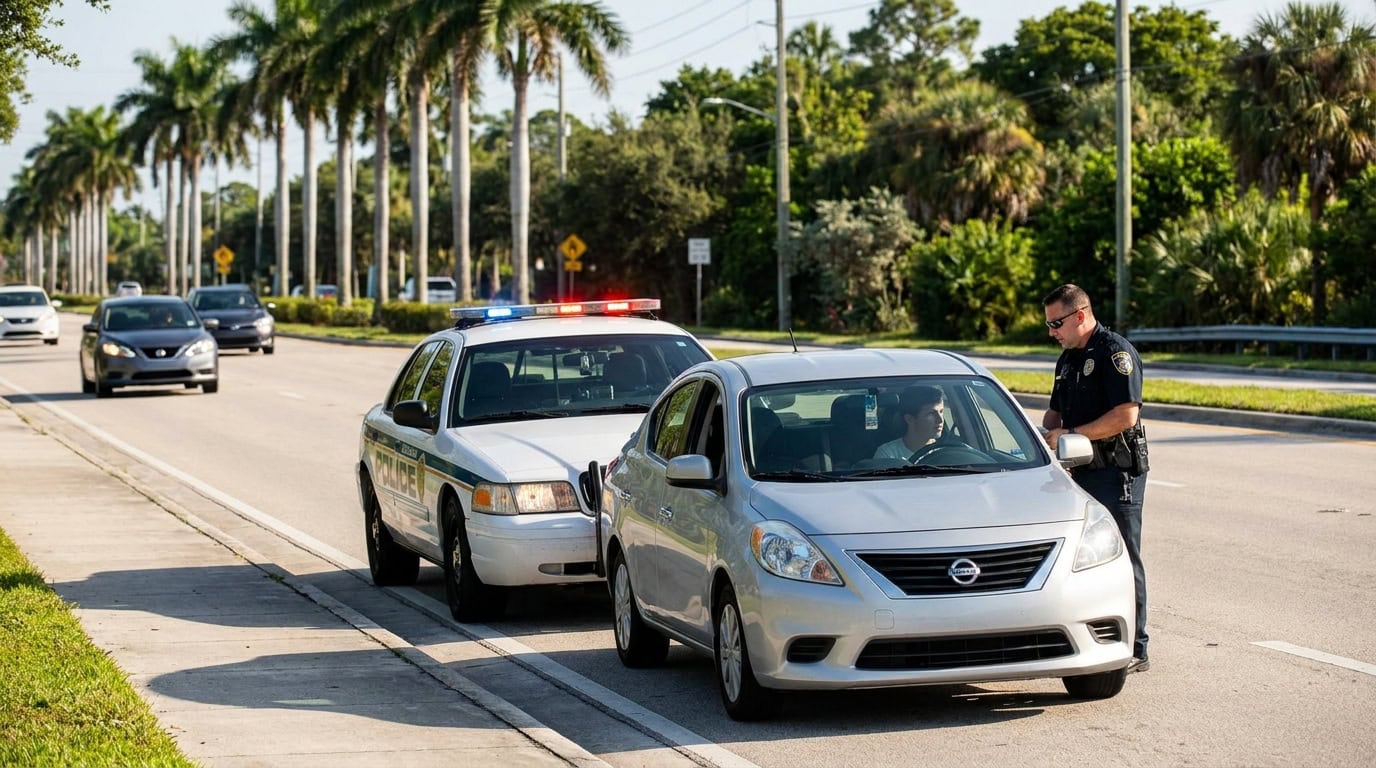
Understanding the Foundation of Privacy Rights in Florida
The distinction between public and private spaces serves as the bedrock for all search-and-seizure law within the state. Florida residents are protected by a dual layer of legal oversight that governs how government agents can intrude into their lives. This legal framework ensures that individuals maintain personal security while allowing law enforcement to perform necessary duties.
The Fourth Amendment of the U.S. Constitution provides the baseline for these protections across the country. In Florida, these rights are mirrored and further defined by Article I, Section 12 of the Florida Constitution. Together, these documents establish that people have a right to be secure in their persons, houses, and papers against unreasonable searches and seizures.
Florida courts frequently look to U.S. Supreme Court precedents to interpret these protections. However, the state also maintains its own case law history. The specific application of these rules often depends on the level of privacy a person can reasonably expect in a given environment. These legal standards evolve as society changes and new technologies emerge, challenging old definitions of private space.
The Fourth Amendment and Florida Constitution Article I, Section 12
The Florida Constitution contains a specific provision that links state search-and-seizure laws directly to federal standards. Article I, Section 12 explicitly states that the right to be free from unreasonable searches and seizures shall be construed in conformity with the Fourth Amendment. The state refers to the provision as the conformity clause. It ensures that Florida citizens receive the same fundamental protections as all Americans.
Florida voters added the conformity clause to Article I, Section 12 in 1982, which tied the state provision to the way the United States Supreme Court reads the Fourth Amendment. Before this alignment, there were occasional variations in how state and federal courts handled evidence. Now, the state's highest courts follow the federal lead in applying those rules to local law-enforcement interactions.
When you're dealing with local police, sheriff's deputies, or state troopers, the conformity clause means a national standard judges their actions. If a search is considered unreasonable under federal law, it's generally considered unreasonable under Florida law as well. Applying a unified standard helps maintain a predictable legal environment for both citizens and officers throughout the state.
What Is a Reasonable Expectation of Privacy?
Courts use a specific legal standard known as the Katz Test to determine if a search has actually occurred. The Katz test involves a two-pronged approach that examines both the individual's actions and society's viewpoint. It's the primary tool judges use to assess the protections you have during a police encounter.
The first prong of the test, established in Katz v. United States, asks whether the person involved exhibited an actual, subjective expectation of privacy in that moment. For example, if you're speaking quietly in a private office, you likely believe your conversation is private. However, if you are shouting sensitive information in a crowded public park, you haven't shown a subjective expectation of privacy.
The second prong is objective and asks if society is prepared to recognize that expectation as reasonable. Florida law, specifically section 934.02(2) of the Florida Statutes, defines oral communication based on these expectations. It protects communications in which a person expects their words won't be intercepted under circumstances that justify that belief.
Society generally agrees that you should have privacy in a bathroom or a closed bedroom, but not while standing on a public street corner. The Supreme Court of Florida has interpreted this test as substantially the same test used in a Fourth Amendment right-to-privacy analysis. Using the Katz test ensures consistency when determining if a state agent overstepped their bounds.
Are Your Constitutional Rights in Florida Protected?
The line between protected and unprotected spaces often shifts depending on the activity involved. Understanding your Constitutional Rights in Florida requires examining how the state views different contexts. From the front porch of a home to the deck of a boat, the rules vary significantly.
Many residents don't realize that their rights extend beyond just the physical walls of their house. Protection often applies to the surrounding area known as the curtilage. However, once you enter a common area or a public road, the legal threshold for police interaction changes.
Recording Police and the Florida Two-Party Consent Law
Florida is an all-party consent state, usually described as two-party consent. Section 934.03 prohibits the intentional interception of an oral communication, and a violation is a third-degree felony, so recording a private conversation without the consent of everyone in it is a crime rather than a civil dispute.
However, this rule changes when you are in a public space where there's no reasonable expectation of privacy. You generally have a right to record police officers performing their duties in public. As long as you don't physically interfere with their work, recording an interaction on a sidewalk is usually protected by law.
The challenge arises when the interaction moves to a private space, such as your living room. In these instances, the expectation of privacy is much higher. If you're planning on recording police officers, Florida law requires you to understand these situational differences to avoid criminal charges.
The Knock and Talk Tactic
The knock-and-talk technique is a common investigative tool used by Florida law enforcement to bypass the warrant requirement. In this scenario, officers approach a front door just like any other citizen to ask questions. They don't need a warrant to walk up to your door and knock, as there's an implied license for the public to do so.
During a knock and talk, you are not required to open the door or speak to the officers. The moment you open the door, officers may use the opportunity to look for evidence in plain view. They might also seek your verbal consent to enter the residence without a warrant.
You have the right to end the encounter at any time by closing the door or asking the officers to leave. If you don't clearly assert your rights, the police may continue to gather information through what started as a consensual conversation. Recognizing this tactic is necessary for anyone interested in knowing their rights if arrested.
Privacy in the Most Private Space: Your Home and Residence
The home is treated with the highest level of protection under both Florida and federal law. Judges and legislators view the private residence as a sanctuary where an individual's privacy is at its peak. This heightened protection means that the threshold of your front door represents a firm legal line that police cannot easily cross.
Law enforcement officers generally cannot enter your home without a warrant, your specific consent, or a clear emergency. This protection extends beyond the building's four walls to include certain surrounding areas. Understanding where these boundaries begin and end is a core part of knowing your rights as a homeowner or tenant.
The Sanctity of the Florida Home and the Warrant Requirement
In general, law enforcement must obtain a warrant from a judge before entering and searching a residence in Florida. To obtain this warrant, officers must present a written affidavit establishing probable cause that a crime was committed. The affidavit must clearly explain why they believe evidence of that crime is located inside your specific home.
A valid search warrant is not a general license for police to rummage through all your belongings. It must specifically describe the place to be searched and the items that the officers are authorized to seize. If the warrant lists a stolen laptop, the officers shouldn't be searching through small jewelry boxes where a laptop couldn't possibly fit.
If the police enter a home without a warrant and no legal exception applies, the evidence they find is often excluded from court. The courts refer to the principle as the exclusionary rule, which serves to discourage law enforcement from taking shortcuts that bypass constitutional rights. Maintaining the sanctity of the home through the warrant requirement is an important check on government power.
Understanding Curtilage and Property Boundaries
The legal protection of the home extends to an area known as curtilage, which is the space immediately surrounding the house. This includes areas like fenced-in backyards, porches, and private driveways that are closely associated with daily home life. Florida courts consider several factors to determine whether an area constitutes curtilage and warrants the same protection as the house itself.
Proximity to the home and whether a fence or wall encloses the area are the most common factors considered. Courts also consider the nature of the area's use and whether the resident has taken steps to protect it from observation. In State v. Morsman, 394 So. 2d 408 (Fla. 1981), a deputy got no answer at the front door and walked around to the back yard, and the Florida Supreme Court held that the resident had a reasonable expectation of privacy back there.
Florida's Fourth District Court of Appeal reached the drug-dog question first, in State v. Rabb, 920 So. 2d 1175 (Fla. 4th DCA 2006), holding that a sniff at the threshold of a home is a search. The rule that governs today comes from Jardines v. State, 73 So. 3d 34 (Fla. 2011), which the United States Supreme Court affirmed in Florida v. Jardines, 569 U.S. 1 (2013). Police cannot walk a drug-sniffing dog onto your front porch to investigate what is inside the house without a warrant.
Because the porch is part of the curtilage, using a trained dog there was considered an invasive search. The dog's presence violated the homeowner's privacy and required a warrant before the dog could be used. Florida residents should know that their fenced yards and porches enjoy high levels of constitutional protection.
When Can Police Lawfully Enter Your Home Without a Warrant?
While the warrant requirement is the general rule, several specific exceptions allow police to enter a home. One of the most common exceptions involves exigent circumstances, which are situations that demand immediate action. If police are in hot pursuit of a fleeing felon, they're allowed to follow that suspect into a private residence.
Another exigent circumstance occurs if there's a reasonable belief that evidence is being destroyed inside the home. Officers might also enter without a warrant if they believe someone inside is in immediate danger and needs emergency aid. These situations are carefully scrutinized by courts afterward to ensure the police didn't fabricate the emergency to bypass the law.
Consent is another way that law enforcement can enter a home without a warrant. If an occupant who has authority over the premises voluntarily allows police inside, the officers don't need further permission. This consent must be given freely and cannot be obtained through police coercion or threats.
You have the right to refuse a request for a consent search, and doing so doesn't give the police probable cause to enter. If you do grant consent, you can also limit where the officers look or withdraw your consent at any time. Once consent is withdrawn, the officers must stop their search unless they've found enough evidence to establish another legal basis to stay.
Privacy Rights in Shared Living and Rentals
Privacy rights in apartment complexes can be more complex than in single-family homes. While your individual unit is a private sanctuary, common areas like hallways, lobbies, and shared laundry rooms are generally not protected. Florida courts often hold that residents lack a reasonable expectation of privacy in common areas accessible to other tenants and the public.
Short-term rentals, such as those on Airbnb, offer protections similar to those for hotel rooms. As long as you are the legal occupant of the rental, you have a high expectation of privacy against government intrusion. Police still generally need a warrant to enter a short-term rental unless there is an emergency or consent.
Conversely, the Open Fields doctrine limits privacy on large tracts of rural land. The open fields doctrine suggests that open fields, even if privately owned and fenced, lack the same Fourth Amendment protection as a home's curtilage. Officers may be able to enter these open areas without a warrant to look for evidence of illegal activity.
Privacy Rights in Your Vehicle on Florida Roads
Privacy rights change significantly when you transition from your home to a motor vehicle. While you still have a right to privacy in your car, that right is diminished because vehicles are mobile and heavily regulated by the state. Courts call that reduced protection the automobile exception to the warrant requirement.
Operating a vehicle on public thoroughfares in Florida means you're subject to various traffic laws and safety inspections. Because a car can be driven away quickly, the law allows for more flexibility in how and when police can conduct searches. While your car isn't a completely public space like a sidewalk, it doesn't enjoy the same sanctuary status as your living room.
The Automobile Exception and Probable Cause
The Carroll Doctrine, originating from the Supreme Court case Carroll v. United States, is the legal rule that allows Florida law enforcement to search a motor vehicle without a warrant under the automobile exception. If an officer has probable cause to believe that a vehicle contains contraband or evidence of a crime, they can search it on the spot. The Carroll Doctrine exception exists because the time it would take to get a warrant would allow the driver to move the evidence.
Probable cause in the context of a traffic stop can be established in several ways. A law enforcement officer must establish probable cause before searching a locked trunk. For instance, if an officer smells the odor of burnt marijuana or sees illegal items sitting on the floorboard, they may have grounds to search.
The standard requires more than a hunch. The officer has to point to specific facts suggesting a crime is occurring. Mobility is the whole reason for the difference: a house stays put while police wait for a judge to sign a warrant, and a car can be across the county line in twenty minutes.
Traffic Stops and the Plain View Doctrine
The plain view doctrine is a frequently used tool during Florida traffic stops. If an officer is lawfully in a position to see an item that's clearly incriminating, they can seize it without a warrant. During a standard traffic stop, the officer is standing outside your window, which is a place they're legally allowed to be.
For the plain view doctrine to apply, three criteria must be met by the responding officer. First, the officer must be legally present in the location where the observation is made. Second, the item must be in plain sight and not hidden under seats or inside closed containers.
Finally, the item's incriminating character must be immediately apparent to the officer. If you are stopped and want to know what to do when pulled over, remember that officers can legally seize anything visible from your window. If the item isn't immediately identifiable as illegal, the officer can't move or manipulate it to get a better look without a warrant.
Privacy on the Water: Boating and Maritime Rights
Florida's vast coastline and many waterways mean many residents spend time on boats. Boating privacy rights are notably different from those of land-based vehicles. Both state and federal law enforcement have broad authority to board vessels for safety inspections without any suspicion of a crime.
During these inspections, officers can check for life jackets, fire extinguishers, and proper registration. While they're on board for safety purposes, they can also use the plain view doctrine to look for illegal items. However, a full-scale search of private cabins or locked storage containers still generally requires probable cause.
The maritime environment is heavily regulated to ensure public safety on the water. Because of this, your expectation of privacy is much lower when you're operating a vessel. Boaters should be prepared for routine boardings and understand that their Fourth Amendment protections are at their weakest in these scenarios.
Privacy Rights at Florida Airports and Border Crossings
Florida residents and visitors frequently travel through international airports and cruise terminals, where standard privacy protections are significantly reduced. Under the border search exception, federal agents from Customs and Border Protection can conduct routine searches of your luggage and personal belongings without a warrant or probable cause. The government justifies these reduced privacy expectations by emphasizing the need to protect national borders and enforce immigration and customs laws.
The rules governing digital devices at borders provide law enforcement with much wider latitude than in a typical street encounter. Federal agents can conduct a basic search of your smartphone or laptop at an international checkpoint. Several federal circuits require reasonable suspicion before a forensic search that copies the contents of a device, but the Eleventh Circuit, which covers Florida, does not. In United States v. Touset, 890 F.3d 1227 (11th Cir. 2018), it held that no suspicion is required for a border search of property, however intrusive. At a Florida port of entry you should assume your device can be searched without any particular reason.
Privacy in Public Spaces: Streets, Parks, and Sidewalks
When you're in a location that's accessible to the general public, your expectation of privacy is at its lowest. The general rule is that what a person knowingly exposes to the public isn't protected by the Fourth Amendment. If you're standing in the middle of a park, you can't reasonably expect that others won't see your actions.
Public spaces include beaches, sidewalks, parks, and government-owned buildings. In these areas, law enforcement can observe your behavior and record your actions without needing a warrant. Understanding that your privacy is significantly lowered in these areas is important for staying within the bounds of the law.
The Plain Feel and Stop and Frisk Standards
In public spaces, Florida law enforcement can use a procedure known as a Terry stop, or a stop-and-frisk. Under Florida Statute 901.151, officers may temporarily detain someone with reasonable suspicion that a crime has occurred or is about to occur. Reasonable suspicion is a lower standard than probable cause, but it still requires the officer to have a factual basis for the stop.
If an officer reasonably believes that the person they've stopped is armed and dangerous, they can perform a pat-down. A pat-down is a limited search of the person's outer clothing, specifically intended to find weapons. It's not a full-scale search of your pockets unless the officer feels something that is clearly a weapon.
The plain feel doctrine also applies during these encounters in public spaces. If an officer is conducting a lawful pat-down for weapons and feels an object whose illegal identity is immediately apparent, they can seize it. If they feel a pipe or a bag of pills and know exactly what it is through their experience, the item can be taken as evidence.
Privacy in Shared Environments: Offices and Hotel Rooms
There's a middle ground of privacy in places that aren't quite homes but aren't entirely public either. Workplaces and hotel rooms are examples of shared environments where privacy rights can be complicated. While you don't own these spaces, you often have high expectations of privacy from government intrusion while you're using them.
Florida law generally treats a hotel guest as having the same privacy rights as a homeowner during their stay. As long as you've checked in and are paying for the room, police usually need a warrant to enter. A hotel guest's protection ends once you check out or are evicted from the premises by management.
Workplaces offer a more limited form of privacy that's often dictated by employer policies. If you work in an office where the public is allowed to walk in and out, your expectation of privacy is low. However, if you have a private, locked desk or a personal office, you may have a reasonable expectation of privacy against police searches, though your employer may still be able to grant them access.
Technology and Modern Privacy Boundaries
Modern technology has made it much harder to define where public and private spaces begin and end. Even when you're standing in a public square, you're often carrying a vast amount of private data in your pocket. Florida courts are constantly adapting to new surveillance methods used by law enforcement to ensure constitutional protections keep pace with innovation.
The evolution of digital privacy law addresses how police can gather information without physically touching a person or entering a building. These cases often involve complex questions about whether digital signals or metadata are protected by the same rules as physical papers. As law enforcement adopts high-tech tools, the legal system must decide where to draw new lines in the sand.
Cell Phones and Digital Data Privacy
A major turning point in digital privacy was the United States Supreme Court decision in Riley v. California. This case established that police generally need a warrant to search a cell phone seized during an arrest. The Fourth Amendment protects digital data stored on personal cell phones.
In the past, officers could search items on a person's body as part of the arrest process. However, phones are different because of the sheer volume of data they hold. Your smartphone contains digital messages, photos, and a detailed history of your physical location.
Florida residents have strong protections for this data. It's viewed more like a personal library than a simple piece of property. Police can't just scroll through your texts or look at your photos without a specific warrant signed by a judge. For the vast majority of arrests, your digital life remains off-limits until a neutral magistrate agrees there's probable cause to look inside.
Surveillance: Drones and Public Cameras in Florida
The use of surveillance technology, such as drones and CCTV, is a growing concern for many Florida residents. You can generally expect to be recorded when you're on public streets, in government buildings, or near high-traffic commercial areas. Cameras in those places are part of the scenery, and courts have not found a reasonable expectation of privacy in what they record.
To address concerns about more invasive surveillance, the state passed the Freedom from Unwarranted Surveillance Act. The Freedom from Unwarranted Surveillance Act limits how Florida law enforcement can use drones to gather evidence or record people on private property. It bars a law enforcement agency from using a drone to gather evidence except in the situations the statute lists, and it bars anyone from using a drone with an imaging device to record privately owned property, or the people on it, with intent to conduct surveillance. The statutory definition of an image reaches thermal and infrared records, not just ordinary video.
While drones can be used for search and rescue or traffic management, their use in criminal investigations is restricted. Unless there's an immediate danger or a warrant has been issued, police shouldn't use drones to monitor your private life. The legislation helps maintain the boundary between public oversight and private sanctuary in an increasingly connected world.
Abandoned Property and Your Trash
The legal concept of abandonment is another area where privacy rights can unexpectedly vanish. Once you voluntarily give up control over an item, you also lose your reasonable expectation of privacy in that item. The abandonment concept most often comes up in criminal investigations involving trash left out for collection.
If you place your garbage in a bin on the curb for public pickup, Florida law considers it abandoned property. Because the trash is now in an area accessible to any passerby or the garbage collector, the police don't need a warrant to search it. They can go through your discarded items to find evidence of drug use, financial crimes, or other illegal activities.
The abandoned property rule applies as long as the trash is outside your home's curtilage. If the garbage cans are still sitting in your garage or behind a fenced-in side yard, they're likely still protected. Understanding that throwing something away has legal consequences is a simple yet important part of protecting your privacy.
How to Handle a Police Encounter in Florida
Knowing how to handle a direct interaction with the police is the best way to protect your privacy rights in the moment. It's necessary to understand the difference between a request and a command when an officer approaches you. Many people accidentally waive their constitutional protections because they feel pressured to comply with every police suggestion.
The law distinguishes between consensual encounters and custodial detentions, and your rights are different in each. In a consensual encounter, you're technically talking to the officer voluntarily and are free to leave at any time. Recognizing which type of interaction you're in allows you to make informed decisions about your privacy.
Step-by-Step Guide to Invoking Your Rights
Handling a police encounter requires a calm and deliberate approach to ensure your rights are preserved. Many citizens unintentionally provide evidence or consent because they don't know the proper language to use. Follow these steps if you are approached by law enforcement in any environment.
- Ask if you are free to go. If the officer says yes, calmly walk away without providing further information.
- State clearly that you do not consent to any searches. The refusal applies to your person, your vehicle, and your home.
- Invoke your right to remain silent. Tell the officer, "I am choosing to remain silent, and I want to speak with an attorney."
- Remain calm and do not physically resist. If an officer proceeds with an illegal search, your resistance could lead to separate charges.
Using this specific language creates a clear record of your refusal. If the case goes to court, your attorney can use these statements to challenge the officer's actions. Protecting yourself begins with your own words during the initial contact.
Consensual Encounters vs. Investigatory Stops
A consensual encounter happens when a police officer approaches you in public and starts a conversation. During this time, the officer isn't using their authority to restrain your liberty, and you have the right to walk away. You don't have to answer any questions or provide identification during a truly consensual encounter in Florida.
A consensual encounter differs completely from an investigatory stop, where an officer has a legal reason to keep you there. In a stop, the officer has used their authority to show that you're not free to leave. You can determine the nature of the encounter by clearly asking the officer, "Am I free to go?"
If the officer says yes, you should calmly and respectfully leave the area. If the officer says no, you are being detained, and you should stop moving, but remember that you still have rights. Voluntarily staying to talk when you are free to go can sometimes lead to you giving up protections or providing information that police can use against you later.
What to Do if Your Privacy Rights Were Violated
If you believe law enforcement overstepped their boundaries during a search or arrest, there are legal remedies available. The judicial system acts as a check on executive power by reviewing officers' actions after the fact. A criminal defense attorney identifies these violations and challenges the evidence gathered as a result.
Police misconduct doesn't just impact a single case. It undermines the public's trust in the legal system. When a court finds that a search was illegal, it sends a clear message that constitutional boundaries must be respected. Understanding how the law handles these violations is the final step in protecting your rights.
The Exclusionary Rule and Motions to Suppress
The exclusionary rule is a legal principle that prevents illegally obtained evidence from being used against a defendant. Courts often refer to the concept as the "fruit of the poisonous tree" doctrine, and a Motion to suppress challenges the admissibility of evidence illegally seized.
To trigger this rule, your attorney will file a Motion to Suppress, which asks a judge to throw out specific evidence. During a suppression hearing, the judge will listen to testimony and review the facts of the search. The burden of proof is often on the state to show that the search was conducted legally under a recognized exception or with a valid warrant.
If the motion is successful, the core evidence in a case might be removed from the record entirely. A successful motion can often lead to the dismissal of criminal charges if the prosecution no longer has enough evidence. If you need help with drug offenses or other charges, suppressing evidence is often the most effective defense strategy.
Legal Relief for Fourth Amendment Violations
If you need to know what to do after an illegal car search in Florida, consulting with a legal team is the most effective first step. Challenging the officer's probable cause is necessary to protect your record. Your lawyer can dissect the police report to find inconsistencies in the officer's narrative.
In cases where an illegal detention occurred, you might have grounds for a civil lawsuit against the department. These are often referred to as Section 1983 claims. They provide a way for citizens to seek damages for the violation of their civil rights by government actors.
Ultimately, how to suppress evidence in a Florida drug case depends on the details of the initial interaction. Whether it was an illegal stop or a warrantless search, these errors can lead to a full dismissal. Hiring a criminal defense attorney for Fourth Amendment violations is the best way to ensure your case is handled with the necessary technical expertise.
Protect Your Rights with a Fort Lauderdale Criminal Defense Attorney
The line between public and private spaces determines the strength of your legal protections under both state and federal law. While your home offers the most security, vehicles and public areas have different standards that law enforcement can exploit. These privacy laws are complex and frequently change in response to new court rulings throughout Florida.
If you feel your rights were violated during a search or an arrest, you shouldn't attempt to handle these legal complexities on your own. Weinstein Legal Team has experienced attorneys who can review the specifics of your case to determine whether law enforcement exceeded its authority in criminal defense litigation involving suppression of evidence.
Whether you're in Fort Lauderdale or elsewhere in the state, we're focused on fighting against unlawful government intrusion in both felony and misdemeanor cases. Contact us today for a personalized consultation about your legal needs, and let our team begin working on your defense.