
- Paint transfer, scrape height, and damage patterns identify which vehicle left its lane in a sideswipe, which matters because there is no rear-end presumption to fall back on.
- Florida Statute 768.81(6) bars recovery by a plaintiff found greater than 50 percent at fault for his or her own harm; a plaintiff found exactly 50 percent at fault still recovers half.
- Dashcam video and Event Data Recorder downloads record steering angle, braking, and signal use, and that data can contradict a driver's account of the merge.
- Florida Statute 316.085(2) bars a driver from leaving a lane until they have determined the move can be made safely, and Section 316.123 gives the right of way to traffic already on the main roadway at a yield-controlled ramp.
- A spoliation letter sent early preserves surveillance video and electronic data that recording systems otherwise overwrite within weeks.
A sideswipe is one of the hardest crashes to pin on the right driver. There is no rear-end presumption to lean on, both cars were moving, and each driver says the other one crossed the line. What settles it is physical evidence, and most of that starts disappearing the day of the crash.
The burden of proof rests heavily on the plaintiff to provide objective evidence that the other driver acted negligently. Without a clear understanding of physical and digital evidence, many victims lose out on the recovery they deserve following a crash. Gathering the right data immediately after the impact is the most effective way to protect your legal rights.
Understanding the Complexity of Merging and Sideswipe Accidents
Proving fault in car accidents that involve lane merging is difficult because these cases often become a matter of one driver's word against another's. Unlike a rear-end collision, where the trailing driver is typically presumed at fault, sideswipe accidents involve two moving vehicles on parallel or intersecting paths. The parallel movement of both vehicles creates ambiguity regarding which vehicle crossed the line first or whether both drivers contributed to the impact.
Due to the inherent ambiguity of these impacts, insurance companies often default to a 50-50 split of liability if no clear evidence exists. Assigning split liability can be devastating for a driver who was maintaining their lane while someone else merged into them. It's necessary to look beyond the initial statements and analyze the physical environment to protect your financial interests.
Florida's roads are particularly dangerous for these types of maneuvers due to heavy commuter traffic and constant tourist traffic. When you're trying to figure out how to prove fault in a Florida merging accident, you must account for the state's specific traffic patterns. Our car accident evidence-gathering process focuses on securing every available data point before it disappears.
National Traffic Trends and Lane Change Baseline Data
The best national numbers on this are old, and they are still the ones everyone works from. NHTSA report DOT HS 809 571 put two-vehicle lane change and merge crashes at roughly 539,000 in a year, working from late-1990s crash data. Read it as a sense of scale rather than a current count.
In that same year, typical lane changes where one vehicle intentionally moved into another accounted for 207,000 crashes. Resolving merge disputes requires litigation-focused representation to dissect each driver's specific actions at the moment of contact. Objective evidence remains the only way to move past conflicting statements and establish a factual timeline of the crash.
Establishing the Duty of Care in Florida Lane Changes
Florida law establishes clear guidelines for how drivers must behave when transitioning between lanes or merging onto a highway. Every driver on Florida roads owes a duty of care to everyone else sharing the pavement. A driver's legal duty of care includes checking mirrors, using turn signals, and ensuring a sufficient gap exists before beginning a merge.
Section 316.085 is titled "Limitations on overtaking, passing, changing lanes and changing course," and subsection (2) is the one that matters here: a driver may not leave a direct course in a lane until they have determined that they are not being approached or passed in the target lane and that the move can be completed safely. Section 316.089(1) adds that a vehicle stays as nearly as practicable within a single lane and does not leave it until the driver has ascertained the movement can be made with safety. The no-passing-zone limits near curves and hills are a separate provision, Section 316.087. Together those first two are the duty a merging driver breaks.
Proving a breach of duty is the first step in any Florida personal injury claim after a sideswipe or merge. An improper lane change or a failure to yield is a moving violation, which puts 3 points on the license under Section 322.27(3)(d). The dollar figure on the ticket depends on the base schedule plus county surcharges, so it varies from county to county rather than sitting at a single statewide number. These are non-criminal infractions, but the citation and the officer's narrative still carry real weight as evidence of negligence.
Navigating Highway On-Ramps and Acceleration Lanes
Section 316.123 governs a vehicle entering a stop or yield intersection, which is what a ramp controlled by a yield sign is. The driver facing the sign slows or stops and gives way to traffic close enough on the main roadway to be an immediate hazard. The burden of the merge sits with the driver joining the stream, not with the one already in it.
Section 316.081 is the keep-right rule, and it makes a different point: on a road like I-95 or the Turnpike a driver stays in the right-hand lane except when overtaking or when that lane is obstructed. Use of the acceleration lane itself is a question of ordinary care rather than a dedicated statute. Use the ramp to match the speed of through traffic, stay under the posted limit, and move over only when a real gap is there.
A safe entry involves a specific sequence of actions that many negligent drivers ignore. You must activate your turn signal early, check your side mirrors, and perform a physical shoulder check to clear your blind spot. Failure to follow this multi-step process often leads to catastrophic accidents where the entering driver is found at fault.
The Role of Physical Damage Patterns in Proving Fault
When eyewitnesses are unavailable, and there's no video footage, the vehicles themselves become the most reliable witnesses. The location and orientation of dents and scrapes can tell a clear story of how the two vehicles interacted during the merge. Forensic analysis of these damage patterns allows investigators to reconstruct the sequence of events with high accuracy.
Determining fault in a sideswipe accident often requires a forensic examination of the scrapes on both vehicles, including their height and depth. Forensic damage analysis helps identify which driver deviated from their lane and the angle of impact. The resulting physical evidence is difficult to dispute, even when a driver provides a false narrative of the crash.
Analyzing the Point of Impact and Angle of Collision
The angle at which the vehicles collided provides significant insight into which driver was the aggressor. A shallow impact angle typically indicates a slow drift or a gradual merge into a space that was already occupied. This type of damage typically indicates that a driver didn't check their blind spot and slowly migrated into the adjacent lane.
A sharper angle of impact usually indicates a sudden and aggressive lane-change maneuver. Aggressive merges often occur when a driver realizes they're about to miss an exit or attempts to weave through traffic. The initial point of contact on the vehicle's side helps determine whether the merging driver struck the other car's front or rear.
If the damage starts at the front fender of the victim's car and moves backward, it suggests the merging driver cut them off. Damage starting at the rear of the victim's car might suggest the victim was already established in the lane. The precise point of contact is what counters a defendant's claim that they had already completed their merge before the impact.
Identifying Longitudinal Scrapes vs. Direct Impact
Longitudinal scrapes that run the length of the vehicle's body are a hallmark of sideswipe accidents. Longitudinal scrape patterns demonstrate the relative speeds of both vehicles at the time of the merge or lane change. The depth and direction of these scrapes can indicate which vehicle was moving faster during the interaction.
While a scrape that starts shallow and deepens toward the rear suggests one set of facts, a deep gouge at the front indicates a different collision sequence. Analyzing the depth of metal distortion helps experts determine if one driver clipped the other while trying to accelerate past them. Analyzing these details ensures that the physical reality of the crash matches the parties' testimony.
Scrapes along the vehicle body panels also provide clues about whether either driver attempted to take evasive action. A sudden change in the direction of the scrape marks might indicate that a driver tried to swerve away at the last second. Demonstrating an attempt to swerve is critical for proving that you attempted to avoid the collision while the other driver remained inattentive.
Common Excuses in Disputed Merge Accidents and How to Counter Them
Insurance companies and at-fault drivers often use standard defenses to avoid liability in sideswipe cases. Insurance defense tactics are designed to shift the blame back onto the victim or to categorize the crash as an unavoidable accident. Your recovery depends on countering these claims with scientific evidence.
Many drivers try to excuse their negligence by claiming they didn't see the other vehicle because it was in their blind spot. While blind spots are a physical reality of driving, they don't provide a legal excuse for an unsafe lane change. Florida law expects drivers to perform a thorough check of their surroundings before moving.
Blind-spot claims are common and usually beatable, because Section 316.085(2) does not ask whether the driver looked. It asks whether they determined the lane was clear before moving. An attorney can use the vehicle's safety features to prove the driver failed to maintain a single lane. If the car had active sensors that were ignored, the claim of not seeing the other car becomes invalid.
Claims of Sudden Emergency or Swerving
Another common defense is the sudden emergency doctrine, in which a driver claims they merged unsafely to avoid another hazard. They might say a dog ran into the road or another car swerved toward them, forcing them into your lane. There's a high bar required to prove this defense, and the existence of the hazard must be verified.
Physical evidence of braking, or the lack thereof, can often debunk a false claim of a sudden emergency. If a driver truly swerved to avoid a hazard, there would likely be evidence of heavy braking or erratic tire marks. Without physical evidence of tire marks, a claim of a sudden emergency often appears to be a convenient excuse for poor driving.
Investigators will also look for other witnesses or camera footage that could confirm the presence of the alleged hazard. If no one else saw the emergency, the driver's defense will struggle to hold up under scrutiny. The burden is on them to prove that the emergency was real and that their reaction was reasonable.
Using Paint Transfer Analysis as Forensic Evidence
Paint transfer between vehicles serves as a form of fingerprint evidence in disputed merge accidents. When two cars collide, the friction and force often cause the top layer of paint from one vehicle to rub off onto the other. Cross-transferred paint provides undeniable proof of contact between the two specific vehicles involved.
Forensic experts identify this foreign paint by comparing it to the manufacturer's color codes and chemical compositions. Chemical matching of paint layers can disprove a defendant's claim that they were never in contact with your car. If the paint on your door matches the chemical makeup of the defendant's bumper, their denial loses all credibility.
The height of the paint transfer is also a key factor in the forensic investigation. Experts measure the distance from the ground to the paint marks on both vehicles to see if they align perfectly. Measuring the height of the paint marks confirms whether the vehicles were on level ground and which specific body parts made contact at the start of the crash.
Leveraging Technology and Digital Evidence
Modern forensic technology provides objective data that simplifies the proof of fault in disputed lane-change accidents. While physical evidence remains a cornerstone of any case, digital footprints often provide the undeniable proof needed for a settlement. On-board telemetry captures the vehicle's precise movements during the collision sequence.
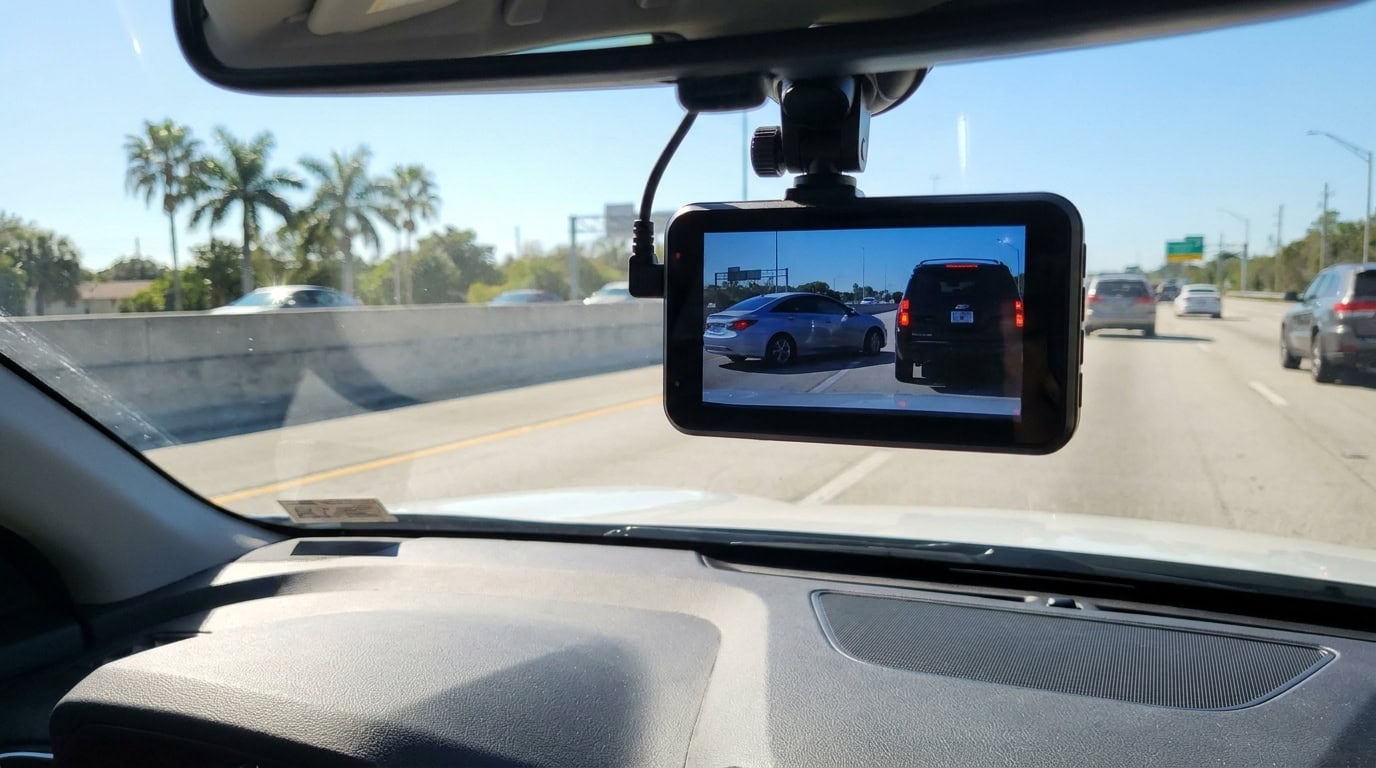
Personal dashcams can capture the exact moment when a driver swerves into your lane without signaling. Many dashcams provide video evidence that leaves little room for debate regarding liability. We encourage all drivers to use these devices to ensure an objective record exists for any future incidents on the road.
The Critical Process of Spoliation Letters
Digital evidence is volatile and can be easily lost if you don't take immediate steps to preserve it. Sending a spoliation letter is a formal legal step that prevents the destruction of surveillance or EDR data. A formal notice of spoliation instructs the defendant and third parties to preserve all electronic information related to the date of the accident.
You should send these letters via certified mail to ensure you have proof of delivery and receipt. If a company deletes footage after receiving this notice, it can face severe legal sanctions in court. Preserving the evidence chain of custody is necessary for securing video from nearby businesses or municipal traffic cameras before it is overwritten.
Extracting Data from Event Data Recorders
Most modern vehicles are equipped with an Event Data Recorder, which is often referred to as a black box. The Event Data Recorder (EDR) records technical information about the vehicle's status in the seconds before, during, and after a collision. Event Data Recorders capture steering wheel angles and braking patterns that reveal a driver's true actions.
Recorded mathematical data is objective and can often contradict a driver's false testimony about their speed or lane position. For instance, a driver might claim they used their turn signal, but the EDR will show if the signal was actually engaged. It can also prove if a driver was accelerating aggressively into a gap that was too small.
Extracting this data requires specialized equipment and expertise to ensure the information is handled correctly. Once the data is retrieved, it provides a mathematical breakdown of the crash that is difficult to challenge. A frame-by-frame breakdown of vehicle status is particularly useful in high-stakes cases involving significant injuries or disputed liability.
Gathering On-Scene Evidence and Witness Credibility
The moments immediately following a sideswipe accident are the most important for gathering evidence. You should take wide-angle photos of the road markings, including any skid marks or debris scattered across the lanes. Collecting evidence of unsafe lane changes at the scene involves more than just photographing the cars.
You must also document the presence of obscured road signs or faded lane markers that may have contributed to the crash. Identifying neutral third-party witnesses who were not involved in the crash is another high priority. Neutral observers provide an unbiased perspective that carries more weight than the statements of the drivers involved.
When you approach these witnesses, ask for their names and contact information and encourage them to stay until the police arrive. The relationship between a witness and the driver can impact how much weight their statement carries during a negotiation. A neutral observer with no connection to either party is considered the most credible source in Florida courts.
Checklist for Engaging with Florida Authorities
Navigating the public records process in Florida requires knowing which agencies hold specific records. The Florida Department of Highway Safety and Motor Vehicles is the primary source for official crash reports. You should request the long-form report as soon as it becomes available to see the officer's initial findings.
The Florida Department of Transportation maintains traffic cameras on many major highways and intersections. Accessing this footage involves a specific request process that must be initiated quickly due to data retention policies. A lawyer can help you manage these requests to ensure no bureaucratic delays prevent you from getting the proof you need.
Local municipal police departments also maintain records that can be useful for your claim. The complete evidence file includes dispatch logs and any audio from 911 calls made by witnesses at the scene. Compiling these records into a single evidence file creates a comprehensive foundation for your personal injury case review.
The Impact of Florida's Modified Comparative Negligence Laws
Florida moved to a modified comparative negligence system with House Bill 837, effective March 24, 2023. A plaintiff found more than 50 percent at fault recovers nothing. The bar applies to cases filed after that date, so it can reach a crash that happened before it. That single rule is why the proof on a merge has to be overwhelming rather than merely better than the other driver's story.
Insurance companies will work hard to shift even a small percentage of blame onto the victim to reduce their total payout. For example, if they can prove you were speeding slightly, they may argue you are 20 percent responsible. A partial liability finding would result in a 20 percent reduction in the compensation you receive for your medical bills and repairs.
If a plaintiff is found to be exactly 50 percent at fault, they can still recover 50 percent of their damages. The bar applies only when your level of responsibility exceeds the 50 percent threshold. Meticulous evidence gathering regarding the other driver's unsafe merge is how you establish the other driver's full responsibility, and that is what your case depends on.
Working with Accident Reconstruction Experts
Professional experts do much of the work in high-stakes lane-merging accident cases where liability is hotly contested. Accident reconstructionists use principles of physics and computer modeling to create a digital simulation of the crash. They incorporate all available evidence, including paint transfer and vehicle damage patterns, to build an accurate model.
The simulation can show the exact path of both vehicles and the speed at which the impact occurred. Physics-based digital modeling provides a level of clarity that verbal testimony cannot match. Experts can explain to a jury why the physics of the crash prove the other driver failed to maintain their lane.
The testimony of an accident reconstruction expert is often the deciding factor in litigation. Expert testimony is especially impactful when the insurance company refuses to accept liability despite the physical evidence. Having an expert on your side ensures that the technical details of your accident are presented clearly and convincingly.
Two deadlines matter after a Florida crash. To qualify for PIP medical benefits, you generally must receive initial services and care within 14 days after the motor-vehicle crash under Florida Statute 627.736(1)(a). Other PIP benefit categories and coverage conditions should be reviewed separately. Separately, a negligence lawsuit against the at-fault driver must be filed within two years of the crash under Florida Statute 95.11(5)(a) for crashes on or after March 24, 2023.
Protect Your Rights with a Fort Lauderdale Personal Injury Attorney
Proving an unsafe lane merge requires a sophisticated combination of forensic physical evidence, digital data, and expert legal strategy. Insurance companies are businesses focused on minimizing their losses, and they'll use any lack of evidence to deny your claim. We know where the 51 percent bar bites and how to keep the other side from parking a share of the blame on you.
We have the resources necessary to manage the forensic experts and digital data extraction mentioned in this article. Our team at Weinstein Legal Team works with top investigators to ensure no detail is overlooked in your accident claim. We understand the technical nature of sideswipe collisions and how to rebut the common excuses used by negligent drivers.
If you've been involved in a merge or sideswipe accident in Florida, don't leave your recovery to chance. Call us today at 888-626-1108 to speak to a lawyer about your accident 24/7, or click here to schedule a case review with an attorney now. We're ready to fight for your rights and help you secure the compensation you deserve.