
Few scenarios are as terrifying as legally purchasing a used vehicle through a private sale, only to be arrested later for possession of a stolen vehicle or grand theft auto. This shocking event is, unfortunately, a common reality for many innocent people in Florida who believe they made a legitimate purchase. Suddenly, an ordinary transaction becomes a serious felony that threatens your freedom and future.
The core legal issue in these cases rests squarely on criminal intent. The State of Florida must prove that the defendant knew, or should have known, that the vehicle was stolen to secure a conviction. The defense is aimed at one element: knowledge. What follows is how Florida law lets the state try to prove it, and what evidence answers back.
Understanding Florida's Stolen Property Laws
Florida law addresses the possession of stolen goods through several key statutes, including Florida Statute § 812.014 (theft) and § 812.019 (Dealing in Stolen Property). A person can face serious criminal charges even if they weren't the original thief who stole the car. Simply possessing or trafficking in stolen property is enough for the state to pursue prosecution.
Dealing in stolen property, which covers transactions involving possession or transfer, is a severe felony. The law is designed to punish those who knowingly participate in the criminal network of stolen goods. However, it inadvertently ensnares innocent buyers who were defrauded by the actual criminals.
The Legal Distinction: Grand Theft Auto vs. Possession
When an innocent buyer is arrested after purchasing a stolen vehicle, the charges usually fall under possession or dealing in stolen property rather than the original act of Grand Theft Auto. Grand Theft Auto is the crime of the initial taking of the vehicle. As the buyer, you're charged for trafficking or possessing the stolen property.
The prosecutor must prove that you entered into the transaction knowing the property was illicit. For this reason, the burden of proof centers entirely on your state of mind at the time of the purchase. The severity of the potential sentence means you need a focused defense to challenge the prosecutor’s theory of knowledge.
The Element of "Knowledge" in Stolen Vehicle Cases
Knowledge is the element these cases turn on. To convict on dealing in stolen property under Fla. Stat. s. 812.019(1), the state must prove beyond a reasonable doubt that the defendant trafficked in, or endeavored to traffic in, property that he or she knew or should have known was stolen.
This element of knowledge is the battlefield upon which the defense will fight. If the defendant can demonstrate a genuine lack of criminal intent, the charges can't stand. The entire defense strategy hinges on negating the prosecution’s ability to prove the buyer had actual or constructive knowledge that the car was stolen.
Penalties for Possession of a Stolen Motor Vehicle
The grade depends on which statute the state charges. Grand theft of a motor vehicle under Fla. Stat. s. 812.014(2)(c)6 is a third-degree felony, punishable by up to 5 years in state prison and a $5,000 fine. Dealing in stolen property under Fla. Stat. s. 812.019(1), which covers trafficking in property you knew or should have known was stolen, is a second-degree felony, punishable by up to 15 years and a $10,000 fine. Buyers are frequently charged under both, and which one sticks changes the exposure threefold. Either way it is a felony on a permanent record rather than a civil dispute over ownership.
Both grades also carry probation, court costs, restitution to the owner, and a felony record that does not go away on its own. A second-degree felony is also ranked high enough on the Criminal Punishment Code sentencing scoresheet that a prior record can put a state prison term in play at sentencing.
For an innocent buyer the defense aims at knowledge and nothing else. What defeats it is proof that the buyer paid a fair price, paid it in a traceable way, and tried to put the car in his or her own name.
Establishing the Bona Fide Purchaser Defense
The “bona fide purchaser” idea comes from Florida property law, not from the criminal code. A bona fide purchaser is someone who acquires property for valuable consideration without notice, actual or constructive, of a prior adverse claim. Florida does not recognize a separate bona fide purchaser defense to a criminal charge. What the same facts do is negate knowledge, and knowledge is an element the state has to prove beyond a reasonable doubt. This defense argues that the buyer acted in good faith, paid a reasonable price, and had no reason to suspect that the property was stolen.
The BFP defense applies whether the purchase was made from a private individual or a small, fraudulent, or unlicensed dealer. If the buyer had actual or constructive notice of another party's interest in the property, they can't claim BFP status. A successful BFP defense essentially dismantles the prosecution’s claim that the buyer knew, or should've known, the car was stolen.
The Good Faith Purchase: Demonstrating Due Diligence
A defendant must actively demonstrate to the court that they acted reasonably and without suspicious intent throughout the purchase process. Showing due diligence is critical to proving the transaction was legitimate in the buyer's mind. Simple, common-sense steps taken during the sale can become powerful evidence in court.
For instance, meeting the seller in a secure or public location, verifying the seller's identification, and asking about the vehicle’s history all demonstrate a genuine belief that the sale was legitimate. A good-faith buyer should always run a vehicle history report and check the Vehicle Identification Number (VIN) for discrepancies.
A Florida seller has two ways to shed civil liability for the car after handing it over, under Fla. Stat. s. 319.22(2)(a): properly endorse and deliver the certificate of title, or send the department a notice of sale, Form HSMV 82050. Checking for such steps can further demonstrate the buyer’s care and honest intent to complete a standard, legal purchase.
The Documents That Prove You Did Not Know
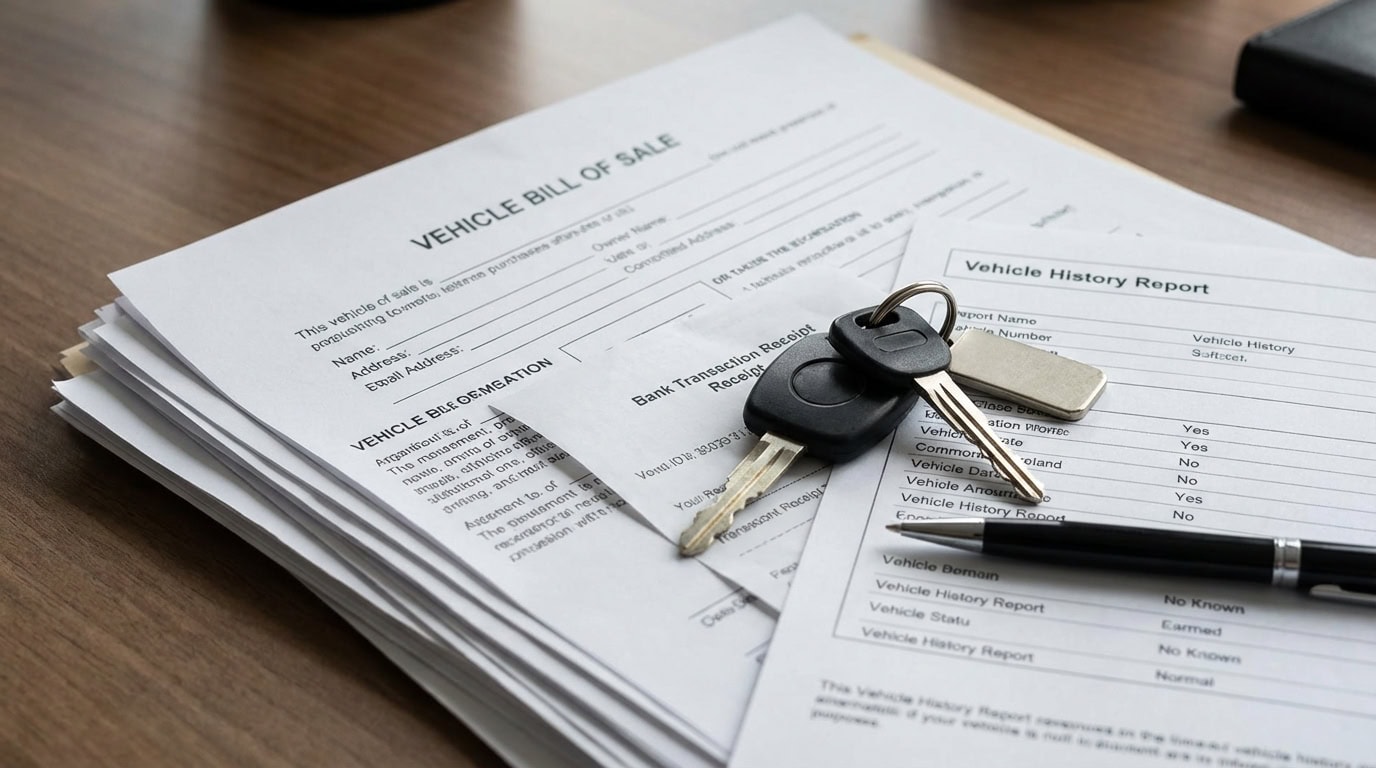
The defense relies heavily on documentation surrounding the private sale transaction. The foundation of the defense is the signed, detailed bill of sale, which proves the intent to purchase the vehicle legally, even if the document doesn't grant a marketable title.
Documentation of the payment method is also extremely important. Using verifiable records like bank transfers, cashier’s checks, or other digital payment methods is preferable to cash transactions, which can raise suspicion of illicit activity. Maintaining a clean financial paper trail supports the good-faith nature of the purchase.
Attempts to transfer the title at a tax collector’s office or a Florida Highway Safety and Motor Vehicles service center before an arrest serve as powerful evidence of good faith. Under Fla. Stat. s. 319.23(6)(a), the buyer must file the title application within 30 days after the vehicle is delivered, and filing late costs an extra $20. The act of attempting a prompt transfer shows the buyer intended to legalize their ownership right away.
Leveraging Digital Communication Records
In modern private sales, digital communication records provide a unique and compelling angle for the defense. Text messages, emails, or messages exchanged through online marketplaces like Craigslist or Facebook can be gathered and presented as evidence.
These records often capture the buyer’s questions about the car’s condition, the negotiation process, and the transaction logistics. These communications demonstrate the apparent normalcy of the sale, directly contradicting any claim that the buyer was suspicious of the seller.
A skilled criminal defense attorney will meticulously gather and analyze these records to construct a detailed timeline of the defendant's honest intent. This evidence helps neutralize the prosecution’s argument that the buyer was attempting to conceal the transaction or was complicit in the theft.
The Prosecution's Inferences: How The State Tries to Prove Knowledge
While the defense focuses on the buyer's lack of knowledge, the prosecutor’s strategy will focus on utilizing specific legal mechanisms to argue the buyer should've known the car was stolen. Fla. Stat. s. 812.022 supplies them. Under s. 812.022(2), proof of possession of recently stolen property, unless satisfactorily explained, gives rise to an inference that the possessor knew or should have known it was stolen. Every inference in that section is permissive rather than conclusive. It lets a jury draw the conclusion and never requires it, it does not shift the burden of proof, and the state still has to prove knowledge beyond a reasonable doubt.
Unreasonably Low Purchase Price
One of the most powerful legal inferences the prosecution relies on concerns the price paid for the vehicle. Under Fla. Stat. s. 812.022(3), proof that stolen property was bought or sold at a price substantially below fair market value, unless satisfactorily explained, gives rise to an inference that the buyer knew or should have known it was stolen. Nothing about it is automatic. The jury may draw that inference and may decline to, and the burden of proving knowledge never leaves the state.
The defense must be prepared to offer a clear and satisfactory explanation for the low price. This might include documented evidence that the car required major mechanical repairs, had abnormally high mileage, or suffered from significant cosmetic or body damage. A defense lawyer's job is to ensure that this explanation is supported by evidence, making it reasonable and persuasive to the court or jury.
Suspicious Vehicle Condition or Paperwork
Prosecutors frequently rely on physical irregularities of the vehicle or deficiencies in the documentation to prove implied knowledge. Under Fla. Stat. s. 812.022(6), proof that a person possessed a stolen motor vehicle whose ignition had been bypassed or whose steering wheel locking mechanism had been broken or bypassed, unless satisfactorily explained, gives rise to an inference that the person knew or should have known the vehicle was stolen. These clear signs of tampering are often difficult for an innocent buyer to explain away.
Other circumstantial evidence includes major paperwork irregularities, such as a seller failing to produce a title, claiming they will mail the title later, or providing a title with obvious signs of forgery. Any of these red flags can be used by the State to argue that the buyer had constructive notice of the fraud and should've walked away from the sale.
When these suspicious conditions exist, the defense must argue that the client was an inexperienced or naive buyer who failed to notice the defects. Alternatively, the defense might prove that the seller actively took steps to conceal the mechanical damage or the irregularities in the title documentation during the transfer.
Immediate Steps to Take After an Arrest for Possession of a Stolen Vehicle
If you're arrested for possession of a stolen vehicle, the immediate steps you take determine whether your defense survives. The single most important action is to remain silent and invoke your right to counsel immediately. You shouldn't speak to law enforcement, answer any questions, or offer any explanations without a lawyer present.
What To Do If You Unknowingly Purchased a Stolen Car
If you discover you've unknowingly bought a stolen car in Florida before an arrest, contact a lawyer before you contact the police or the Florida Department of Highway Safety and Motor Vehicles. A lawyer can guide you on how to formally report the issue without inadvertently damaging your defense by making statements that could later be misinterpreted as knowledge of the crime. Additionally, your lawyer can assist if the car is impounded after the private sale.
The second critical step is to quickly preserve all documentation related to the purchase. Secure every piece of evidence, including the bill of sale, all payment receipts, and any digital communications with the seller. Do not attempt to repair or tamper with the vehicle, especially if the police have already inspected it.
Contact a skilled criminal defense attorney immediately. A lawyer can move to preserve the financial records, the messages with the seller, and the vehicle's condition before anything is altered. Those are the items that disappear first.
Speak To A Lawyer About Your Stolen Property Charges In Florida Today
Being charged with a serious felony like possession of a stolen vehicle, especially when you were an innocent, good-faith buyer, is a devastating situation. However, the lack-of-knowledge defense is incredibly strong when supported by meticulous documentary evidence. Success relies on demonstrating your legitimate intent through documentation such as the bill of sale, communication records, and prompt attempts to secure a legal title.
At Weinstein Legal Team, we understand the urgency and severity of these felony charges. We are prepared to aggressively defend your rights and fight the prosecution's attempts to infer knowledge based on price or condition. Call us now at 888.626.1108 to speak with a lawyer about your case, or click here to schedule a confidential consultation now.