
- A retail incident report is a corporate risk management document, not a neutral account. Florida courts have treated an internally prepared incident report as work product compiled in anticipation of litigation, which under Florida Rule of Civil Procedure 1.280(c)(4) the store can often withhold from you in discovery.
- No Florida or federal law requires an injured shopper to sign a store's internal incident report or any waiver language attached to it. You can give your name and contact information and decline the rest.
- These forms ask leading questions about footwear, hurry and medication in order to build a comparative fault record. Under Florida Statute 768.81 a party found greater than 50 percent at fault for their own injuries recovers nothing, so an admission written onto a store form can end the claim outright.
- Do not guess at how a spill got there or how long it had been present. Florida Statute 768.0755 puts the burden on the injured person to prove the business had actual or constructive knowledge of the transitory foreign substance, and a wrong guess undercuts the element you have to establish.
- Adrenaline and shock hide injuries, so telling staff you are fine becomes evidence against you later. Photograph the hazard and the completed form instead. Florida Statute 92.33 requires anyone holding a written statement from an injured person to furnish a copy on request.
- Florida Statute 95.11(5)(a) gives you two years from the date of the fall to sue if it happened on or after March 24, 2023, and four years if it happened before that date.
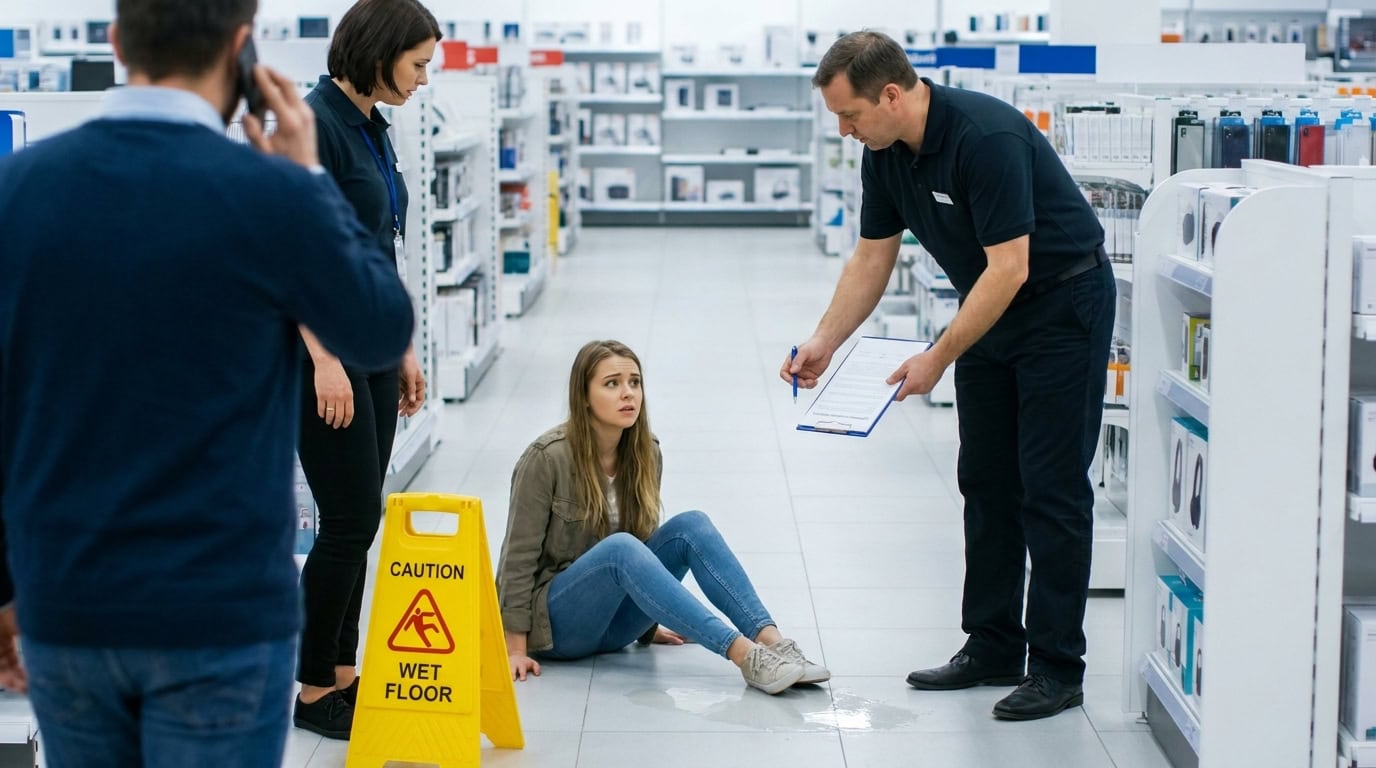
A store manager will usually put an incident report in front of you within minutes of a fall, while you are still shaken and have not had time to think. Falls are no small category of accident: they account for about a third of the 26.5 million injury-related emergency department visits counted in a national study by the Healthcare Cost and Utilization Project. While retail staff may present these forms as a routine part of guest services, they primarily function as a tool for corporate defense teams to limit financial exposure.
Filling out one of these forms while you are in pain or in shock leads to mistakes you cannot take back. The form is drafted to protect the business, not to help you recover. Understanding the legal weight of these documents helps you protect your right to a fair recovery under Florida premises liability laws.
What is a Retail Store Incident Report and How Does it Affect Your Claim?
Retail incident reports function as internal administrative records that businesses use to document any accident occurring on their premises. While a manager might describe the form as a simple record for corporate headquarters, its primary role is corporate risk management. These documents serve as the first line of defense for the company's legal and insurance departments.
While official store policies often frame incident reports as tools for improving safety and recording customer complaints, their legal purpose is highly strategic. Risk management teams use the gathered data to evaluate the strength of a potential injury claim, compiling an audit trail that allows the business to track liability and record property conditions. By capturing specific details about what happened and who was involved early, the store can build a defense long before the victim has a chance to speak to an attorney.
Common Details Requested on Incident Reports
Store incident forms typically ask for a specific set of details designed to lock in the facts of the event. Knowing what a store will ask helps you prepare to share only the necessary information.
- The exact time and location of the incident
- A description of the customer's footwear
- Whether the customer was carrying any items
- A description of any hazard or spill
- Contact information for the injured person and any witnesses
A retail store incident report is designed to protect the private interests of the retail chain or supermarket rather than the shopper. Legal experts draft these forms to record the event in a way that minimizes the store's liability, treating them as internal safety and security records rather than a neutral account for the benefit of the injured patron.
Injured patrons are often surprised to learn they have no legal obligation to protect the business's interests. In fact, Florida courts, including the Third District Court of Appeal in Winn-Dixie Stores, Inc. v. Lopez (2021), have ruled that internally prepared incident reports can be protected from discovery as work product compiled in anticipation of litigation. As a result, the store is often not obliged to hand its internal report over during a lawsuit unless you can show that you need the materials and cannot obtain the substantial equivalent without undue hardship. That is the test in Florida Rule of Civil Procedure 1.280(c)(4), which is where the work product provision moved when the rule was renumbered effective January 1, 2025. You should approach manager-led documentation with legal scrutiny to preserve your future options.
Hidden Traps and Pitfalls in Retail Store Incident Reports
Standardized store incident reports contain specific structural and verbal traps intended to undermine premises liability claims. These forms often use targeted questions that seem harmless but carry heavy legal weight. Understanding how these sections are organized helps you avoid making statements that damage your case.
Subtle Admissions of Fault and Biased Wording
Managers often use leading questions to prompt shoppers to admit fault without realizing it. Forms from companies like EMC Insurance ask about the type of footwear a customer was wearing or what they were doing just before the fall. Other forms may ask if a visitor was taking any medications or using a walking aid. These questions aim to shift the focus from the store's negligence to the victim's personal actions.
Small admissions like stating you were in a hurry can be weaponized under Florida's modified comparative negligence framework. Under Florida Statute 768.81, which was modified by House Bill 837 in 2023, any party found to be greater than 50 percent at fault for their own injuries is completely barred from recovering damages. If a store can use your own words to prove you were mostly responsible, the court will deny your claim entirely. Insurance companies rely on these biased forms to establish that the victim's share of responsibility was the primary cause of the accident.
Retail employees are trained in corporate risk-mitigation protocols. Before they even approach you after a fall, they know how to secure statements that protect the store's bottom line. They might suggest you write that you don't know what happened, which effectively erases the store's liability. These traps lock you into a narrative that benefits the corporation.
Undisclosed Liability Waivers and Claims Exemption Clauses
Some major retail chains embed restrictive language within the fine print of their incident documentation. These sections might include a retail store liability waiver or a clause granting the store access to your private medical history. Signing such a document could inadvertently waive your right to seek full compensation for your injuries. You must scrutinize every line of a corporate document to ensure you are not signing away your legal rights.
Managers might describe the signature as a simple acknowledgment that you received assistance or a copy of the store rules. However, the legal reality of signing a rights exemption can be permanent and damaging. Some corporate liability templates attempt to limit future claims by having the victim agree that no dangerous condition existed. You should never feel pressured to sign a document containing legal terminology that you do not fully understand.
Downplaying Injury Severity and the Adrenaline Trap
Adrenaline and shock often hide the true extent of injuries immediately after a fall. Many victims tell store staff they feel fine or do not need an ambulance because they are embarrassed. These statements are then recorded on the incident report to argue that no injury occurred. Insurance adjusters use these early claims to suggest that later medical treatment is unrelated to the store accident.
Serious conditions like concussions or spinal trauma may not show symptoms for hours or even days. Soft tissue damage often results in swelling and stiffness that only peaks the following morning. If you check a box saying you are uninjured, the store will use it as evidence against your credibility. It is better to remain silent about your physical condition than to claim you are unharmed prematurely.
The financial stakes of these injuries are immense for insurance carriers. According to the Centers for Disease Control and Prevention, older adult falls account for roughly $80 billion in medical costs a year, and Medicare carries about two thirds of that. Because the costs are so high, insurers are aggressive in seeking early admissions of fault or lack of injury. They want to close the file before you realize the true extent of your medical needs.
Speculative Statements and Omission of Critical Facts
Incident forms often encourage victims to guess about the cause of their accident. A manager might ask how long a liquid spill was on the floor or where a specific substance came from. Speculating on these facts is dangerous because Florida Statute 768.0755 requires an injured person to prove that the business had actual or constructive knowledge of the transitory foreign substance. If you guess incorrectly, you may accidentally undermine your ability to prove the store was negligent.
Managers frequently omit critical details from the report that would reflect poorly on the business. They may fail to mention a missing warning sign or a broken floor mat that contributed to the fall. While the form asks the victim to speculate on their own fault, it rarely prompts the staff to record their own maintenance failures. Sticking to the objective facts you saw with your own eyes is the only way to avoid these corporate incident documentation risks.
Are You Legally Required to Sign a Store Incident Report?
Many people mistakenly believe that shoppers must sign company paperwork before they are allowed to leave the store. Managers may insist that their corporate office requires a signature to process any report. Such pressure can make victims feel as though they are breaking a law by refusing to sign. In reality, you maintain your autonomy and legal protections even when a manager is being persistent.
Your Legal Rights as an Injured Shopper
No state or federal law requires an injured patron to sign an internal corporate document. While it is helpful to inform the store that an accident happened, signing a liability form is completely voluntary. You have the right to provide your name and contact information while declining to sign any other paperwork.
Many victims confuse internal store incident reports with official police reports. Unlike a police report, which provides a neutral third-party account of an event for public safety records, a store report is a private document crafted by the property owner to protect their corporate interests.
| Feature | Store Incident Report | Official Police Report |
| Primary Purpose | Internal risk management, liability control, and corporate defense preparation. | Neutral public safety documentation and objective fact-gathering. |
| Prepared By | Store managers or employees trained to protect the business. | Responding municipal, county, or state law enforcement officers. |
| Is Signing Required? | Completely voluntary. No law requires an injured shopper to sign. | The officer drafts the report; you may be asked to provide statements, but your signature is generally not required to validate the report's creation. |
| Work-Product Protection | Highly protected. Stores often refuse to share, claiming "litigation anticipation." | None. It is an open public record accessible by any party. |
| Obtaining a Copy | Often withheld unless demanded via Florida Statute 92.33 or formal litigation discovery. | Readily available to the public and all legal parties for a nominal administrative fee. |
If a manager tells you that a signature is required, they are referring to their internal employment rules, not your legal obligations. You are a private citizen and not an employee of the retail chain. Declining to participate in their internal documentation process does not prevent you from filing a future claim. Get medical care first. The store's paperwork can wait.
Quick Actions to Take Instead of Signing a Store Incident Report
- Provide only your name and contact information to the manager.
- State the objective location and time of the fall without adding extra details.
- Respectfully decline to sign any document containing liability or waiver language.
- Use your phone to photograph the hazard and the unsigned report.
Store policies are internal rules for employees and do not carry the weight of statutory law. While workers are trained to obtain a signature to satisfy risk management, those rules do not apply to the general public. Florida premises liability laws are what actually govern the store's responsibility for your safety. Following or ignoring a store's paperwork protocol has no impact on the validity of a legitimate injury case.
Recent changes to Florida law have significantly shortened the timeframe for filing a premises liability claim. For any fall occurring on or after March 24, 2023, section 95.11(5)(a) gives you two years from the date of the fall to file, down from the four years that applied before. Two years passes faster than people expect, and that deadline is what decides whether you still have a case. A store's paperwork rules decide nothing. An experienced attorney can ensure you meet these strict requirements regardless of what the store's internal policy says.
How Store Managers Use Documentation Tactics Against Injury Victims
Retail managers are often trained to handle accidents using specific behavioral tactics. These methods are designed to settle the matter quickly and quietly before the victim realizes the severity of the situation. Recognizing these behaviors can help you stay calm and maintain control during a stressful encounter.
The Rush Strategy and High-Pressure Environments
Personnel often capitalize on the embarrassment and pain a victim feels to rush them through the reporting process. A manager might suggest that the paperwork must be finished immediately so they can take care of you. The rushed process creates a high-pressure environment where you are more likely to sign a supermarket manager incident form without realizing it contains a waiver. Being rushed into making a statement is a common tactic to secure admissions of fault.
You should never feel obligated to finish a form if you are in significant pain. If you need medical attention, that must always be your priority. A store cannot legally prevent you from leaving or receiving help until you sign their forms. Taking the time to breathe and assess your surroundings is better than rushing through a biased corporate document.
Controlled Narration and Dictated Statements
In many cases, the store manager will offer to write the description of the accident for you. They may interview you and then paraphrase your words into a narrative that sounds less damaging to the store. Controlling the narrative allows them to exclude mentions of wet floors or lack of signage that would prove their negligence. If you sign a form written by someone else, you are effectively adopting their biased version of events.
Always verify every word on a document before you agree to sign it. If a manager rewords your statement, you have the right to correct it or refuse to sign entirely. Some managers use phrases like "slipped on nothing" or "fell for no reason" to protect the business. Signing a dictated statement can make it very difficult to prove the true cause of your injuries later in court.
How to Protect Yourself When Reporting an Accident
Documenting an accident is a necessary step, but it must be handled with a specific strategy. Your goal is to record the facts without providing the store with ammunition to use against you. By following a few simple steps, you can gather the evidence needed for a successful claim while protecting your legal interests.
Provide Essential Facts Without Speculating
When speaking with a manager, you should stick strictly to objective facts such as the date, time, and specific location. Describe exactly what happened, such as stating you slipped on a puddle of clear liquid in aisle four. Do not apologize and do not blame yourself out loud, and that includes saying you should have been watching where you were going. These brief, factual statements are much harder for insurance adjusters to twist during negotiations.
Avoid guessing about how the hazard got there or how long it had been present. You are not responsible for knowing the store's cleaning schedule or maintenance protocols. If you do not know an answer, it is perfectly acceptable to say you are unsure. Providing speculative information only helps the store build a defense based on your lack of certainty.
Independent Evidence and Footwear Documentation
Creating your own evidence file is more reliable than trusting the store's documentation. Use your smartphone to take clear photos and videos of the hazard that caused your fall. Capture the surrounding area, including any nearby warning signs or the total lack of them. Wide shots are especially helpful for showing lighting conditions and the locations of overhead surveillance cameras.
Be sure to document the footwear you were wearing and any visible injuries, such as bruising or cuts. Commercial insurance adjusters routinely scrutinize footwear choices to find grounds for shifting blame under comparative negligence. You should photograph your shoes immediately to prove they were appropriate for the conditions and did not contribute to the fall.
Refusal to Provide Copies and Florida Statute 92.33
It is a standard corporate practice for stores to refuse to give a copy of the incident report to the victim. Staff may claim the report is internal property or that they are not allowed to hand out corporate documents. This tactic leaves the victim without a record of what they signed or what the manager wrote down. However, Florida Statute 92.33 requires any person in possession of a written statement from an injured person to provide a copy upon request.
If a manager refuses to provide a copy, you should still attempt to document the information yourself. You can ask for the report number and the name of the person who completed the form. Fendrick v. Faeges, 117 So. 2d 858 (Fla. 3d DCA 1960), applied section 92.33 to this exact situation. A written statement by an injured person is inadmissible unless a true and complete copy was furnished at the time the statement was made, and it is inadmissible as well if whoever holds it later refuses your request for a copy. Either failure keeps the statement out.
You should politely but firmly insist on taking a photo of the completed form with your phone. This ensures you have an exact record of what was documented before any changes can be made by corporate staff. Having a photo of the report prevents the store from later claiming you said something you did not. Photographing the document protects you from the common practice of stores losing or altering unfavorable incident reports.
When Should You Consult a Personal Injury Attorney?
A claim against a national retail chain is not a fair fight to take on alone. These companies have significant resources and legal teams dedicated to minimizing payouts. Consulting a personal injury attorney early in the process can prevent you from making mistakes that devalue your claim. An attorney provides the professional guidance needed to handle corporate insurers effectively.
Evaluating Corporate Settlement Offers and Early Contact
Corporate claims representatives often reach out to victims within days of an accident to offer quick settlements. These offers might include small cash payments or store gift cards intended to close the claim immediately. While it may be tempting to accept fast money, these lowball offers rarely cover the full cost of medical bills. Once you accept a payment and sign a release, you lose the right to seek further compensation.
You should also avoid giving recorded statements to insurance adjusters before speaking with a lawyer. In Florida, you are not legally required to provide a recorded statement to the store's insurance company. These adjusters are trained to ask questions that lead you to downplay your injuries or admit fault. Having legal counsel allows you to manage these communications and protect the true value of your case.
How Legal Representation Protects Your Claim
Experienced attorneys use specific legal tools to investigate retail accidents thoroughly. For example, an attorney can send a spoliation of evidence letter to the store. The official legal notice compels the business to preserve security camera footage and cleaning logs. Without this letter, many stores will delete surveillance video within days as part of their regular recording cycle.
Legal representation also protects you from the predatory tactics often used by corporate insurers. Your lawyer can handle all negotiations and ensure that every piece of evidence is used to support your claim. According to the House Bill 837 analysis, the shift to a modified comparative negligence system makes proving fault more complex. A professional advocate forces the insurance company to take your case seriously.
Contact Weinstein Legal Team for a Free Case Evaluation
Signing a retail store incident report is a high-stakes step that can jeopardize your entire recovery. These documents are internal corporate tools designed to gather admissions of fault and downplay your physical injuries. Knowing that the form is voluntary, and that it is written by the other side, is enough to keep you in control of what happens next. You do not have to work out Florida's slip-and-fall rules on your own.
Weinstein Legal Team is here to provide the diligent legal advocacy needed to hold negligent property owners accountable. We understand the tactics used by store managers and insurance adjusters to reduce your claim's value. Protect your right to compensation before the two-year legal deadline expires. Contact us today to start building your case for the justice you deserve.