
Trampolines have been an American pastime for years. In the blistering Florida heat, however, jumping up and down in the bright sun may not be the ideal way to spend a summer day. Hence, indoor trampoline parks were born.
Indoor trampoline parks grew quickly, and the injury numbers grew with them. Researchers at Connecticut Children's Medical Center, writing in the American Academy of Pediatrics journal Pediatrics, estimated that United States emergency department visits for trampoline park injuries rose from 581 in 2010 to 6,932 in 2014, while home trampoline injuries did not increase over the same period. Broward and Miami-Dade County are dotted with these indoor playgrounds today.
Are Indoor Trampoline Parks Dangerous?
Yes, and the pattern of injury differs from a backyard trampoline. Kasmire, Rogers and Sturm, "Trampoline Park and Home Trampoline Injuries," Pediatrics 138(3) (2016), analyzed National Electronic Injury Surveillance System data from 2010 to 2014 and found that trampoline park injuries were more likely than home trampoline injuries to involve the lower extremities, more likely to be a dislocation, and more likely to require hospital admission, including open fractures and spinal cord injuries.
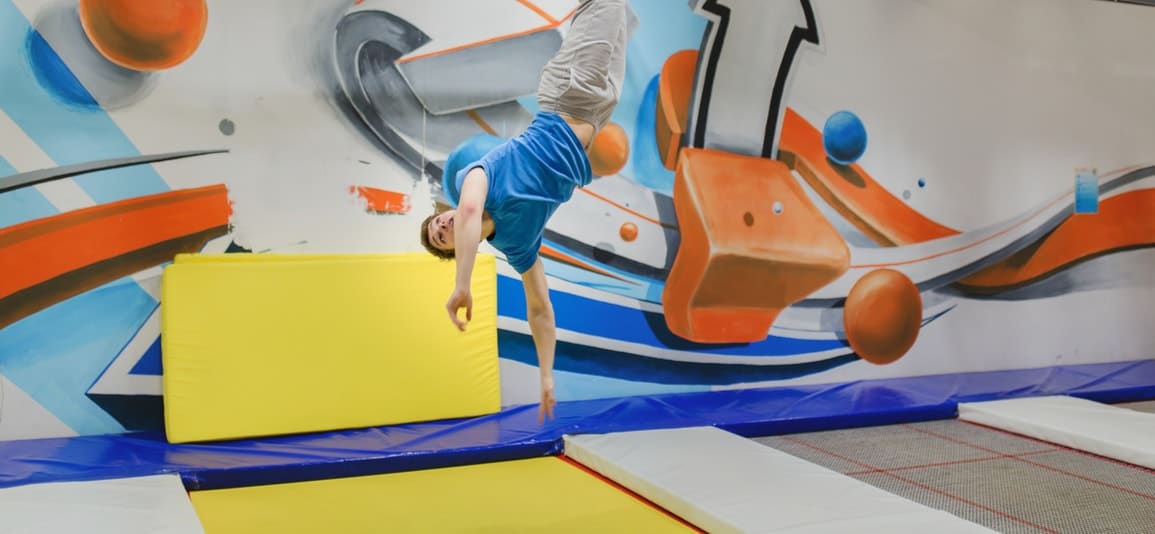
Paying a visit to one of these indoor trampoline parks will reveal plenty of displayed safety signs, with a handful of employees supervising. Visitors are told that double bouncing, rough-housing, double flips, and climbing the padded walls are all strictly forbidden, and that participators should jump at their own risk and within their ability. Yet, despite these guidelines, a 2018 NBC 6 South Florida investigation found teens still performing risky flips and jumping close to one another.
In the two years before that report, close to 300 calls to 911 came from trampoline parks across South Florida about injuries and falls, and paramedics responded to at least 70 of them.
The Personal Injury Debate
In July 2018, NBC 6 South Florida reported on a teenager, Alexandra Karob-Volpina, who broke her ankle when another jumper landed on it at Off the Wall, an indoor trampoline park in Coconut Creek, and was taken to urgent care. Dispatch records reviewed by the station showed 911 had been called more than 60 times to that location in the preceding two years, and hers was one of two calls for help made that day.
Alexandra had two surgeries and physical therapy, and missed months of the activities she had been doing. She and her family sued Off the Wall, the trampoline park where the injury happened. She is not alone: NBC 6 reported that Broward Clerk of Courts records showed at least 12 lawsuits filed against the company as a result of injuries.
The Emerging Lawsuit
Alexandra's lawsuit claims Off the Wall was negligent because it failed to supervise properly. NBC 6 reported that the company denied the allegations in its court filings, said the teenager's own actions caused the accident, and argued it could not be held accountable because her father had signed a waiver.
Alexandra's father, Yan Karob, told NBC 6 he signed the waiver without reading it. The station reported that the first page carried a strongly worded warning that Off the Wall's trampolines are “dangerous” and have “inherent risks,” and that by signing, Karob agreed not to sue over anything that happened to his daughter, including injury caused by negligence, and agreed to cover the cost of claims filed against the park. Off the Wall then sued Karob on that indemnity clause, which could leave him paying the park's attorney fees.
NBC 6 reviewed the waivers of 13 South Florida trampoline parks and found nearly all of them use the same wording. That wording is deliberate, and it does not do everything parents assume it does.
In Kirton v. Fields, 997 So. 2d 349 (Fla. 2008), the Florida Supreme Court held that a parent cannot execute a pre-injury release on behalf of a minor child for participation in a commercial activity. The Legislature responded with Florida Statute 744.301(3), which lets a natural guardian waive a minor's claims in advance against a commercial activity provider only for injury “resulting from an inherent risk in the activity.” Section 744.301(3)(a) defines an inherent risk as a danger characteristic of the activity that is not eliminated even when the provider acts with due care, and it expressly excludes the provider, its owners, employees and agents from the other-participant language.
So no, these waivers are not a license to be negligent. A park's own failure to supervise or maintain equipment is not an inherent risk of jumping. Florida Statute 744.301(3)(b) also requires a specific uppercase notice, at least 5 points larger than the surrounding text, before the release is enforceable at all, and under 744.301(3)(c) a claimant can rebut the presumption that the injury came from an inherent risk by clear and convincing evidence.
The American Academy of Pediatrics takes a harder line on the activity itself. Its 2012 policy statement, “Trampoline Safety in Childhood and Adolescence,” Pediatrics 130(4), strongly discourages recreational home trampoline use and identifies multiple simultaneous jumpers and attempted somersaults or flips as the main injury mechanisms. Measures parks and parents commonly rely on include:
- Constant adult supervision
- Adequate protective padding
- 1 jumper per trampoline
- Avoidance of flips and somersaults
Alexandra and her father argue that since Off the Wall failed to have adequate adult supervision, they failed to uphold their end of the waiver. For this reason, they're arguing negligence.
Types of Injury Experienced at Trampoline Parks
Injuries at indoor trampoline parks are far from rare. Unfortunately, the enclosed trampolines, typically packed with kids, can result in a variety of injuries. Common types of injuries experienced at trampoline parks can be caused by:
- Falls on the trampoline mat
- Falls off a trampoline
- Impact with the trampoline frame or springs
- Collisions of multiple trampoline users
Most commonly these incidents can cause twisting of the lower extremities, such as the ankle or knee, broken or fractured bones, spinal fractures, head trauma including traumatic brain injury (TBI), and abrasions.
Indoor trampoline parks carry real risk. Read the waiver before you sign it, and know that under Florida Statute 744.301(3) a waiver you sign for your child covers the inherent risks of jumping, not the park's failure to supervise or to maintain its equipment. If you or a member of your family has recently experienced an injury while attending a trampoline park, contact the personal injury attorneys at Weinstein Legal Team today.