
- Uninsured motorist coverage in Florida follows the person rather than the car. A named insured and resident relatives are Class I insureds, so the coverage protects them when they are struck on foot. A Class II insured, such as a non-family passenger, is covered only while occupying the insured vehicle.
- Under Florida Statute 627.727(8), uninsured motorist coverage stacks by default. An insurer may sell nonstacked coverage only if the named insured signs the approved form, so a policyholder who never signed it can combine the limits on each insured vehicle.
- Personal Injury Protection pays first, at 80 percent of medical expenses and 60 percent of lost wages up to $10,000, and only with treatment inside 14 days. Uninsured motorist coverage then reaches the medical coinsurance, the lost wages PIP never pays, and the long-term costs after PIP is exhausted.
- Florida Statute 627.727(7) allows nothing for pain, suffering, mental anguish or inconvenience on an uninsured motorist claim unless the injury meets one of the four thresholds in Section 627.737(2): significant and permanent loss of an important bodily function, permanent injury within a reasonable degree of medical probability, significant and permanent scarring or disfigurement, or death.
- Florida Statute 626.9541(1)(o)3. bars an insurer from surcharging you solely because you were in a crash, unless its claim file supports a good-faith determination that you were substantially at fault. It is not an absolute bar on a rate increase, and carriers work around it by stripping discounts or re-rating a ZIP code.
If you are a pedestrian hit by an uninsured driver in Florida, your immediate concern is likely how you will cover catastrophic medical expenses. Many pedestrians do not realize that their own auto insurance policy may contain a powerful, portable safeguard: uninsured motorist coverage.
Under Florida law, this coverage is not tied to your physical vehicle; it follows you on foot, allowing you to seek critical compensation for medical care, lost wages, and rehabilitation.
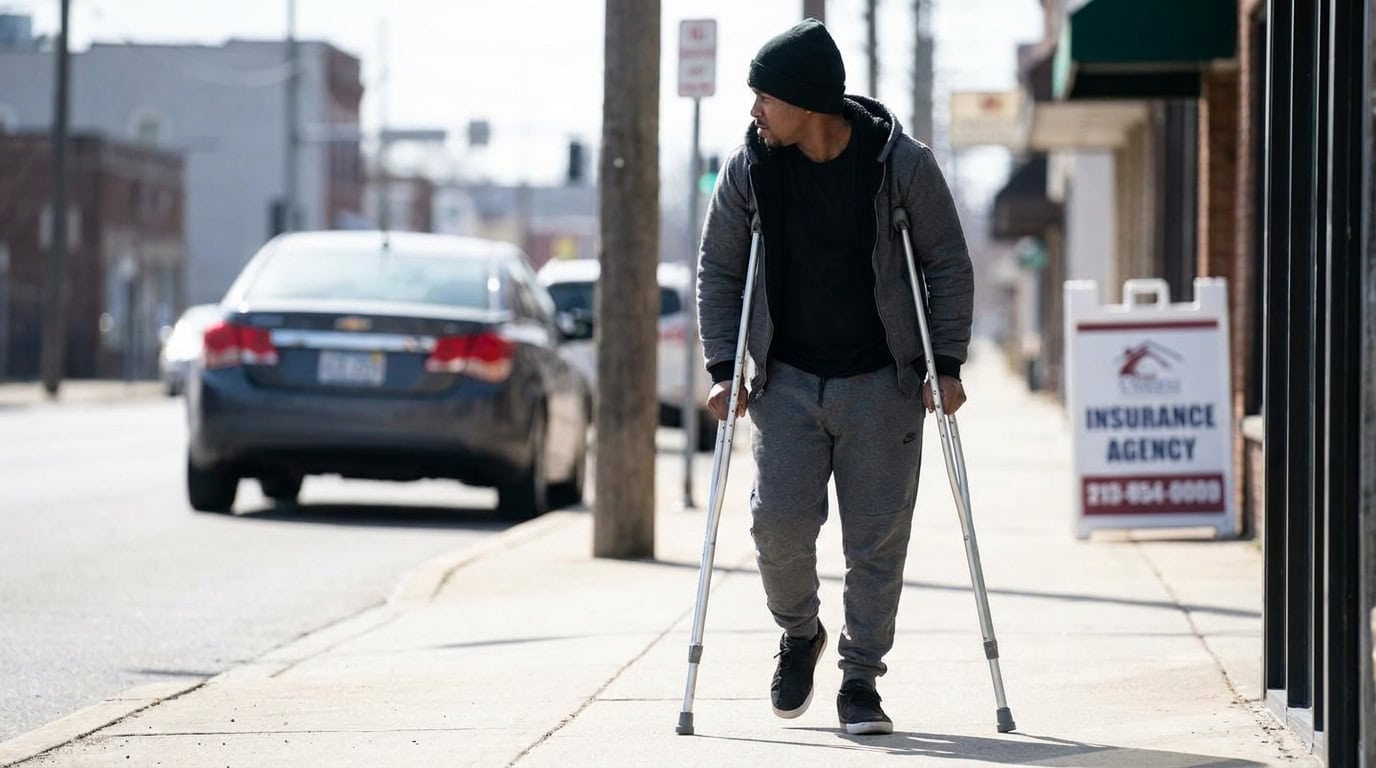
Why Florida Pedestrians Face a High Risk of Uninsured Driver Accidents
Florida is one of the most hazardous states in the country for anyone traveling on foot. The Governors Highway Safety Association counts 713 pedestrian deaths in Florida in 2024, down from 799 in 2023, and only California and Texas recorded more. These collisions often lead to severe, disabling injuries and medical bills that outrun a minimum policy.
High-speed urban corridors and a high density of uninsured motorists create a high risk for residents and visitors. Florida has ranked in the top three states for pedestrian deaths in every year of the GHSA's 2019 to 2024 series. The legal environment contributes to this risk because many drivers operate vehicles with no coverage for the physical injuries they cause.
The High Rate of Uninsured and Underinsured Drivers in Florida
Florida auto insurance requirements contribute to a system where many walkers are left vulnerable after a collision. While the law mandates Personal Injury Protection, it does not require drivers to carry bodily injury liability insurance. This allows thousands of motorists to drive legally while having no financial means to pay for the severe physical damage they might inflict on others.
Pedestrians hit by uninsured drivers in Florida have few options if the driver is judgment-proof and lacks liability coverage. The Insurance Research Council estimated that 15.9% of Florida motorists were uninsured in 2022, a figure the Insurance Information Institute republishes, and victims of those drivers rely on their own policies for recovery.
When a driver lacks bodily-injury insurance, the victim faces the burden of medical bills and rehabilitation costs alone. This loophole in state law makes personal uninsured motorist coverage a necessary component of a comprehensive insurance plan.
UM Coverage for Hit-and-Run and Phantom Vehicle Accidents
Florida experiences a high frequency of accidents where the at-fault driver leaves the scene without providing identification. The Florida Department of Highway Safety and Motor Vehicles tracks hit-and-run crashes as a standing safety problem. When a driver flees, there is no third-party insurance policy to pursue for medical costs or pain and suffering.
When an injured pedestrian files a hit-and-run claim in Florida, they must often rely on their own policy to bridge this financial gap. Unidentified vehicles that cause an accident without making physical contact are legally known as phantom vehicles. These situations occur when a motorist's reckless actions force a pedestrian to take evasive maneuvers, resulting in a fall or a secondary impact.
Under Florida law, both hit-and-run drivers and phantom motorists are categorized as uninsured motorists. Having a personal insurance policy is the only realistic way for a victim to secure a financial recovery in these difficult scenarios.
Understanding the Portability of Uninsured Motorist Coverage in Florida
Auto insurance coverage in Florida is far more flexible than many policyholders realize. Many residents believe their car insurance only provides protection when they are sitting inside the vehicle listed on their policy. State law provides broad personal protections that extend well beyond the physical boundaries of the automobile.
What Does "Portable" Mean Under Florida Auto Policies?
Portable uninsured motorist coverage is an insurance benefit structured to attach to the person rather than a physical vehicle. Because of this structure, the policy acts as a personal shield that follows the insured individual wherever they go, protecting Florida pedestrians whether they are walking, cycling, or sitting on a park bench.
Many residents are surprised to learn that using UM coverage as pedestrian claimants is a standard right under most Florida policies. If a negligent driver strikes you while you are walking your dog, your own insurance carrier steps into the shoes of the at-fault party. Portable uninsured motorist benefits ensure that your safety net is not tied to the car sitting in your driveway.
Under Florida case law, insureds are divided into two categories: Class I and Class II. Policyholders and their resident relatives are Class I insureds, meaning their UM coverage is personal and portable and protects them as pedestrians. In contrast, Class II insureds (such as non-family passengers) are only covered while occupying the insured vehicle and cannot claim UM benefits if struck as pedestrians.
The Resident Relative Clause: Extending Protection to Family Members
A personal insurance policy provides benefits to more than just the named policyholder. The resident-relative clause extends insurance benefits to household members. This provision typically covers individuals related to the policyholder by blood, marriage, or adoption (such as children, parents, and spouses) provided they primarily reside in the same household.
Extending protection to household residents is particularly valuable for family members who do not own their own vehicles or carry their own insurance policies. It ensures that the most vulnerable members of a household have access to medical care after a pedestrian accident. The policy applies to these relatives just as it applies to the main policyholder during their daily activities.
Consider a situation where a teenager is walking the family dog and is struck by a vehicle that leaves the scene. Even if the teenager does not own a car, they can file a claim under their parent's uninsured motorist coverage. This allows the family to recover funds for the teenager's medical bills despite the lack of a third-party insurance policy.
Stacked vs. Non-Stacked UM Coverage for Florida Pedestrians
Florida Statute Section 627.727 governs the differences between stacked and non-stacked uninsured motorist coverage. Coverage stacks unless you sign away the right to stack it. Section 627.727(8) is what lets an insurer sell nonstacked coverage, and only if the named insured signs an approved form accepting the limits listed there, so a policyholder who never signed that form can combine the limits on each insured vehicle. For example, if a household has two vehicles, each with $100,000 in coverage, stacking allows for $200,000 in protection.
Stacked coverage matters most to a pedestrian for the size of the pot. A nonstacked policy still covers you on foot, but Fla. Stat. § 627.727(8)(e) limits you to any one vehicle's limit rather than the combined total, and § 627.727(8)(d) takes UM coverage away entirely if you are hurt while occupying a vehicle you own for which UM was never purchased.
How Florida Auto Insurance Claims Hierarchy Works for Pedestrians
Following a collision, you must apply your insurance coverages in a specific sequence. Because the state follows a no-fault system, there is a strict order of operations for determining which policy pays first. This hierarchy is legally mandated to ensure all available benefits are accessed correctly.
To recover funds after a pedestrian accident, victims must navigate Florida's strict insurance priority rules, structured as follows:
| Priority Order | Coverage Type | What It Covers | Key Conditions & Limits |
| 1. Primary | Personal Injury Protection | 80% of medical bills and 60% of lost wages, up to $10,000. | Must seek treatment within 14 days; requires an Emergency Medical Condition diagnosis to access the full $10,000 (otherwise capped at $2,500). |
| 2. Secondary (If Available) | Medical Payments (MedPay) | Covers the remaining 20% co-payment not covered by PIP, up to your policy's MedPay limit (typically $1,000 to $5,000). | Optional add-on; acts as an immediate bridge before Uninsured Motorist coverage applies. |
| 3. Excess / Long-Term | Uninsured Motorist Coverage | 100% of remaining medical expenses, lost wages, and non-economic damages (pain and suffering). | Triggers after PIP/MedPay are exhausted; requires meeting the statutory serious-injury threshold to recover for pain and suffering. |
This sequence determines how your medical bills get paid during the recovery process. The first layer provides immediate relief, while the second layer provides comprehensive long-term support. Following this order ensures that you do not leave available money on the table.
Step 1: Personal Injury Protection and the Florida No-Fault Base
Personal Injury Protection is the first line of defense for any pedestrian injured in a motor vehicle accident in Florida, though which policy pays depends on who you are. Under Section 627.736(4)(e), a pedestrian who owns an insured vehicle, or who lives with a relative who does, claims PIP under that household policy. A Florida resident struck on foot who owns no vehicle requiring security claims PIP from the insurer of the vehicle that hit them. This mandatory no-fault coverage pays 80% of reasonable medical expenses and 60% of lost wages, up to a $10,000 limit. However, accessing the full $10,000 depends on strict legal requirements: you must receive a medical diagnosis of an Emergency Medical Condition from an authorized medical professional. Without a documented EMC, your medical benefits are severely capped at just $2,500.
Under Florida Statute Section 627.736, you must seek initial medical treatment within 14 days of the collision. Failing to obtain a medical evaluation within this strict two-week window results in a total forfeiture of your PIP benefits. This no-fault system is designed to facilitate rapid treatment, but its rigid deadlines and medical caps often leave severely injured pedestrians financially stranded.
Why PIP Is Rarely Enough for Pedestrian Injuries
Because pedestrians lack the protection of crumple zones, airbags, or seat belts, collisions often result in catastrophic trauma. While PIP provides a baseline safety net, the numbers reveal its severe limitations. PIP pays 80% of reasonable medical expenses up to a $10,000 limit, so the benefit runs out at about $12,500 in billed care and leaves the other $2,500 on you. For a pedestrian injury involving surgery or trauma care that totals $100,000, PIP pays its full $10,000 limit and you are left with $90,000 in unpaid medical bills.
Step 2: Transitioning to Uninsured Motorist Coverage
When a pedestrian is struck by a multi-ton vehicle, emergency room care and trauma surgeries can exhaust PIP coverage within hours. Once these initial benefits are exhausted, you must transition to Uninsured Motorist coverage to cover ongoing rehabilitation, specialized surgeries, and long-term medical needs. Your personal UM policy acts as your primary source of excess recovery, stepping in to cover costs once PIP is exhausted and bridging the financial gap left by the at-fault driver's lack of insurance.
What Damages Can You Recover Through a Pedestrian UM Claim?
A UM claim reaches the damages PIP leaves behind, including the 20% medical coinsurance and the 40% of lost wages PIP never pays. Non-economic damages have a further condition. Section 627.727(7) says a UM insurer owes nothing for pain, suffering, mental anguish and inconvenience unless the injury is one of the four described in Section 627.737(2): significant and permanent loss of an important bodily function, permanent injury within a reasonable degree of medical probability, significant and permanent scarring or disfigurement, or death.
A well-built UM claim accounts for the full, long-term impact of the accident on your life. This includes future medical expenses, permanent occupational disability, costs for home accessibility modifications, and specialized mental health support. Unlike the narrow, capped structure of PIP, a UM claim seeks to restore you financially to the position you would have been in had the accident never occurred.
Will Filing a Pedestrian UM Claim Increase Your Car Insurance Premiums?
A common fear among accident victims is that filing a claim with their own insurance company will lead to higher rates. This concern often prevents people from accessing the benefits they have paid for over many years. Florida has consumer protection statutes designed to prevent insurance companies from unfairly penalizing innocent policyholders.
Florida Statute Section 626.9541: The Prohibition on Not-at-Fault Surcharges
Under Florida Statute Section 626.9541(1)(o), an insurer may not surcharge or refuse to renew your motor vehicle liability, personal injury protection, medical payment or collision coverage solely because you were involved in a crash, unless its claim file contains information from which it determines in good faith that you were substantially at fault. When a negligent, uninsured driver strikes you while you are walking, there is nothing in that file to support a fault finding against you.
At Weinstein Legal Team we hold insurers to Section 626.9541(1)(o)3. when they try to move a client's rate after a crash that was not their fault. The paragraph also gives you a specific right after a hit-and-run: if you reported the crash to the authorities within 24 hours, the insurer has to refund the surcharge or renew the policy.
The Role of Substantial Fault under Florida Modified Comparative Negligence Law
Under Florida Statute Section 626.9541(1)(o)3., an insurer may impose a surcharge only if its claim file contains information from which it determines in good faith that you were substantially at fault. The statute does not attach a percentage to that phrase. Section 768.81 is a separate rule with a number in it, and it bars an injured party from recovering any damages if they are found more than 50% at fault for the incident.
Because of this '50% bar' rule, insurance adjusters aggressively look for excuses to shift blame onto the pedestrian. They may argue that you were walking outside a marked crosswalk, distracted by your phone, or wearing dark clothing at night. Defeating these liability-shifting tactics is critical: if the insurer successfully assigns you more than 50% of the blame, it can deny your UM claim entirely.
Common Tactics Insurers Use to Sidestep the Law
Insurance companies often deploy indirect methods to increase costs for policyholders without technically violating state laws. Common tactics include:
- Reclassifying Geographic Risk: The insurer may attribute a rate increase to general risk hikes within your ZIP code, masking an individual penalty as a routine regional adjustment.
- Stripping Policy Discounts: Instead of applying a direct surcharge, carriers may remove discretionary discounts, such as accident-free or claims-free credits, effectively raising your premium.
- Exploiting Comparative Fault: Adjusters may seize on minor details, such as walking on a shoulder rather than a sidewalk, to assign you more than 50% fault, thereby freeing them from paying the UM claim and allowing them to impose a premium surcharge.
How to File a UM Claim in Florida: Notification and Legal Support
Successfully navigating an uninsured motorist claim requires careful preservation of evidence from the start. Taking methodical steps immediately following a pedestrian collision protects your physical recovery and ensures your insurer cannot find grounds to deny your claim.
1. Seek Immediate Medical Evaluation and Document Injuries
Obtaining emergency medical care is the most important step after any pedestrian accident, even if you feel fine. Many serious injuries, such as internal bleeding or concussions, do not produce obvious symptoms for hours or even days. You still need to seek medical treatment within 14 days of the accident to preserve full benefits under the state's no-fault law.
This medical documentation is required to unlock Florida PIP benefits and to establish the necessary foundation for a successful UM claim. If you delay seeking care, the insurance carrier will argue that your injuries were pre-existing, minor, or caused by an unrelated event. Following your doctor's exact treatment plan is critical for your recovery and provides objective proof of your damages, making it much harder for insurers to dispute your claim. Given that the Governors Highway Safety Association consistently ranks Florida among the worst states for pedestrian deaths, having airtight medical proof is your strongest tool against aggressive insurance adjusters.
2. Gather Evidence at the Scene and Report to Law Enforcement
Promptly calling 911 is critical to ensure that emergency medical services and law enforcement respond immediately. Under Florida Statute Section 316.065, the driver of a vehicle involved in a crash that injures or kills someone must give notice to law enforcement immediately by the quickest means of communication. Section 316.066 then requires the responding officer to produce the written crash report, which serves as foundational evidence for your UM claim. While at the scene, if you are physically able, take high-resolution photographs of the striking vehicle, road conditions, skid marks, traffic signals, and your visible injuries.
Additionally, secure contact information from any bystanders who witnessed the crash. In hit-and-run or "phantom vehicle" claims, where there is no physical contact with the negligent vehicle, third-party witness testimony is often the sole legal mechanism to corroborate your account. Documenting this evidence immediately prevents the insurance company from claiming the accident never occurred or trying to shift the blame to you.
3. Notify Your Insurance Company and Consult an Attorney
Most auto policies contractually require you to report any accident within a specific timeframe (often within 30 days, or "promptly"). However, you should exercise extreme caution when communicating with insurance adjusters. Do not agree to a recorded statement, discuss your level of pain, or sign any broad medical authorization forms before consulting with an attorney. Your insurer can weaponize these initial statements to devalue or deny your claim.
Retaining an attorney early in the process ensures that your rights are shielded. A skilled legal team will manage all correspondence, gather and submit the necessary medical documentation, and audit the policy to find all available coverage. Your attorney will also evaluate early settlement offers to make sure they account for your future medical needs and lost earning capacity.
Why You Need a Florida Personal Injury Attorney for a Pedestrian UM Claim
Many accident victims mistakenly assume that because they are filing a first-party claim with their own insurer, the process will be cooperative and fair. In reality, a first-party UM claim is highly adversarial. Because your insurance company steps into the shoes of the uninsured driver, their primary goal is to minimize their financial payout, effectively turning your own carrier into your legal opponent.
The Adversarial Nature of Your Own Insurance Carrier
Insurance adjusters routinely deploy tactics to minimize payouts, such as demanding independent medical examinations, questioning the necessity of specialized chiropractic or orthopedic treatments, or arguing that your injuries are pre-existing. A qualified Florida personal injury attorney understands these bad-faith and devaluing tactics and knows how to counter them with objective medical evidence, expert witness testimony, and precise legal arguments.
A dedicated attorney will conduct a comprehensive coverage audit to locate every available source of recovery. This includes identifying stacked UM options across all household vehicles and evaluating the auto policies of resident relatives in accordance with Class I insured guidelines. This exhaustive search is often the only way to secure a recovery that fully covers catastrophic medical expenses.
Navigating Florida's complex insurance statutes and policy exclusions requires seasoned legal expertise. An attorney can interpret dense policy language to prevent your carrier from exploiting ambiguities or minor technicalities to deny a valid claim. This rigorous investigative and legal advocacy is what maximizes your financial recovery, whether through a negotiated settlement or a court verdict.
Contact Weinstein Legal Team for a Free Case Evaluation
Recovering from a pedestrian accident is physically and financially demanding, but you do not have to navigate the insurance maze alone. By understanding the portability of your UM policy, asserting resident-relative coverage, and strictly adhering to Florida's insurance claims hierarchy, you can secure the funds you need for your long-term recovery.
Weinstein Legal Team understands the physical and emotional toll a collision takes on victims and their families. We are dedicated to providing aggressive representation to pedestrians injured in Fort Lauderdale, West Palm Beach, Orlando, and throughout Florida. Our attorneys have the experience necessary to navigate complex insurance disputes and advocate diligently for the compensation you deserve.
If you or a loved one has been injured while walking or cycling, do not wait to protect your rights. Contact us today for a free, no-obligation case review with an experienced car accident lawyer.