
- An event data recorder captures vehicle speed, throttle position, braking, steering wheel angle and anti-lock brake status in the seconds around a crash, and NHTSA reports that more than 99.5 percent of passenger vehicles sold since model year 2021 carry one.
- The two fatality charges use different causation tests. Under Florida Statute 316.193, DUI manslaughter requires only that impaired driving caused or contributed to causing the death, while Section 782.071 requires that a vehicular homicide be caused by operating a vehicle recklessly in a manner likely to cause death or great bodily harm.
- Reconstruction experts convert Delta-V, steering input and throttle position into a timeline that tests whether the driver had any opportunity to avoid the collision within normal human reaction time.
- Commercial truck electronic control modules log hard-braking events, speed and engine diagnostics over minutes or hours and pair with GPS fleet tracking and electronic logging devices under 49 CFR Part 395, where a passenger car recorder saves only a short snapshot around the impact.
- In State v. Worsham, 227 So. 3d 602 (Fla. 4th DCA 2017), the Fourth District held that a driver has a reasonable expectation of privacy in recorder data and that police need a warrant to extract it from an impounded car absent exigent circumstances. That is one district court of appeal rather than settled statewide law, but it is where a motion to suppress starts.
- A deployment event is locked permanently under 49 CFR Part 563, while non-deployment records sit in a buffer that later ignition cycles can overwrite, which is why a preservation of evidence letter and a disconnected battery matter in the first days.
When you're fighting charges for DUI, vehicular manslaughter, or vehicular homicide in Florida, the numbers in your car's own computer often make a better witness than anyone who saw the crash. Event data recorders capture what the vehicle was doing in the seconds before impact: how fast, on the brakes or not, which way the wheel was turned. That record does not get rattled on cross-examination.
Building a criminal defense around your vehicle's black box means relying on objective telemetry from the car's internal computer. This technology functions as a digital footprint, providing a window into the mechanical reality of a crash. Hard data from a vehicle's sensors provides a path to showing you weren't the actual legal cause of a fatality.
Leveraging the Event Data Recorder in Your Criminal Defense
According to data from the National Highway Traffic Safety Administration (NHTSA), more than 99.5 percent of passenger vehicles sold in the United States since model year 2021 are equipped with a federal standards-compliant event data recorder (EDR).
What is a Vehicle Black Box and What Data Does It Capture?
An Event Data Recorder (EDR) is an onboard electronic device that captures and stores critical telemetry, such as vehicle speed, braking action, and steering angle, in the seconds leading up to a collision or near-crash event.
An event data recorder is a specialized device regulated under federal standards, specifically Title 49 of the Code of Federal Regulations (CFR) Part 563. Unlike consumer electronics, the EDR doesn't record cabin audio or capture video of the driver. Instead, it continuously monitors physical and diagnostic data from the vehicle's internal computer systems. It operates in a loop, overwriting old data until a specific trigger occurs.
These trigger events usually involve an airbag deployment or a sudden change in velocity known as a Delta-V. When the system detects a trigger, the device permanently saves a brief snapshot of the moments before, during, and after the impact. The recorded snapshot typically covers the five seconds leading up to the collision. An NHTSA final rule raises that to 20 seconds sampled at 10 Hz, up from 5 seconds at 2 Hz. It phases in: 25 percent of each manufacturer's applicable vehicles built from September 1, 2028, then 50, then 75 percent, reaching every vehicle on September 1, 2031. Anything on the road today still carries the short snapshot.
Federal law requires a minimum of 15 data points for these systems. Mandatory telemetry includes:
- Vehicle speed
- Engine throttle position
- Braking application
- Engine revolutions per minute (RPM)
- Steering wheel angle
- Anti-lock brake system status
Modern systems often exceed this baseline, recording dozens of additional metrics, such as ignition cycle count and exact impact force.
By logging the safety belt status and the seat track position, the EDR provides a comprehensive mechanical profile. It also records the time between crash events if multiple collisions occur. Together those fields describe the mechanical state of the car at impact closely enough to test any account of how the crash happened.
Technical Nuances: The Airbag Control Module and Powertrain Control Module
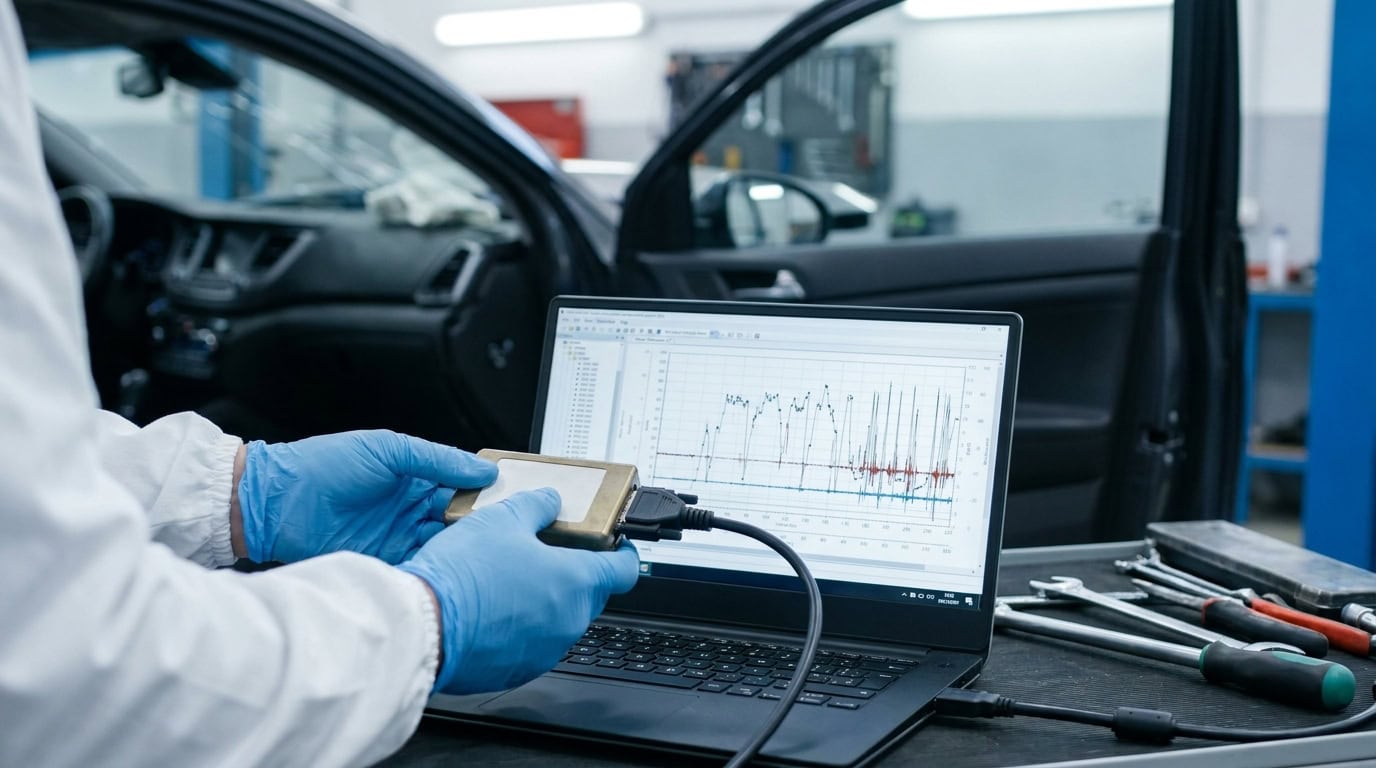
Retrieving this information requires specialized equipment known as a Crash Data Retrieval (CDR) tool. Most investigators use Bosch-manufactured tools to perform these downloads. While early EDR data was primarily housed within the Airbag Control Module (ACM), modern vehicles may distribute or mirror this telemetry across other systems, including the Powertrain Control Module (PCM), the Rollover Sensor (ROS), or dedicated Advanced Driver Assistance Systems (ADAS) modules. The ACM, however, remains the primary lock-box for crash-trigger data.
The ACM is responsible for deciding when to deploy airbags based on sensor input. Because it must make these decisions in milliseconds, it constantly processes acceleration data. When a crash occurs, the ACM locks the relevant data into non-volatile memory. Locking the memory ensures the information survives even if the vehicle loses power during the accident.
The PCM manages the engine and transmission functions by providing data regarding throttle application and engine speed. When combined with the ACM, this telemetry maps the exact mechanical reality of the collision.
How EDR Data Differs from Consumer GPS and Telematics
Consumer technology (such as GPS apps and insurance dongles) and dash cams are useful for general navigation or visual guidance. Still, they lack the millisecond-level precision required for a criminal courtroom. An EDR provides a more legally defensible record because:
- Direct Hardware Integration: EDRs are hardwired into the vehicle's sensing and diagnostic systems, capturing physical mechanical data rather than relying on GPS systems that typically sample at a low 1 Hz frequency (once per second). In contrast, EDR sensors measure acceleration and braking inputs at much higher frequencies, often up to 100 Hz (100 times per second), eliminating data gaps during rapid deceleration.
- Millisecond Granularity: It logs exact technical inputs, such as the precise percentage of throttle application, which visual evidence like a dash cam cannot capture.
- Immunity to Signal Drops: Because the data is generated internally, it is not distorted by dead zones or network connection loss.
Technical Differences Between Passenger and Commercial Vehicle Black Boxes
Commercial trucks, such as semi-trucks and heavy haulers, use different hardware and tracking standards compared to passenger cars. The table below outlines the primary differences between passenger EDRs and commercial ECMs.
| Feature | Passenger Vehicles (EDR) | Commercial Trucks (ECM) |
| Primary Function | Crash event recording and airbag deployment | Fleet management and long-distance engine diagnostics |
| Recording Duration | Typically 5 seconds before impact, rising to 20 seconds at 10 Hz under 49 CFR Part 563 on a phase-in that starts September 1, 2028 and covers every vehicle by September 1, 2031 | Continuous monitoring for minutes or hours |
| Regulatory Standard | 49 CFR Part 563 | Industry-specific fleet management standards (such as SAE J1939) |
| Key Metrics Tracked | Delta-V, steering angle, and immediate braking | Hard braking trends, daily speed logs, and driver hours of service |
Electronic Control Modules in Heavy Trucks
An ECM in a commercial vehicle records data over a much longer duration than a passenger car EDR. It specifically tracks "hard braking" or "quick stop" events, which typically trigger when a vehicle decelerates at a rate exceeding a predetermined threshold, commonly 7 to 9 miles per hour per second (mph/s). These logs expose a truck's speed and braking patterns for several minutes leading up to a stop. Did the driver hit the brakes hard? Did they react in time? The ECM logs answer these questions directly, revealing exactly whether a commercial driver was fatigued or distracted.
ECMs also monitor engine parameters like coolant temperature and oil pressure. This allows investigators to determine if a mechanical failure contributed to the crash. If a truck's brakes failed due to a system error, the ECM will likely record the fault code. This physical evidence can shift the blame away from the driver and toward a maintenance issue.
GPS-Linked Speed Logs and Recording Durations
Many commercial ECMs are linked to GPS fleet-tracking systems. This provides a record of the truck's speed and location for the entire day leading up to the accident. These systems, working in tandem with federally mandated Electronic Logging Devices under 49 CFR Part 395, provide an indisputable record of hours-of-service compliance. This telemetry network is significantly more comprehensive than the pre-crash snapshots historically recovered from passenger vehicles.
The longer recording duration helps experts understand the context of a collision. For example, the logs might show that the truck was maintaining a steady speed for miles before a sudden obstacle appeared. This helps prove that the driver was attentive until the moment of the emergency. This technical nuance is a powerful tool in commercial vehicle litigation.
The Role of Accident Reconstruction in Florida Vehicular Homicide Defense
Because black box records store raw data in complex hexadecimal formats, defense teams rely on certified forensic experts to extract, translate, and present this telemetry in court. Applying accident reconstruction methodologies to this data provides an objective, physics-based counterweight to the subjective or hurried assumptions often found in initial police accident reports.
Translating EDR Telemetry Into Physical Reality
To use EDR data in court, defense teams rely on specialized accident reconstruction experts who convert raw telemetry into a comprehensible timeline of physical events. The forensic process begins with the physical extraction of data from the vehicle. A certified expert typically connects a CDR tool to the vehicle's Onboard Diagnostics II (OBD-II) port under the dashboard. If the vehicle has sustained catastrophic damage, the expert may connect directly to the control module. This ensures the data is retrieved even if the car's wiring is destroyed.
Once retrieved, the expert focuses on the Delta-V metric. This metric represents the vehicle's total change in velocity during the crash. It's used to calculate the exact force and angle of the impact. By applying physics to this data, the expert determines how each vehicle moved. This model often reveals that initial police accident reports contain inaccuracies about the impact point.
Mechanical evidence serves as a check against the subjective findings of law enforcement. While an officer might estimate an impact point based on debris, the EDR provides the exact millisecond of the crash. This allows the defense to create a timeline that is much more accurate than one based on human observation. These findings can contradict the prosecution's theory entirely.
Reconstructing Collision Avoidance and Reaction Times
Forensic experts use black-box data to map human factors, such as reaction time. By analyzing steering and braking data and comparing it with physical evidence such as skid marks, an expert can pinpoint exactly when a driver recognized a danger and whether their reaction time fell within normal human limits.
Quantitative data is used to prove whether a crash was mathematically inevitable. If a third party suddenly swerved in front of the defendant, the EDR shows the exact interval. If that interval is shorter than the average human reaction time, the defendant had no opportunity to avoid the crash. In these cases, the data proves the driver's actions weren't the cause of the fatality.
Establishing this timeline is critical for a vehicular homicide defense in Florida. Demonstrating that a defendant actively steered away from a hazard before impact directly undermines the state's claims of reckless driving and provides juries with a factual, mechanical basis for acquittal.
The Legal Standard of Causation in Florida Fatality Crashes
In Florida, the fact that a person was driving while impaired isn't enough to secure a conviction for a fatal accident. The prosecution must establish a direct legal link between the driving and the resulting death. This standard defines the entire battleground for your defense strategy. If the link is missing, the criminal charges cannot stand.
Proving "Caused or Contributed" in DUI Manslaughter Cases
The two charges do not share a causation test. Section 316.193 makes DUI manslaughter out of driving under the influence that caused or contributed to causing a death, and the state does not have to show the defendant was the only cause. Contribution is enough, which is a low bar. Section 782.071 is harder for the state: vehicular homicide requires that the killing be caused by operating a vehicle in a reckless manner likely to cause death or great bodily harm, so careless driving that happens to kill someone is not vehicular homicide.
Because even a minor contribution can lead to a felony, the defense must be aggressive. Accessing and analyzing EDR data is the most effective way to meet this challenge head-on by mathematically proving a lack of causation.
By presenting data that shows the vehicle was operated safely, the defense can systematically dismantle the "caused or contributed" element. When objective numbers contradict subjective claims of excessive speed, it becomes significantly harder for the prosecution to secure a conviction.
Shifting Fault and Independent Intervening Causes
A defendant can't be convicted if the decedent's own conduct was the sole reason for the crash. If the victim's reckless behavior was the only factor, the defendant isn't legally responsible. This defense focuses entirely on the actions of the deceased or of a third party. Defense attorneys use EDR data to build a factual record of the victim's behavior.
For instance, if the victim's black box shows they ran a red light, that data becomes the centerpiece of the defense. It shows the defendant was a passive participant in a situation created by another driver. An independent intervening cause, such as a sudden mechanical failure, can also break the chain of liability. If a steering rack snaps unexpectedly, the driver loses all control regardless of their sobriety.
Proving an intervening cause negates the causation element required for a conviction. If a victim survives the crash but dies due to medical negligence, that error may constitute an intervening cause. These defenses rely on technical evidence to show that the chain of events was broken. When the jury believes an outside force was responsible, they must acquit the defendant.
Mechanics of the Defense: How EDR Data Refutes the State
Police accident reports and eyewitness narratives are frequently shaped by initial impressions or the chaos of the crash scene. Comparing these subjective accounts against the empirical data from a vehicle's black box removes the guesswork from the courtroom.
Vehicle Speed Pre-Impact Analysis
Prosecutors often claim that a defendant was traveling at a reckless or excessive speed. They rely either on witnesses who describe the vehicle as "flying" or on flawed crush-damage calculations. These methods are notoriously inaccurate and lead to false narratives of recklessness. A vehicle-speed pre-impact analysis derived from an EDR is currently the most scientifically reliable method to determine actual velocity.
The EDR records the vehicle's speed for the five seconds preceding the impact. This profile shows if a driver was maintaining a steady speed within the legal limit. In a recent Hillsborough County case handled by our firm, EDR data revealed the driver was actually traveling below the speed limit. That objective evidence allowed us to change the entire trajectory of the legal proceedings and dismantle the state's narrative.
By presenting this data, the defense can demonstrate lawful operation. If the victim's EDR reveals they were traveling at a lethal velocity, liability shifts, focusing the jury on empirical data rather than emotional testimony.
Throttle Position and Braking Action
The EDR also captures the exact percentage of throttle application and the timing of braking. This information shows whether the defendant tried to avoid the collision. If the data shows the driver released the gas and applied maximum brakes, it proves they were attentive. This contradicts claims that the driver was oblivious or acted with total disregard for safety.
The same fields work in the other direction. If the other driver's recorder shows the brake was never applied, that is evidence of a driver who never saw what was coming. This supports the argument that the victim's behavior was the primary factor in the accident. Comparing the actions of both drivers highlights who was actually trying to prevent the tragedy.
An accident reconstruction expert explains to the jury how much speed the braking action scrubbed off. This demonstration proves the defendant did everything physically possible to mitigate the impact. It serves as powerful evidence that the driver wasn't the reckless party the state described. Hard numbers provide a more compelling story than witness estimates.
Steering Input and Lane Intrusions
Steering input is recorded in degrees of steering wheel angle, capturing every turn. This data is useful in cases involving sudden lane intrusions or "cut-off" scenarios. If a victim swerved into the defendant's path, the steering angle from the victim's car confirms the maneuver. This physical record proves that the defendant faced an emergency they didn't create.
When a lane intrusion happens quickly, the collision is often mathematically unavoidable. The steering data provides the proof needed to back up this claim in court. It shows the defendant didn't have the space or time to steer away. This transforms a subjective argument into a clear demonstration of physics and vehicle dynamics.
This information also proves that the defendant maintained their lane position leading up to the event. If the prosecution claims the defendant drifted, the steering wheel angle data can refute that claim. If the EDR shows a zero-degree steering angle, it strongly indicates the driver was holding the wheel straight. However, forensic experts must also account for pre-existing alignment issues or physical damage to the tire. This physical record can disprove a prosecution's claim of erratic lane weaving.
Navigating the EDR Data Admissibility Court Process
Bringing black box data into a Florida courtroom involves clearing strict legal hurdles. Before a jury ever sees the numbers, the data must pass rigid constitutional and scientific tests. A defense attorney must be prepared to navigate these challenges to ensure the data is used effectively. Failure to follow these procedures could result in the evidence being excluded.
Privacy Rights and Search Warrant Requirements
The leading Florida decision is State v. Worsham, 227 So. 3d 602 (Fla. 4th DCA 2017). Police impounded a car after a fatal crash and downloaded its EDR twelve days later without a warrant. The Fourth District held that a driver has a reasonable expectation of privacy in the data the recorder keeps, and that absent exigent circumstances an officer needs a warrant before extracting it from an impounded vehicle. Worsham is one district court of appeal, not the Florida Supreme Court, so it is not settled statewide law, and it leaves the state free to argue consent, exigency or a warrant exception on the facts of a given case. It is still the decision a motion to suppress in Florida starts from.
Law enforcement typically needs a search warrant to access vehicle telemetry in most impounded-vehicle cases. The police may also access the data if they secure explicit and voluntary consent from the owner. If the police fail to obtain a warrant or consent, the data may have been obtained unlawfully. A skilled attorney can then file a motion to suppress that evidence, preventing its use at trial.
This privacy protection is a cornerstone of a modern criminal defense in fatality cases. It prevents the state from building a case based on evidence gathered in violation of constitutional rights. If the motion to suppress is successful, it can gut the prosecution's mechanical evidence entirely. This legal shield ensures the government respects the privacy of digital records.
The Daubert Standard and Expert Methodology
Florida follows the Daubert standard (codified in Florida Statutes Section 90.702) for the admissibility of expert testimony and scientific evidence. Under this threshold, the party introducing EDR evidence must establish that the expert witness is qualified, the testimony is based upon sufficient facts or data, the testimony is the product of reliable principles and methods, and the expert has reliably applied those principles and methods to the facts of the case. For black box data, this means proving both the technical reliability of the extraction tool (such as the Bosch Crash Data Retrieval system) and the forensic soundness of the reconstruction expert's analytical formulas. All four have to be established before the jury hears a number.
These hearings often involve a detailed examination of the equipment used for the download. The defense must ensure the expert witness has the necessary certifications to handle the Bosch equipment. A skilled attorney can also use a Daubert challenge to exclude the state's expert if their analysis is flawed. For example, if the expert failed to account for system calibration errors, their testimony might be thrown out.
Focusing on scientific integrity prevents "junk science" from entering the courtroom. It ensures that the mechanical evidence presented to the jury is accurate and based on physics. By holding the prosecution to this high standard, the defense prevents biased reconstructions from influencing the verdict. Testing the state's methodology is part of the defense, not an optional extra.
The Driver Privacy Act of 2015
The federal Driver Privacy Act of 2015 provides an additional layer of protection for vehicle owners. This act states that any data recorded by an EDR belongs strictly to the vehicle's owner or lessee. Federal law reinforces the state-level privacy protections established in Florida. It makes it clear that the data is private property rather than something the government can take at will.
The act limits how third parties can access this information without the owner's consent. While insurance companies might request access, they can't legally compel the release of the data without a court order. This ownership rule is a pivotal tool for defense attorneys who need to control the flow of information. It ensures the defendant's own vehicle data isn't used against them without a proper legal basis.
Strategic Steps for Preservation and Defense
A vehicular homicide case is often decided in the days immediately following the accident. The window of opportunity to secure evidence is short, and the risks of losing it are high. A defense attorney must act with urgency to protect the defendant's rights and secure the facts. Moving quickly locks down the objective truth of the collision.
Immediate Preservation of Evidence Letters
One of the most significant risks in these cases is the destruction of vehicle black box data. While a severe crash that deploys an airbag creates a locked, non-overwritable file under federal regulations, minor or near-deployment events remain vulnerable. If the vehicle is started, driven, or undergoes subsequent ignition cycles (such as when being moved or tested at a tow yard), this event data can be permanently overwritten. If the vehicle goes to a salvage yard and is crushed, the module and the data on it are gone for good. To prevent this, an attorney must immediately issue a formal preservation-of-evidence letter.
These letters are sent to law enforcement agencies, tow yards, and insurance companies. They provide formal notice that the vehicle is evidence and must be kept in its post-accident state. The letter demands that no repairs be made and that the computer systems remain untouched. This legal step ensures the EDR data remains available for a forensic download by the defense team.
Driving, towing, or repairing the vehicle can overwrite key crash data. Lawyers recommend securing the vehicle and contacting an attorney immediately after a serious accident. This prevents the loss of information that could prove your innocence. Safeguarding the physical hardware is the priority in any fatality investigation.
3 Steps to Preserve Your Vehicle's Crash Data
- Secure the vehicle: Move the vehicle to a secure, climate-controlled storage facility immediately after the accident.
- Prevent new ignition cycles: Disconnect the vehicle's battery to ensure no new engine cycles overwrite the existing collision data.
- Issue a preservation letter: Have your attorney send a formal legal notice to tow yards and insurance companies demanding that the vehicle remain untouched.
The Danger of Data Overwriting and Ignition Cycles
Under 49 CFR Part 563, an EDR must lock a deployment event permanently so it cannot be overwritten. However, non-deployment events (which still contain pre-crash speed, braking, and steering records) are stored in volatile buffers that are easily overwritten by subsequent ignition cycles or minor sensor triggers. Starting the engine, cycling the key during towing, or running diagnostic scans can completely wipe these non-deployment records. Disconnecting the vehicle's battery immediately freeze-frames this telemetry in its exact post-accident state.
Some systems allow for only one or two "events" to be stored before the data is overwritten. If the vehicle was involved in a minor incident shortly after the fatal crash, the older data might be lost. Forensic experts must retrieve the data before these cycles occur. Understanding this technical limitation highlights the need for immediate legal intervention.
Hiring Independent Forensic Experts
The defense should never rely on the accident reconstruction findings provided by the state. Law enforcement experts are often biased toward securing a conviction and may overlook details that favor the defendant. Instead, the defense must hire an independent forensic expert to conduct its own investigation. This expert will perform an independent EDR download and inspection.
A privately retained expert can build an objective narrative that challenges the prosecution's allegations. They look for mechanical failures, human error, and environmental factors that the police may have missed. This independent analysis provides the defense team with leverage to negotiate for a reduction in charges. In many cases this technical evidence is what the causation dispute turns on.
Request a Confidential Case Evaluation with Weinstein Legal Team
Facing charges for a fatal crash is a life-altering experience that requires a sophisticated technical strategy. In Florida, the stakes are high due to the mandatory minimum sentences associated with DUI manslaughter. Challenging causation through event data recorder analysis is often the most effective way to protect your future. We work with reconstruction analysts who can pull and read an event data recorder download.
Because EDR data can be permanently erased by something as simple as turning the ignition key or moving a wrecked vehicle, securing this evidence is highly time-sensitive. Weinstein Legal Team works with leading forensic experts to ensure every byte of data from your vehicle is analyzed and leveraged for your defense. Contact us today for a free, confidential consultation to learn more about your defense options.