
- At a Florida violation of probation hearing the state has to show only by the greater weight of the evidence, which is what lawyers elsewhere call a preponderance, that the violation was willful and substantial (State v. Carter, 835 So. 2d 259 (Fla. 2002)).
- There is no jury. A violation hearing is decided by a judge alone under Florida Rule of Criminal Procedure 3.790 and Florida Statute 948.06, and the Sixth Amendment jury right does not apply to it.
- Hearsay is admissible at a violation hearing, but a revocation cannot rest on hearsay alone. Florida appellate courts reverse revocations where no live witness or other non-hearsay evidence supports the allegation.
- Tolling takes two steps under Florida Statute 948.06(1)(g). The probation period is tolled once an affidavit alleging a violation is filed and a warrant, a warrantless arrest or a notice to appear follows, and it stays tolled until the court rules, so waiting out the termination date does not work.
- A judge who finds a willful and substantial violation may revoke probation and impose any sentence available at the original sentencing, up to the statutory maximum for the underlying offense. The Criminal Punishment Code scoresheet under Florida Statute 921.0024 sets the lowest permissible sentence, and the violation itself adds 6 points, or 12 where it includes a new felony conviction before the sentencing court.
- On a first low-risk technical violation by a probationer who is not a violent felony offender of special concern, Florida Statute 948.06(2)(f) requires the court to modify or continue supervision rather than revoke it, and caps any jail term attached to that outcome at 90 days.
In a Florida violation of probation hearing the state does not have to prove anything beyond a reasonable doubt. It has to show, by the greater weight of the evidence, that you willfully and substantially violated a condition of your supervision. There is no jury, a judge decides, and hearsay that would be kept out at trial is admitted.
Those three differences are why a VOP can end in a prison sentence on evidence that would never support a conviction. This page covers the standard the state has to meet, the limits on hearsay, what a judge can do after a finding of violation, and where the defenses actually are.
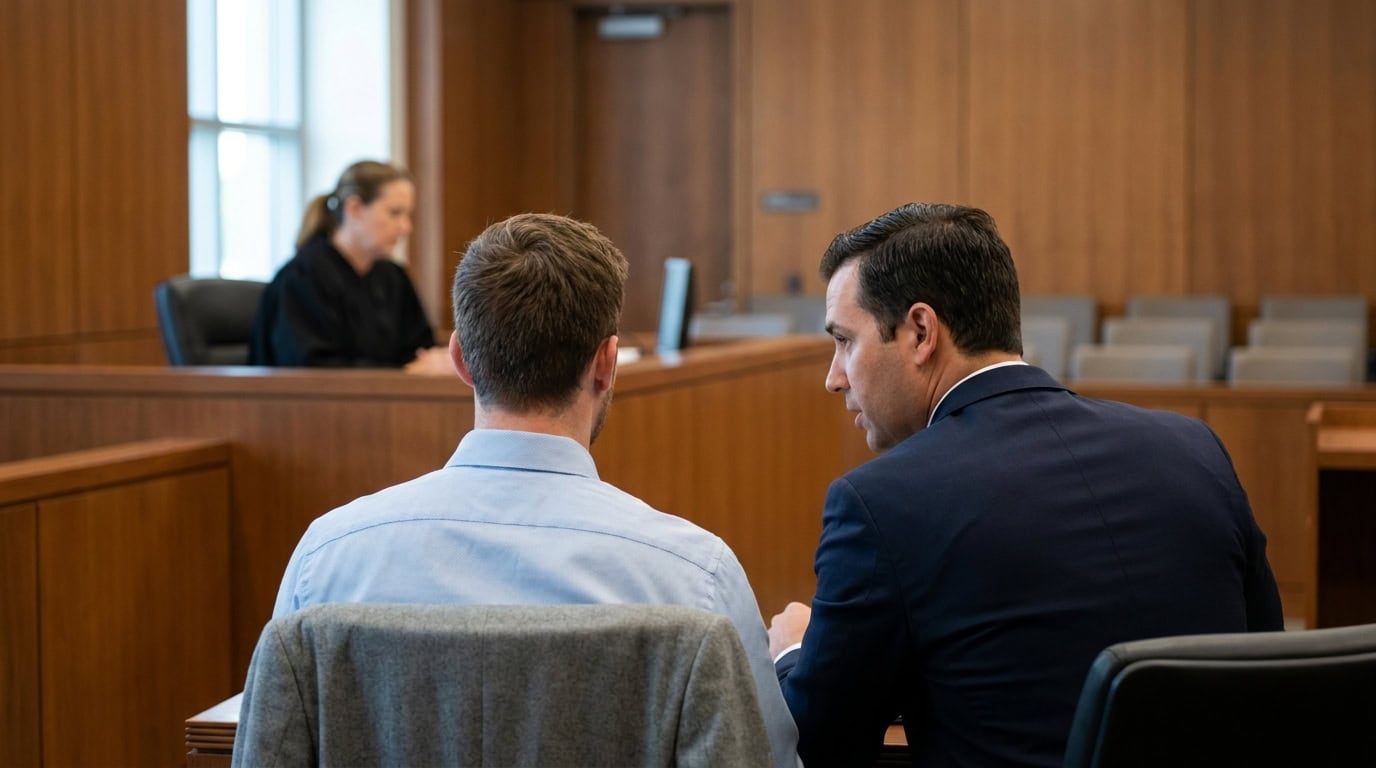
Understanding Your Legal Status During a Violation of Probation Hearing in Florida
In Florida, probation is considered a matter of grace rather than a constitutional right. When a judge sentences a defendant to probation, they're essentially allowing that person to remain in the community rather than serve a prison sentence. Probationary privilege remains conditional, meaning the individual must strictly follow every rule set by the court.
While you're on probation, you're not technically incarcerated, but you're still under the court's continuous supervision. The Florida Department of Corrections supervises felony probationers throughout the state. Your status as a probationer significantly alters your standing compared to a standard citizen because you've already been convicted of a crime.
You don't enjoy the same presumption of innocence that a defendant in a new criminal trial would have. If the state alleges that you've violated the terms of your supervision, the legal proceedings that follow are quite different from a standard trial. You won't have a jury to decide your fate, and the state doesn't have to prove its case as convincingly as it did before.
These specific legal challenges make it much easier for the state to move toward revoking your freedom. Understanding how to handle these hurdles is why many individuals seek a criminal defense attorney to help them navigate the system. These attorneys focus on challenging the state's evidence before a judge makes a final ruling.
What is a Violation of Probation (VOP)?
A Violation of Probation, often called a VOP, occurs when a defendant fails to comply with the specific conditions set by the judge. These conditions are intended to ensure the defendant's rehabilitation and the public's safety. Florida Statute 948.06 governs probation violation procedures and provides the framework for handling these cases in court.
The court divides these requirements into general conditions and special conditions. General conditions usually include tasks such as regularly reporting to a probation officer, staying within a specified geographic area, and paying court costs. Special conditions are tailored to the specific case, such as completing a drug treatment program or maintaining employment. A violation of probation must be willful and substantial to result in a revocation.
When an officer believes you've failed to follow these rules, they'll file an affidavit of violation with the court. A probation officer's submission of an affidavit of violation to the court does not exceed their statutory authority. This sworn statement details the willful and substantial ways in which you supposedly broke the rules. After reviewing the affidavit for reasonable grounds, the judge will issue an arrest warrant.
Probationers often worry about what to do if there is a VOP warrant out for their arrest. Facing a VOP warrant is a high-stakes situation that requires immediate attention from a legal professional. The court will review the affidavit, determine whether reasonable grounds exist, and issue a warrant or a notice to appear in court.
Warrantless Arrests and the 'Capias' in Florida VOP Cases
While most probation violations begin with a judge signing a warrant, Florida law allows for warrantless arrests in specific circumstances. Under Florida Statute 948.06, a probation officer may arrest a probationer without a warrant if they have reasonable grounds to believe the individual has violated their conditions in a material respect. Additionally, a judge may issue a 'Capias,' a specific type of arrest order directing law enforcement to take the defendant into custody immediately. This distinction is important because it affects how quickly you might be processed into the county jail and how soon your attorney must act to file a motion for bond. Knowing whether you were arrested via a standard warrant or a warrantless arrest can change the procedural strategy your defense team uses during the initial stages of your case.
Tolling and the Statute of Limitations in Probation Cases
Many probationers mistakenly believe they can outlast their probation period if they have an active warrant for a violation. In reality, Florida law includes a concept called tolling, which stops the probation clock. The tolling process ensures that a defendant cannot escape the consequences of a violation simply because their scheduled end date has passed.
Tolling takes two steps, not one. Under Fla. Stat. s. 948.06(1)(g), the probationary period is tolled once an affidavit alleging a violation is filed and a warrant, a warrantless arrest or a notice to appear follows, and it stays tolled until the court rules on the violation. The court keeps jurisdiction over you even if the original end date came and went months or years ago. That is why waiting out your termination date does not work, and it is also why the date the affidavit was filed is one of the first things a defense lawyer checks.
How an Affidavit of Violation Impacts Your Probation Term
When a probation officer files an affidavit, and the judge issues a warrant, the probation is officially tolled. The clock doesn't start ticking again until the defendant is back under the court's control. The tolling mechanism ensures that any willful and substantial violation can be addressed by the judge, no matter how much time has passed.
A person on probation cannot earn credit toward the completion of their sentence. If you were supposed to finish probation in December but a warrant was issued in June, the time you spend avoiding the warrant doesn't count. Once you're arrested, you'll still have those remaining six months of probation to deal with. Supervised release is also tolled when a defendant is incarcerated in connection with a different conviction.
The court must issue the warrant or summons based on the alleged violation before the supervision period expires to maintain jurisdiction. As long as the paperwork is filed on time, the court's power remains active until the case is resolved. The automatic tolling of the probation period poses a significant hurdle for those trying to avoid an out-of-state FL warrant.
The First Appearance Hearing: What to Expect
The first appearance hearing is the first step in the legal process after a person is arrested for violating probation. This hearing usually takes place within 24 hours of the arrest. During this time, a judge will review the affidavit of violation to ensure that probable cause exists for the arrest. The first appearance does not constitute the final hearing, though it represents a critical moment in the defense strategy.
During the first appearance, the judge will also determine if the defendant is eligible for bond. In many VOP cases, defendants are held without bond until their final evidentiary hearing. The judge will officially provide the defendant with notice of the alleged violations. The first appearance provides the defense attorney their initial chance to argue for a release or a lower bond amount.
The court will also set dates for future proceedings, including an arraignment and the final VOP hearing. If the defendant cannot afford an attorney, the court will appoint one at this time. Most defendants find this part of the process to be highly stressful. Having a lawyer present during the first appearance can help ensure that the defendant's rights are protected from the very beginning.
The Legal Theory Behind Reduced Rights for Probationers
The legal philosophy justifying reduced rights for probationers centers on the idea of a diminished expectation of liberty. Since a probationer has already been found guilty or pleaded no contest to an underlying offense, they've forfeited a portion of their constitutional protections. The state views the VOP hearing not as a brand-new trial, but as a continuation of the original criminal case.
The legal theory rests on the premise that probation constitutes a contract between the defendant and the court. By accepting probation to avoid prison, the defendant agrees to follow the court's rules in exchange for their freedom. Because the person is still technically serving their sentence under supervision, the full range of procedural due process isn't required to revoke that privilege.
U.S. Supreme Court precedents, such as the rulings in Morrissey v. Brewer and Gagnon v. Scarpelli, have shaped how these hearings function. These cases established that while a defendant must be accorded a minimum of due process, they aren't entitled to the full protections of a criminal trial. The limited due process allows the state to use more streamlined procedures to prove that a violation occurred.
Florida law follows these federal guidelines while adding its own specific statutes. Because the focus is on whether the probation contract was breached, the court has broad authority to determine the outcome. This legal framework allows the state to use a lower standard of proof and less formal rules of evidence.
Preponderance of the Evidence vs. Beyond a Reasonable Doubt
The biggest difference between a criminal trial and a VOP hearing is the standard of proof. Florida courts describe it as the greater weight of the evidence, which is the same thing lawyers elsewhere call a preponderance and which means no more than that something is more likely than not. The state must show by that standard that the violation was both willful and substantial (State v. Carter, 835 So. 2d 259 (Fla. 2002)). Willful and substantial is doing as much work in that sentence as the burden itself, because a violation that was neither cannot support a revocation no matter how clearly it happened.
Even though the stakes are high, the law doesn't require the same level of certainty. The difference between these two standards is often described in terms of a percentage or the weight of the evidence on a scale.
When a defendant alleges a trial court erred in finding a violation, the appellate court will assess whether the trial court committed an abuse of discretion. The preponderance of the evidence standard also applies to probation revocation in federal cases. Understanding this distinction is necessary for anyone facing criminal charges in Florida.
Defining Beyond a Reasonable Doubt in Standard Criminal Trials
Beyond a reasonable doubt represents the highest burden of proof in all standard criminal prosecutions across the United States. It's the highest burden of proof in the American legal system and is a fundamental protection under the Due Process Clause. The reasonable doubt standard is specifically designed to prevent the wrongful conviction of innocent people by putting the entire burden on the government.
Initially, an arrest that results in formal charges by the State Attorney must be proved beyond a reasonable doubt to obtain a conviction. In a jury trial, this standard requires jurors to be nearly certain of the defendant's guilt before returning a guilty verdict. If there's any logical, reasonable doubt based on the evidence, the jury must acquit the defendant.
It's not enough for the prosecutor to show that the defendant probably committed the crime. They must prove it to a near moral certainty. The American legal system maintains this high threshold because the loss of liberty is the most severe punishment the state can impose. In a standard trial, the state is seeking to deprive someone of their freedom for the first time for a specific act.
Defining the Preponderance of the Evidence Standard
In contrast, the preponderance of the evidence standard used in Florida VOP hearings is much more lenient for the prosecution. This standard is often described as the 51% rule or simply as " more likely than not. To win a VOP case, the state only needs to provide enough evidence to show that it's more likely than not that the violation occurred.
The judge only needs the scales to tip. That is the same standard of proof used in most civil lawsuits, including car accident cases, and it takes far less certainty than convicting someone of a new crime. The authority that governs in Florida is State v. Carter, 835 So. 2d 259 (Fla. 2002), where the Florida Supreme Court confirmed that a trial court has broad discretion to find a willful and substantial violation shown by the greater weight of the evidence. Decisions from another state's supreme court do not bind a Florida judge and are not what your hearing will be decided on.
The preponderance of evidence standard fundamentally requires that the state demonstrate it's more likely than not that the accused violated the terms of their probation. Evidence that might be considered weak or insufficient to convince a jury in a criminal trial could satisfy a judge in a VOP hearing. The state doesn't need to eliminate all doubt during these proceedings.
Why the Lower Standard Makes VOP Hearings So Dangerous
The practical dangers of this lower standard are significant when the evidence against a defendant is weak. A prosecutor might realize they can't meet the high burden of proof for a new criminal charge before a jury. However, they can use that same evidence to easily meet the preponderance standard for a VOP in front of a judge.
In many cases, this results in a defendant being accused of a new crime while on probation. Even if the state decides not to file formal charges, the judge can still find the defendant in violation of probation. If a probation officer testifies that the accused missed a scheduled meeting and provides attendance records, that testimony could meet the preponderance-of-the-evidence standard.
Drug tests and police reports are the other common route. An unchallenged positive test result put in front of the judge can carry the state's burden by itself. It cuts both ways, though, because the state still has to show the violation was willful and substantial, and Florida courts have reversed revocations built on a technical slip that had an innocent explanation, such as a probationer who was home but did not hear the officer at the door.
If a probationer is arrested for a new crime, the arresting officer's testimony and arrest report could be used as evidence. Even without a conviction on the new charge, the arrest might be enough to meet the preponderance-of-the-evidence standard. The lower evidentiary threshold makes it difficult for defendants to explain their actions without the protection of a high burden of proof.
The Absence of a Jury in VOP Proceedings
In a standard Florida criminal trial, you have a constitutional right to have your case decided by a jury of your peers. However, VOP hearings are bench trials, which means there's no jury present to hear the evidence. Instead, the judge acts as the sole arbiter of both the law and the facts of the case.
The Sixth Amendment right to a trial by jury doesn't apply to VOP hearings in Florida. The absence of a jury further tips the scales of justice toward the prosecution. Judges often view these cases differently from how a group of citizens would. Without a jury to persuade, the entire dynamic of the courtroom changes for the defense.
The rule that governs a Florida revocation hearing is Florida Rule of Criminal Procedure 3.790, which requires the hearing to be held without unreasonable delay. Federal Rule of Criminal Procedure 32.1 applies to federal supervised release and has nothing to do with a state VOP. Under rule 3.790 and Fla. Stat. s. 948.06 you are entitled to notice of what you are accused of and a hearing where you can appear, be represented and put on evidence. The judge weighs the witnesses and decides whether the state met the greater weight of the evidence.
The court views probation as a contract between the judge and the defendant, so the judge is considered the appropriate person to decide whether that contract was broken. A judge's prior experience with a defendant can also change the outcome. If the same judge originally sentenced the defendant, they might feel a personal sense of disappointment. Their general views on probation compliance can make them less sympathetic to the defendant's arguments.
Why the Judge Acts as the Sole Fact-Finder
In these proceedings the judge's reading of the facts decides the case. Because you have already been convicted of the underlying offense, the hearing is a streamlined one rather than a new trial. The judge alone determines whether the violation was willful and substantial, and that single finding is what the entire defense is aimed at.
Juries are excluded from these proceedings for historical and legal reasons. The court believes that, since the judge granted probation, the judge should be the one to decide whether to revoke it. The judge's consolidation of power means the defense must be very strategic in its presentation. The judge's history with the case can often be a double-edged sword for the defendant.
If the judge has seen the defendant making progress, they may be more inclined to offer a second chance. Conversely, if the judge feels the defendant is ignoring the court's authority, they may impose a harsher sentence. A judge-led environment requires a defense that focuses strictly on technical legal elements and mitigating factors.
The Impact on Your Defense Strategy
Because there's no jury, a defense attorney must adapt their strategy to focus on a single person: the judge. Emotional appeals that might work on a jury often carry less weight in a VOP hearing. Judges are generally more interested in technical legal arguments and the specific details of the case.
The tactical shifts required in a VOP hearing often involve focusing on mitigating circumstances. A defense lawyer might argue that while a technical violation occurred, it wasn't substantial enough to warrant a prison sentence. They may also work to show that the defendant made a good-faith effort to comply with the rules.
In these hearings, the defense is often fighting a battle of technicalities. Since the rules of evidence are more relaxed, the lawyer must be prepared to challenge the reliability of hearsay. The goal is to convince the judge that even under the lower standard, the state's case isn't strong enough.
Why Hearsay Evidence is Admissible in a VOP Hearing
One of the most frustrating aspects of a VOP hearing for many defendants is the admissibility of hearsay. In a standard criminal trial, hearsay is generally kept out to ensure that the defendant can cross-examine their accusers. However, the strict rules of evidence are relaxed in VOP proceedings, allowing the state to use statements made outside of the courtroom.
Hearsay is defined as an out-of-court statement offered to prove the truth of the matter asserted. While this type of evidence is usually excluded in standard trials, it's permitted in VOP hearings under certain conditions. Under these relaxed rules, a probation officer might testify about what someone else told them, even if that other person isn't there to be questioned.
Florida treats a revocation hearing as an informal proceeding, so the strict trial rules of evidence are relaxed and hearsay may be admitted and considered. The reasoning is that the judge granted the supervision and should get a full picture of how you have handled it. Where the judge finds the hearsay reliable, the state may use it as part of its proof.
Understanding Hearsay and the Florida Evidence Code
The Florida Evidence Code typically protects defendants from hearsay because it's considered less reliable than live testimony. When someone makes a statement outside of court, the judge cannot see their demeanor or weigh their honesty, and the defendant gets no chance to cross-examine the actual accuser.
In the context of probation violations, Florida law allows judges to consider this evidence to provide a fuller picture. The reasoning is that VOP hearings are intended to be more informal and efficient than standard trials. If the hearsay is reliable, the court must weigh the need for it against the defendant's right to confront adverse witnesses. For instance, the exclusionary rule often doesn't apply to revocation proceedings. This allows the state to bring in a wider range of information that would be strictly forbidden in a jury trial.
The Limits of Hearsay in Proving a Willful Violation
Despite the relaxed rules, there's an important limitation known as the Hearsay Rule in Florida VOP cases. While hearsay is admissible, a violation cannot be based solely on hearsay evidence. There must be some non-hearsay, independent evidence to support the court's finding of a willful and substantial violation.
This means that if the state's entire case consists of a probation officer reading from a police report, it might not be enough. A skilled defense attorney can use this limitation to challenge the prosecution's case. There must be at least some direct evidence to corroborate the hearsay statements made in court. The requirement for corroborating evidence is a technical nuance that can lead to a dismissal.
Florida appellate courts reverse revocations that rest on hearsay alone. If the only proof that you did the thing is a report, or a statement from somebody who never came to court, the state has not met its burden however low that burden is. Forcing the state off uncorroborated hearsay is one of the most effective ways to defend a VOP, and it is the reason your lawyer will ask, for each allegation, which live witness supports it.
If a witness doesn't testify and there's no other evidence of the violation, the court cannot legally revoke probation. For example, if a probation officer testifies that the defendant admitted to using drugs, that admission is non-hearsay evidence. The combination of the admission and the report would likely satisfy the judge. Without such an admission, the hearsay report might fail to meet the legal requirements.
Substantive vs. Technical Violations: How Burden of Proof Applies
Not all probation violations are viewed the same way by the court or the Department of Corrections. Violations are generally categorized as either technical or substantive. Both categories can lead to the same result of incarceration, but they're proven in different ways. Understanding these categories helps in preparing a proper defense strategy.
A technical violation involves breaking the administrative rules of probation. In contrast, a substantive violation involves the commission of a new crime. Even though the preponderance-of-the-evidence standard applies to both, the state often pursues substantive violations more aggressively. Deciding how to defend your case often depends on which type of violation is alleged.
What Constitutes a Technical Violation of Probation?
Technical violations occur when a defendant fails to follow the administrative rules set by the judge. Common examples include missing a scheduled meeting with a probation officer or failing a drug or alcohol test. Other technical violations might involve failing to pay required court costs or failing to report a change of address. These violations are often seen as less serious than new crimes but can still result in jail time.
The burden of proof applies here by requiring the state to show that the defendant willfully ignored these rules. For example, if you missed a meeting because you were in the hospital, the violation might not be considered willful. However, the state only needs to show it was more likely than not that you missed the meeting without a documented excuse.
Florida now routes many technical violations away from a full revocation hearing. Under Fla. Stat. s. 948.06(9), every judicial circuit runs an alternative sanctioning program, and for a low-risk violation such as a missed report, a positive test or leaving the county without permission, a probation officer may offer sanctions like up to 5 days in county jail, extra community service or a curfew instead of filing an affidavit. Taking it is voluntary and you give up counsel and a hearing to do so. Separately, s. 948.06(2)(f) requires the court to modify or continue probation rather than revoke it on a first low-risk technical violation by a probationer who is not a violent felony offender of special concern, and it caps any jail attached to that outcome at 90 days.
Defenses for Technical Violations
Inability to pay is the most common technical-violation defense, and Florida puts that burden on you rather than on the state. Under Fla. Stat. s. 948.06(5), once the state establishes that you did not pay restitution or the cost of supervision, it is up to you to prove by clear and convincing evidence that you did not have the money despite sufficient bona fide efforts to get it. If you carry that, the court must consider punishments other than imprisonment first. Bring pay stubs, denial letters and bank records, because a bare statement that you were broke does not meet a clear and convincing standard.
Medical emergencies are another strong defense against technical violations, such as missing a meeting or failing to report. If a defendant can provide medical records showing they were incapacitated, the violation is not considered willful. A lawyer can use these records to show that the defendant intended to comply with the rules but was prevented by forces beyond their control.
Learning how to beat a technical violation of probation often involves highlighting these mitigating factors. If the violation resulted from a misunderstanding or a clerical error by the probation office, the defense can argue that it wasn't substantial. Providing clear documentation is necessary to convince a judge to reinstate the probation rather than revoke it.
What Constitutes a Substantive Violation of Probation?
Substantive violations are considered much more serious because they occur when a probationer is arrested for a new criminal offense. A material respect violation occurs when a person has been arrested for a new felony, misdemeanor, or criminal traffic offense. These allegations suggest that the defendant hasn't been rehabilitated and still poses a risk to the community.
If you're arrested for a new crime while on probation, the state will likely file a VOP immediately. They don't have to wait for you to be convicted of the new charge to move forward with the probation hearing. Even if the new charge is a relatively minor misdemeanor, it can trigger a VOP that leads to years in prison based on your original sentence.
The state prefers to pursue substantive violations because they're often easier to prove in a VOP hearing. The arresting officer's testimony and the arrest report might be sufficient to meet the preponderance-of-the-evidence standard. This allows the state to secure a long prison sentence through the VOP process even if the new criminal case is difficult to win before a jury.
The Paradox of Acquittal: New Criminal Charges and VOP
One of the most difficult situations for a defendant to face is the nightmare scenario where they're found not guilty of a new crime but still lose their VOP hearing. The discrepancy in outcomes arises because the burdens of proof in the two proceedings differ. The outcomes of the criminal trial and the VOP hearing don't have to match under Florida law.
Because the VOP hearing uses the lower preponderance standard, a judge can find that a violation occurred based on the same facts. The procedural paradox causes immense frustration for defendants who feel that a not-guilty verdict has vindicated them. Understanding the legal mechanics of this situation is important for any probationer facing a new arrest.
The disconnect between trial and hearing outcomes involves the legal doctrine of collateral estoppel, which generally does not apply between a criminal trial and a VOP hearing in Florida. Under Florida law, the jury's decision does not bind the judge, and the judge can reach their own conclusion based on the lower standard of proof. A defendant must be prepared to fight the same allegations twice under very different rules.
How You Can Be Found in Violation Despite a "Not Guilty" Verdict
When a jury returns a not guilty verdict, it doesn't mean the defendant is innocent. It simply means the state failed to prove every element of the crime beyond a reasonable doubt. Since the standard for a VOP is much lower, the judge can decide that the defendant probably committed the act.
The judge's finding at the VOP hearing is legally independent of the jury's decision. If the judge believes the state met the 51 percent threshold, they have the authority to revoke probation and sentence the defendant to prison. This can happen even if the jury was completely unconvinced by the state's witnesses during the criminal trial.
This legal independence exists because the court views the VOP as an inquiry into the defendant's fitness for continued supervision. The judge isn't looking for proof of a new crime to the same degree as a jury. If the arrest itself provides enough evidence of a breach, the judge can act regardless of the trial outcome. The independence of these rulings highlights the danger of relying on a jury outcome to save your probation.
When the State Drops Charges but Pursues the VOP
It's common for prosecutors to drop new criminal charges while proceeding with the VOP hearing. Prosecutors often choose this strategy because a VOP is significantly easier for the state to win than a new criminal charge. By dropping the new charge, the prosecutor avoids the high burden of beyond a reasonable doubt and the unpredictability of a jury.
The state might choose this path if they've witnessed issues or if the evidence was obtained in a way that might not hold up. Since the rules of evidence are relaxed in a VOP, a VOP can often achieve the same result with less effort. A found violation can result in the same prison term as a new conviction, making the VOP a powerful tool for the prosecution.
For the defendant, this strategy is dangerous because it limits their options. If the new charges are dropped, there's no trial in which they can fully clear their name before a jury. They're left facing only the judge, who will decide their fate using the lower preponderance standard. The decision to drop charges while pursuing the VOP often leaves defendants in a vulnerable legal position.
The Florida Anti-Murder Act and Bond Eligibility
The Florida Anti-Murder Act is a significant piece of legislation that affects bond eligibility for specific types of probationers. This law targets individuals who are classified as Violent Felony Offenders of Special Concern (VFOSC). If a person with this designation is arrested for violating probation, they are subject to much stricter detention rules.
Two separate things happen under Fla. Stat. s. 948.06(8), and they are easy to run together. The first is custody: a violent felony offender of special concern accused of anything other than failing to pay costs, fines or restitution shall remain in custody until the violation is resolved, so there is no bond argument to make. The second is the outcome: before ruling, the court must make written findings on whether the person poses a danger to the community. If it finds danger, the court shall revoke and may sentence up to the statutory maximum. If it finds no danger, the court may revoke, modify or continue the supervision.
The Anti-Murder Act was designed to prevent violent offenders from committing new crimes while awaiting their revocation hearings. For a defendant, this means they could spend weeks or months in jail before they have a chance to defend themselves.
The Potential Consequences of a Found Violation
If a judge finds that you've willfully and substantially violated your probation, they have broad discretion during the sentencing phase. The judge isn't limited to just sending you to prison. They can choose from a range of outcomes based on the circumstances. The judge's broad discretion explains why presenting mitigating evidence is so important in a VOP hearing.
The judge will consider several factors before making a decision, including your prior criminal record. They'll also look at how well you were doing on probation before the alleged violation occurred. The goal of the sentencing phase is to determine if you can still be successfully supervised or if incarceration is necessary.
According to the Supreme Court's Morrissey v. Brewer decision, the court must issue a written statement specifying the evidence it relied upon. This ensures at least some due process for the defendant during the revocation phase. The judge's decision can range from a simple warning to a lengthy prison sentence, depending on the severity of the violation.
Reinstatement, Modification, or Revocation of Probation
The court generally has three primary options after finding a violation. First, the judge can reinstate the probation as it was, essentially giving the defendant another chance. Reinstatement usually occurs when the violation was minor or if the defendant has a very strong excuse for their behavior. Reinstatement of probation is the best possible outcome for a defendant found in violation.
Second, the judge can modify the probation to include stricter terms. Modification of terms might involve extending the duration of the probation or adding house arrest. Modification is often used as a middle ground when the judge believes the defendant needs more structure but doesn't necessarily belong in prison. The judge may also require additional drug treatment or community service.
Third, the judge can revoke and terminate the probation entirely. This usually leads to a jail or prison sentence, as the defendant is no longer allowed to serve their time in the community. The judge will issue a final order that converts the remaining probation time into an active sentence. Revocation represents the most severe outcome and often results in immediate transport to a correctional facility.
The Threat of Maximum Sentencing for the Underlying Offense
The most dangerous aspect of a VOP is the suspended sentence concept. When you're found in violation, the judge can sentence you to the maximum legal penalty for the original crime. For example, if you're on probation for a second-degree felony, you could face up to 15 years in prison. The possibility of a maximum sentence applies even for a relatively simple technical violation.
Florida uses a Criminal Punishment Code scoresheet to set the lowest permissible sentence at a VOP sentencing. Points come from your primary offense, any additional offenses, victim injury, your prior record and the violation itself. Primary offense points follow the offense severity level assigned in Fla. Stat. s. 921.0022, not the degree of the felony, so two third-degree felonies ranked at different levels score very differently. Level 3 scores 16 points and level 7 scores 56, and both include third-degree felonies.
The suspended sentence structure means that a person who was originally given probation as a lenient sentence can end up with a very long prison term. The judge has the power to impose any sentence that could have been given at the time of the original sentencing. This reality makes VOP hearings incredibly high-stakes, as your entire future depends on the judge's decision and the points on your scoresheet.
The Role of the Florida Sentencing Scoresheet in VOP Cases
Every felony is ranked on a severity level, and the level sets the points. At a VOP sentencing the scoresheet is recalculated to add the violation. Under Fla. Stat. s. 921.0024, a community sanction violation adds 6 points, or 12 points where the violation includes a new felony conviction before the sentencing court. If the total comes to 44 points or fewer, the lowest permissible sentence is any nonstate prison sanction. Above 44, the statute produces a minimum prison term in months by subtracting 28 from the total and reducing the remainder by 25 percent, unless the court finds a valid basis to depart downward. Ask your lawyer to run the scoresheet at the start, because that number, rather than the label on the violation, is what the negotiation is really about.
Speak To A VOP Defense Attorney About Your Charges Today
Facing a Violation of Probation hearing is a daunting experience because the legal system is designed to favor the state. The lower burden of proof makes these cases much harder to win than a standard criminal trial, as the state only needs to tip the scales slightly. Without a jury and with the admissibility of hearsay, the odds are heavily stacked against you from the moment the affidavit is filed.
What a defense lawyer does at a VOP is concrete. Check that the affidavit was filed and the warrant issued before the term expired, because a late one costs the court its jurisdiction. Test whether the alleged violation was willful and substantial rather than a technical slip. Force the state off hearsay that no live witness will support. Then put the mitigation in front of the judge who has to choose between reinstatement, modification and revocation. Weinstein Legal Team answers the phone 24 hours a day, because a VOP arrest usually comes with no bond and first appearance is the next morning.
If you are facing a VOP charge in Florida, you should not attempt to handle the hearing alone. Contact Weinstein Legal Team 24/7 at 888.626.1108 for a free case review with a criminal defense lawyer, or click here to schedule a free consultation.